Construction Site Hydration Guide for UAE Sites in 2026
UAE construction sites are the primary focus of summer <a href="/tools/heat-stress-assessment">heat stress</a> enforcement, and for good reason: they concentrate large numbers of workers performing heavy physical labor in full sun exposure precisely when ambient temperatures peak. A construction site hydration program cannot be improvised — it must be planned, resourced, implemented, and documented before the first hot day of the season arrives. This guide provides site managers and HSE officers with the practical framework for a compliant, effective hydration program throughout the 2026 UAE construction summer season.
Calculating Your Daily Electrolyte Requirement
Begin with a consumption calculation based on your outdoor workforce. Classify workers by heat exposure: very high exposure (heavy labor in full sun with full PPE — concrete finishers, steel fixers, scaffolders, roofers, block layers); high exposure (moderate labor with some shade access — formwork crews, MEP trades in partially enclosed areas); and medium exposure (supervisory and inspection roles moving between shaded and exposed areas). Very high-exposure workers: one Hydralyte serving every 45 minutes. High-exposure: every 60 minutes. Medium-exposure: every 90 minutes. Sum daily servings across all workers and add a 20% buffer for hot days and delivery variability.
Matching Product Format to Site Configuration
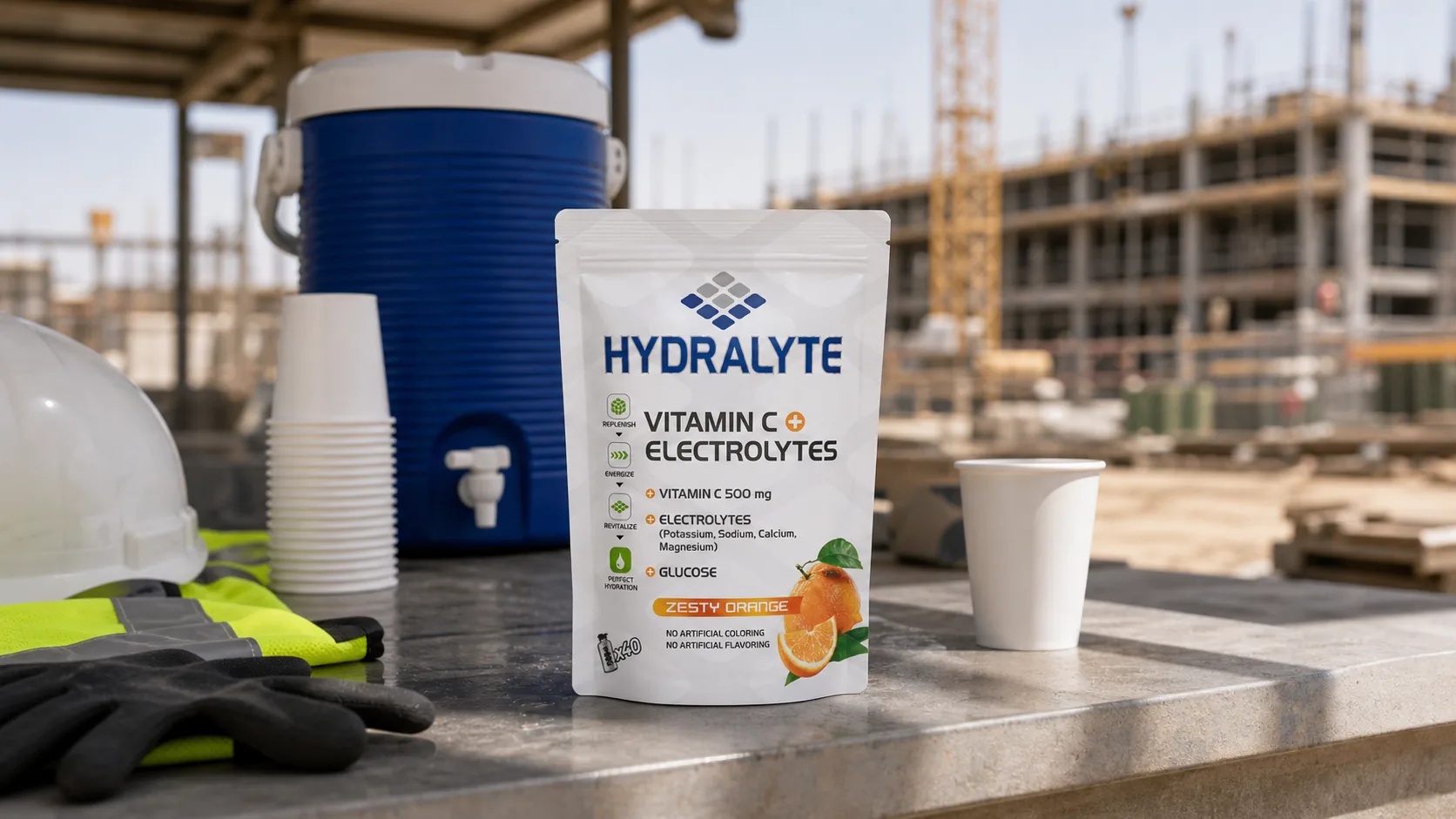
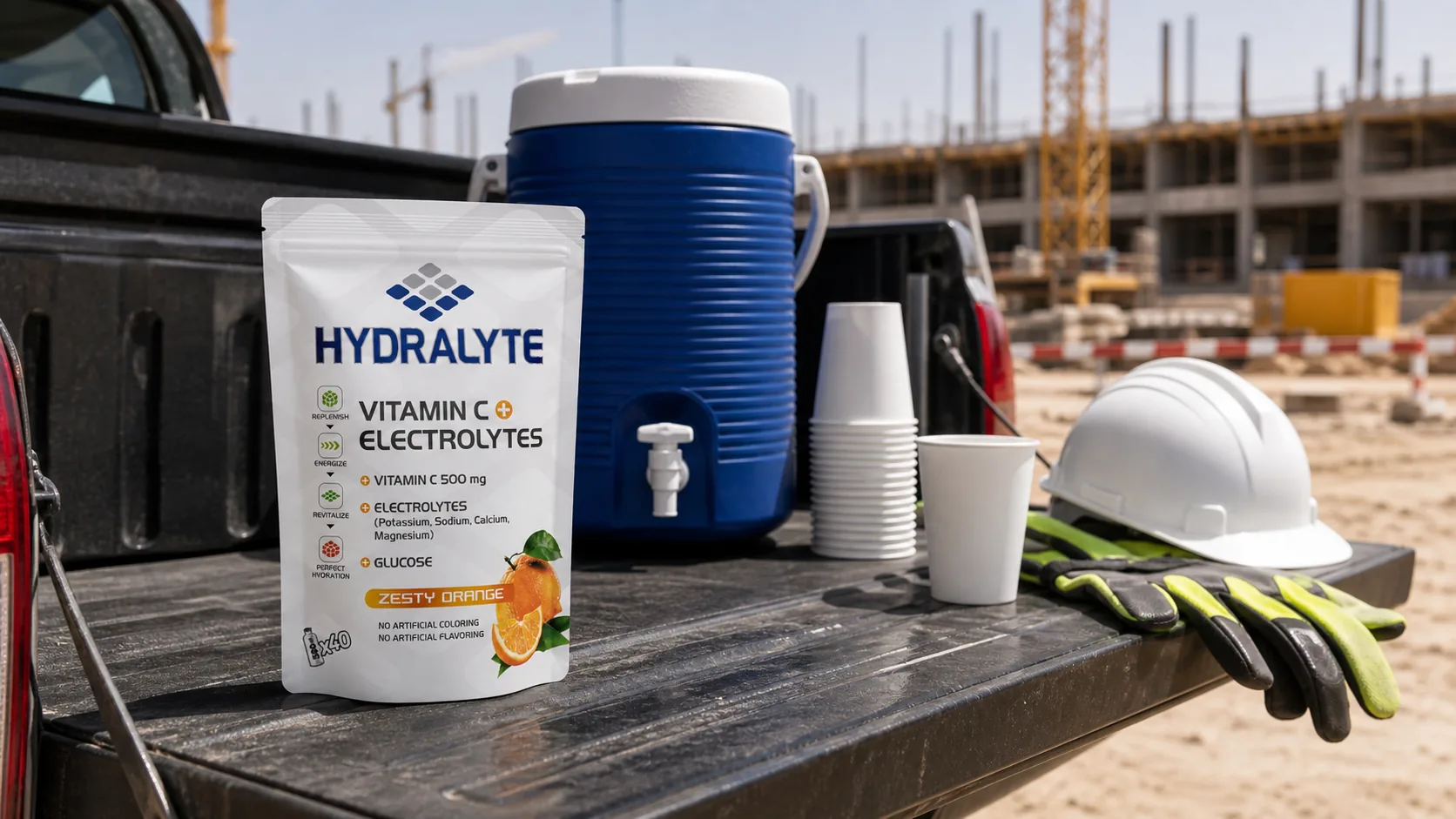
Site physical layout determines which Hydralyte format works best. Large flat sites — ground-level civil works, road construction, utility installations — suit centralized welfare stations using 800g bulk pouches, positioned every 100 to 150 meters so workers always have close access. Each 800g pouch provides 40 servings, covering 20 workers consuming two servings per break cycle at a central station. Vertical sites — high-rise towers, multi-level residential, podium construction — cannot rely on workers descending multiple floors for a central station serving. Issue individual 20g sachets or new Hydralyte stick packs at shift start, so workers carry their own supply to their floor level. For smaller specialist teams of 5 to 15 workers, the 200g jar providing 10 servings works well without the logistics overhead of a full welfare station.
Setting Up and Running a Welfare Station
A properly functioning Hydralyte welfare station includes: one or more 800g pouches in a shaded accessible location; a labeled scoop or measuring system for consistent serving preparation; clean water access; personal cups or encouraging workers to carry reusable bottles; and a distribution log where a designated welfare monitor records the time and number of servings distributed at each interval. Stations should be signed in the primary languages of your workforce — typically English, Urdu, Hindi, Malayalam, and Arabic — and positioned to be accessible without crossing active vehicle routes or live working areas.
Supervisor Distribution Enforcement
Workers in physically demanding outdoor roles do not always voluntarily hydrate even when products are available — heat-induced cognitive impairment reduces self-care motivation precisely when it is most needed. Site supervisors must actively enforce the hydration schedule: distributing sachets or directing workers to the welfare station at each interval, visually confirming consumption, and documenting any workers who skipped a serving. This active enforcement requirement distinguishes compliant programs from passive provision. See our construction site electrolyte supply page for product format options and wholesale pricing.
Frequently Asked Questions
How do I set up a Hydralyte welfare station for a large UAE construction site?
Place 800g Hydralyte pouches in a shaded accessible location every 100–150 meters on flat sites. Add labeled scoops, clean water access, cups or bottles, and a distribution log. Post multilingual signage. Issue individual sachets or stick packs to workers on upper floors who cannot access ground-level stations.
How many Hydralyte 800g pouches does a 100-worker construction site need per day?
A 100-worker site with workers consuming an average of 8 servings per day requires 800 servings daily. Each 800g pouch provides 40 servings, meaning 20 pouches per day. Hydralyte's B2B team can calculate precise requirements for your specific workforce and shift pattern.
What documentation should UAE construction sites maintain for Hydralyte compliance?
Maintain: daily distribution logs recording servings per station per interval, supervisor sign-off sheets, procurement invoices showing continuous supply, and incident reports for any heat-related health events. These form your MOHRE compliance file and are auditable during inspection.
Implementing a Construction Site Hydration Protocol
A structured hydration protocol is the most effective way to reduce heat-related incidents on UAE construction sites. This requires more than simply placing water coolers — it demands a systematic approach to electrolyte provision timed around work-rest cycles.
Start by mapping your site's thermal exposure zones. Areas with direct solar radiation, reflective surfaces (steel decking, concrete pours), and enclosed spaces all create different dehydration risk profiles. Workers in these high-risk zones should receive Hydralyte at each mandatory rest break, not just water.
Hydration stations should be placed within 50 metres of every active work zone, stocked with Hydralyte 800g pouches for mixing at volume. For workers in mobile roles (crane operators, surveyors, scaffolders), provide individual 20g sachets that can be carried in PPE pockets and mixed with any available water source.
Document every aspect of your hydration program — from procurement receipts to distribution logs. This documentation becomes critical evidence during MoHRE inspections and any heat illness incident investigations. A well-documented program demonstrates duty of care and can significantly reduce employer liability.
Heat Acclimatisation and Hydration for New Workers
New workers arriving on UAE construction sites face the highest dehydration risk. Research shows that heat acclimatisation takes 7–14 days of gradual exposure. During this period, new workers lose significantly more electrolytes through sweat as their bodies haven't yet adapted to the thermal environment.
Implement a graduated work schedule: 50% workload in week one, 75% in week two, with increased electrolyte provision during the entire acclimatisation period. Providing Hydralyte during induction sends a clear signal that your site takes heat safety seriously — and reduces the risk of losing new workers to heat-related illness in their first fortnight.
🏗 Protecting Outdoor Workers? Hydralyte supplies bulk electrolyte programs for construction, oil & gas, logistics, and manufacturing companies across the GCC — with full MoHRE compliance documentation. See Industry Hydration Programs →
🛒 Ready to try Hydralyte? Available in three refreshing flavours across multiple pack sizes — from individual sachets to 800g bulk pouches. Shop Hydralyte Online → or request a corporate quote.