Heat Stroke vs Heat Exhaustion in UAE Workers: What Every Supervisor Must Know
In UAE summer heat, the line between heat exhaustion and heat stroke can be crossed in under 30 minutes without the right intervention. For site supervisors, HSE officers, and first aiders working on outdoor UAE sites, distinguishing between these two conditions and responding correctly is not just important — it is the difference between a worker recovering at the welfare station and a worker requiring emergency hospital transport. This guide explains the key differences, the correct response to each, and how consistent electrolyte hydration prevents both conditions from developing.
Heat Exhaustion: Symptoms and the Correct Response
Heat exhaustion is the body's response to sustained fluid and electrolyte depletion. A worker experiencing heat exhaustion will present with profuse sweating — the body is still attempting to cool itself; weakness and fatigue disproportionate to the work being done; muscle cramps particularly in the legs and abdomen, indicating electrolyte depletion; headache; nausea or vomiting; dizziness or faintness; and pale moist skin. Critically, the worker remains conscious and at least partially responsive, even if confused or struggling to communicate clearly.
Correct response: Move the worker immediately to shade or air conditioning. Remove excess PPE and work clothing. Administer one full Hydralyte serving — 500ml — immediately, encouraging slow steady consumption. Apply cool wet cloths to neck, armpits, and wrists. Monitor the worker every five minutes for 20 minutes. If symptoms improve steadily, reassign the worker away from outdoor duties for the rest of the shift. If symptoms do not improve within 20 minutes, treat as a possible heat stroke emergency and call for ambulance attendance.
Heat Stroke: The Critical Emergency
Heat stroke occurs when core body temperature exceeds 40°C and the body's temperature regulation mechanism fails. The symptom that distinguishes heat stroke from heat exhaustion is skin condition: heat stroke presents with hot and DRY skin, not moist sweating skin. Additional symptoms include confusion, incoherence, or loss of consciousness; rapid but weak pulse; seizures in severe cases; and an inability to self-manage condition or follow instructions coherently. The worker cannot help themselves.
Correct response: Call emergency services immediately — do not wait for improvement. While waiting, apply aggressive cooling through all available means: cool water immersion if available on site, or maximum application of ice packs or cool wet towels to all major blood vessel areas (neck, armpits, groin). Do not give the worker anything to drink if they are confused or unconscious. Continue cooling until ambulance arrives and document all circumstances for the incident investigation report.
The Prevention Principle
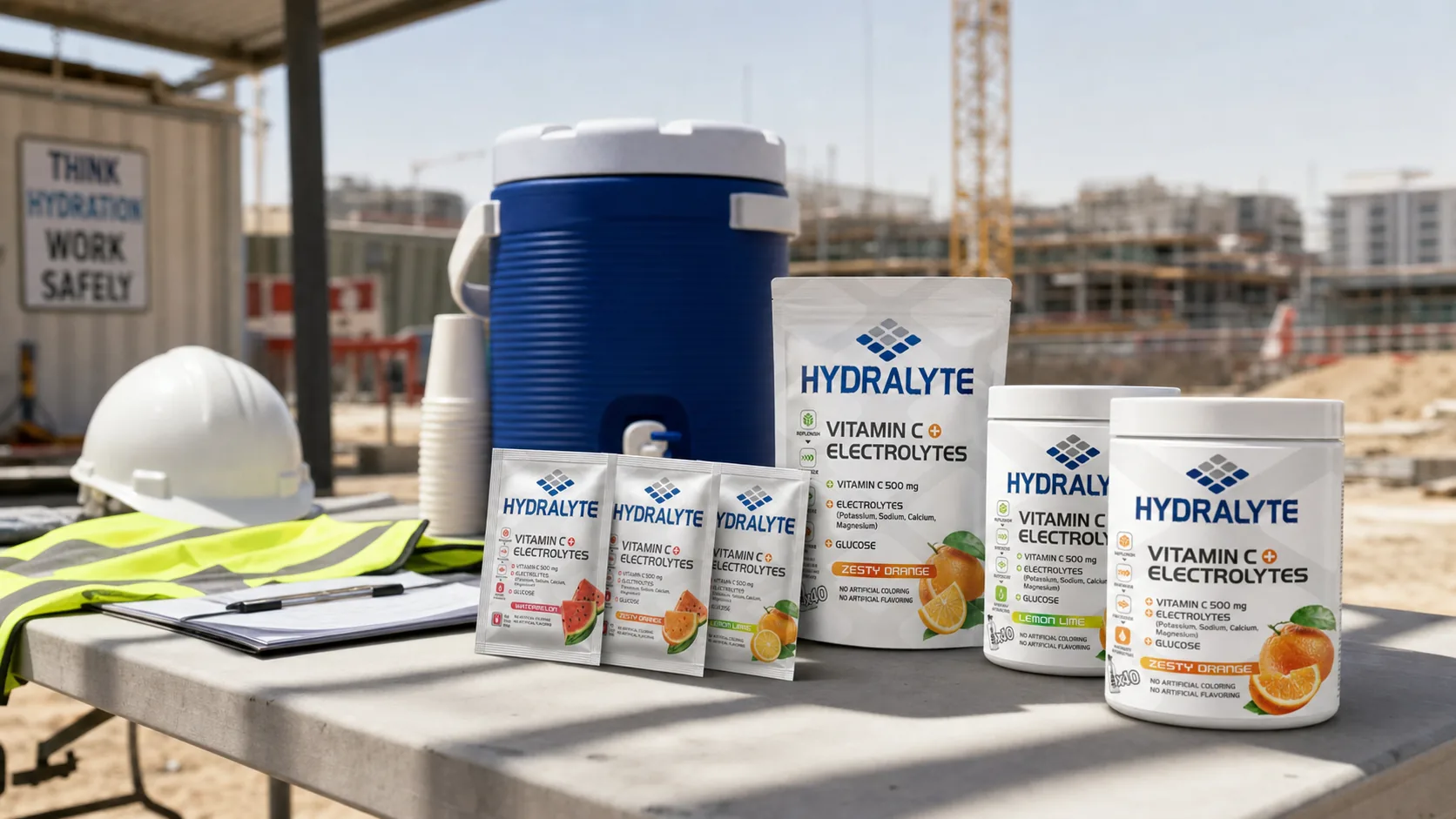
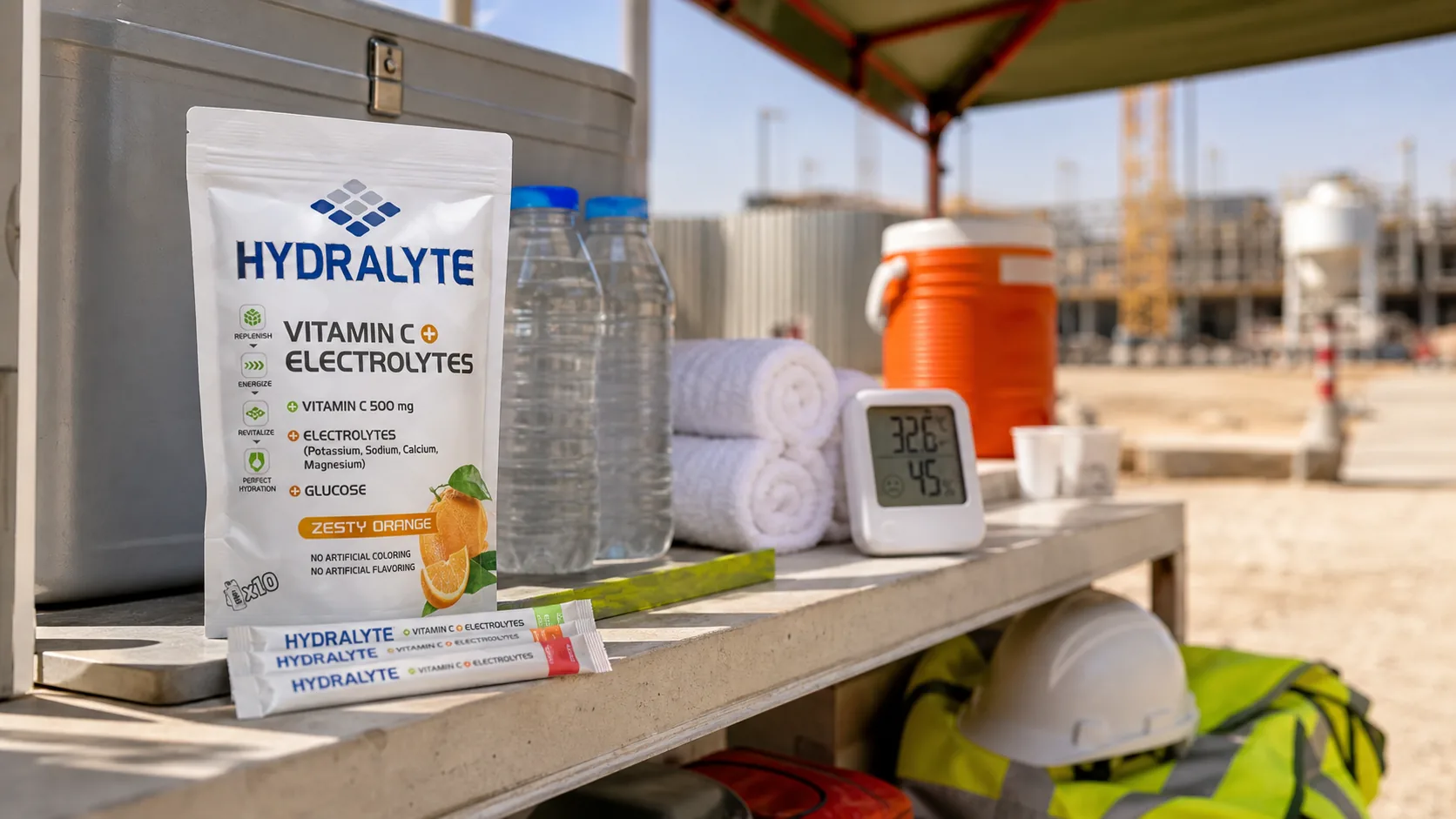
Both conditions are preventable through consistent electrolyte hydration before symptoms develop. A worker who consumes a Hydralyte serving every 45 to 60 minutes during UAE summer outdoor work maintains fluid and electrolyte reserves above the threshold where heat illness initiates. The new Hydralyte stick pack, delivering 180mg Potassium and 105mg Sodium per serving alongside 500mg Vitamin C, provides the exact electrolyte profile that prevents the depletion pattern leading to heat cramps and heat exhaustion. Prevention through regular scheduled hydration is categorically more effective and less costly than reactive emergency intervention. See our complete heat exhaustion prevention guide for UAE employers.
Frequently Asked Questions
What is the most critical difference between heat exhaustion and heat stroke symptoms?
The most critical distinguishing symptom is skin condition. Heat exhaustion presents with pale moist sweating skin — the body is still cooling itself. Heat stroke presents with hot DRY skin — the cooling mechanism has completely failed. This is the life-threatening emergency signal that requires immediate ambulance attendance.
Can a worker recover from heat exhaustion on site without going to hospital?
Mild to moderate heat exhaustion can be managed on site with immediate transfer to shade, electrolyte rehydration with products like Hydralyte, and monitoring. If symptoms do not improve within 20 minutes or worsen, emergency services must be contacted immediately.
How does regular Hydralyte consumption prevent heat exhaustion?
Hydralyte replaces sodium, potassium, calcium, and magnesium lost through sweating, preventing the electrolyte deficit that drives heat cramps and heat exhaustion. Workers consuming one serving every 45–60 minutes maintain electrolyte reserves above the threshold where heat illness begins.
Recognising the Stages of Heat-Related Illness
Heat-related illness progresses through distinct stages, each requiring escalating intervention. Understanding these stages enables supervisors to intervene early — before a <a href="/tools/heat-stress-assessment">heat stress</a> incident becomes a medical emergency.
- Stage 1 — Heat Cramps: Muscle spasms in legs, arms, or abdomen. Caused by electrolyte depletion. Intervention: Rest in shade, provide Hydralyte, stretch affected muscles.
- Stage 2 — Heat Exhaustion: Heavy sweating, weakness, cold/clammy skin, nausea, dizziness. Core temperature below 40°C. Intervention: Remove from heat immediately, cool actively, provide Hydralyte, monitor for 30 minutes.
- Stage 3 — Heat Stroke: Hot/dry skin, confusion, loss of consciousness, core temperature above 40°C. Medical emergency. Intervention: Call emergency services immediately, cool aggressively, do NOT give fluids if unconscious.
The critical window between heat exhaustion and heat stroke can be as short as 15–30 minutes. Proactive electrolyte hydration with Hydralyte throughout the workday prevents workers from ever reaching Stage 1.
Building a Site-Level Heat Stress Response Plan
Every outdoor work site in the UAE should have a documented heat stress response plan that includes: designated cool-down zones within 50m of work areas, trained first aiders on every shift, emergency cooling equipment (ice packs, misting fans), and pre-positioned Hydralyte electrolyte stocks at every welfare station and first aid point.
Train all workers — not just supervisors — to recognise heat stress symptoms in colleagues. Buddy-system monitoring is one of the most effective early warning mechanisms, especially during peak heat hours. Ensure your plan includes MoHRE compliance documentation requirements.
🏗 Protecting Outdoor Workers? Hydralyte supplies bulk electrolyte programs for construction, oil & gas, logistics, and manufacturing companies across the GCC — with full MoHRE compliance documentation. See Industry Hydration Programs →
🛒 Ready to try Hydralyte? Available in three refreshing flavours across multiple pack sizes — from individual sachets to 800g bulk pouches. Shop Hydralyte Online → or request a corporate quote.