How to Set Up a <a href="/tools/heat-stress-assessment">Heat Stress</a> Program in Dubai: Step-by-Step for 2026
Building a heat stress program that satisfies both MOHRE and Dubai Municipality requirements is a structured process that must be completed before June 15. Organizations that attempt to address heat safety reactively — distributing water bottles when workers start complaining — frequently discover during inspections that their provisions fall short of the documented, systematic approach regulators expect. This step-by-step guide gives Dubai employers the framework to build a program that is genuinely protective, fully auditable, and capable of surviving unannounced inspection.
Step 1: Assign Ownership and Define Scope
Your heat stress program must have a named owner — typically the site HSE manager or facilities safety officer — who is accountable for its implementation and maintenance throughout summer. The program scope must clearly define which roles, locations, and operations are covered. Dubai employers operating construction sites, outdoor maintenance teams, event crew operations, and logistics warehouses need sector-specific scope definitions, as the heat exposure patterns and MOHRE inspection focus differ significantly between a roofing crew and a warehouse operation. Name specific roles and temperature thresholds in the scope document.
Step 2: Conduct a Heat Risk Assessment
Before summer begins, assess each outdoor role's heat risk by examining: average work intensity and metabolic heat generation; PPE thermal load (heavy coveralls add 5 to 10°C of apparent body temperature); sun exposure duration during typical shifts; acclimatization status of each worker, particularly those who arrived or returned to UAE in the weeks before summer; and any medical conditions flagged through pre-employment health screening. Categorize workers into high, medium, and lower heat-risk groups. This classification drives the hydration frequency schedule.
Step 3: Design the Electrolyte Hydration Protocol
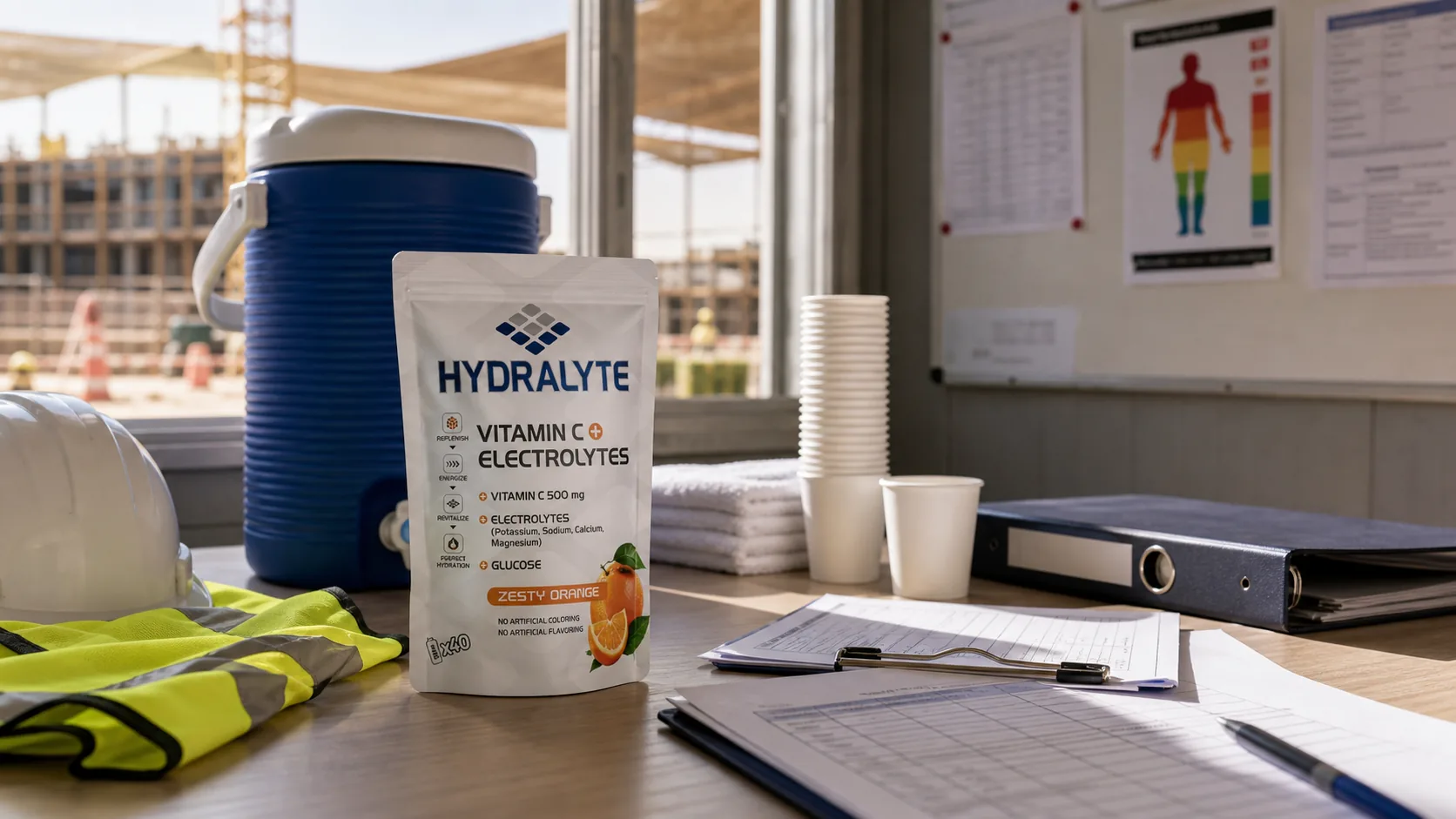
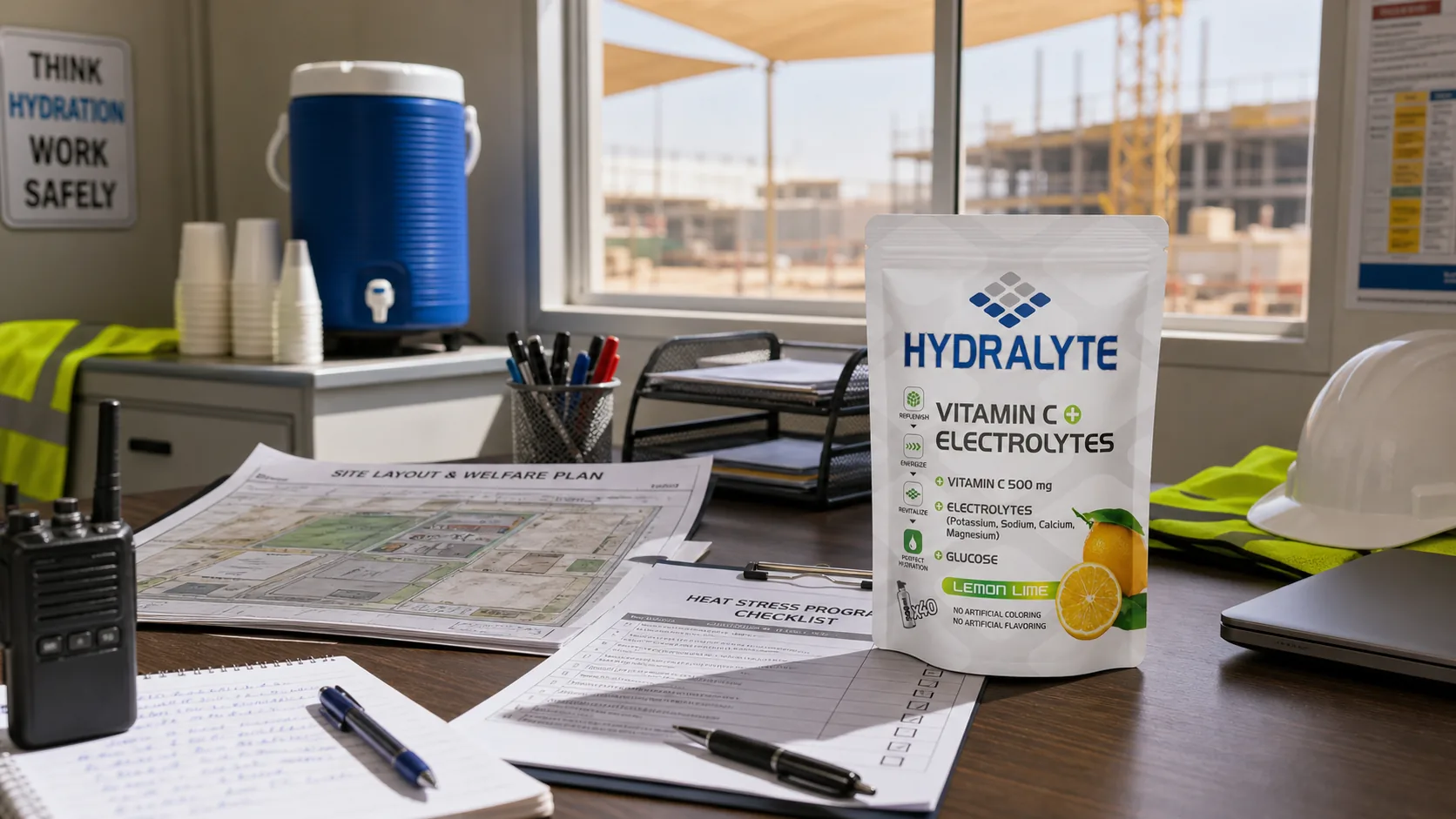
Select a compliant electrolyte product — Hydralyte's isotonic formula meets Dubai Municipality and MOHRE requirements — and define the serving schedule per risk category. High-risk workers such as concrete finishers, scaffolders, and roofers: one serving every 30 to 45 minutes of active outdoor work. Medium-risk such as MEP trades with partial shade access: every 45 to 60 minutes. Choose your distribution format: 800g Hydralyte pouches for <a href="/industries">welfare station</a>s serving large groups, 200g jars for team-level supply, individual 20g sachets or new stick pack format for personal issue to workers on high floors or remote areas.
Step 4: Train All Supervisors Before June 1
Every shift supervisor must be trained on: the hydration schedule and their enforcement responsibility; early dehydration and heat exhaustion symptoms; the correct on-site response including electrolyte administration and escalation criteria; and daily documentation requirements. Training must be completed before June 1 with attendance records filed. Refresh at mid-summer. Document all training completions in your HSE management system.
Step 5: Stock and Delivery Logistics
Calculate daily consumption from your risk-categorized <a href="/industries">workforce</a> count and serving schedules. Add a 25% buffer. Confirm Hydralyte wholesale account with delivery cycles maintaining 4 to 6 weeks of stock on hand throughout summer. Your procurement records integrate directly into your MOHRE compliance file. See our full heat stress prevention program guide for detailed implementation support.
Frequently Asked Questions
How long does it take to set up a compliant heat stress program in Dubai?
A complete heat stress program — including risk assessment, protocol design, supervisor training, and procurement setup — typically takes 3 to 4 weeks to implement properly. Starting before April gives time to complete all steps well before the June 15 midday work ban enforcement begins.
Can one heat stress program cover multiple Dubai sites?
A master program document can cover multiple sites, but each must have site-specific appendices addressing local workforce size, work patterns, and distribution logistics. MOHRE inspectors evaluate compliance at the individual site level.
What documentation must a Dubai heat stress program maintain throughout summer?
Required documentation includes: the program document with risk assessments, supervisor training records with dates and signatures, daily hydration distribution logs, procurement invoices confirming continuous supply, and incident reports for any heat-related events during the season.
🛒 Ready to try Hydralyte? Available in three refreshing flavours across multiple pack sizes — from individual sachets to 800g bulk pouches. Shop Hydralyte Online → or request a corporate quote.
The Hydralyte Advantage for UAE and GCC Conditions
Hydralyte is a potassium-rich, low-sodium isotonic electrolyte formula designed specifically for proactive daily hydration — not just reactive emergency recovery. With 500mg Vitamin C per serve and a low-sugar formula, it provides comprehensive hydration support for anyone living, working, or exercising in the extreme heat of the UAE and GCC.
Unlike traditional ORS sachets designed for acute illness, or high-sugar sports drinks designed for athletic performance, Hydralyte is formulated for safe, repeated daily consumption across the entire summer season. This makes it the preferred choice for workplace hydration programs, family use, and fitness enthusiasts across the region.
Available in three flavours (Orange Blast, Lemon Lime, Pineapple) and four pack sizes, Hydralyte is stocked online and across GCC retail, with bulk corporate supply available for businesses with 50+ workers.
Why Proactive Hydration Outperforms Reactive Treatment
The fundamental shift in modern occupational health is from reactive treatment to proactive prevention. Traditional approaches wait for dehydration symptoms to appear before intervening — by which point cognitive impairment, reduced coordination, and heat illness risk are already elevated.
Proactive hydration with Hydralyte maintains electrolyte balance throughout the workday, preventing the dehydration-impairment cascade from ever beginning. This is particularly critical in the UAE where ambient conditions can cause 1–2% body weight fluid loss within 60–90 minutes of outdoor work.
The economic case is equally compelling. Proactive electrolyte provision costs approximately AED 2–4 per worker per day. A single heat-related medical incident costs AED 20,000–50,000. A single MoHRE fine costs AED 5,000 per worker. The mathematics overwhelmingly favour prevention — and every employer who runs the numbers through the Hydralyte ROI Calculator reaches the same conclusion.