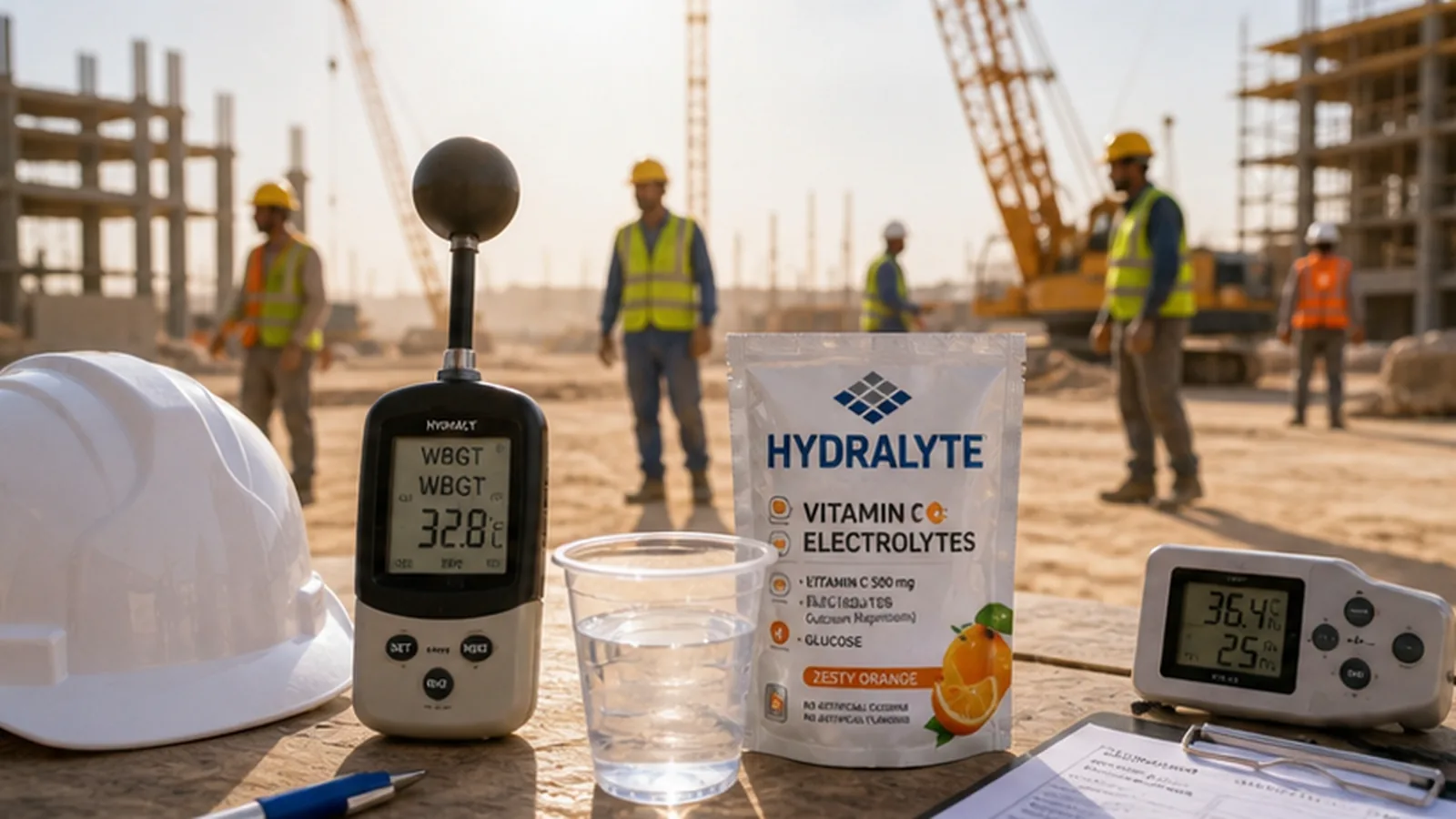
Solar Radiation — How UAE Summer Sunlight Worsens Worker Dehydration
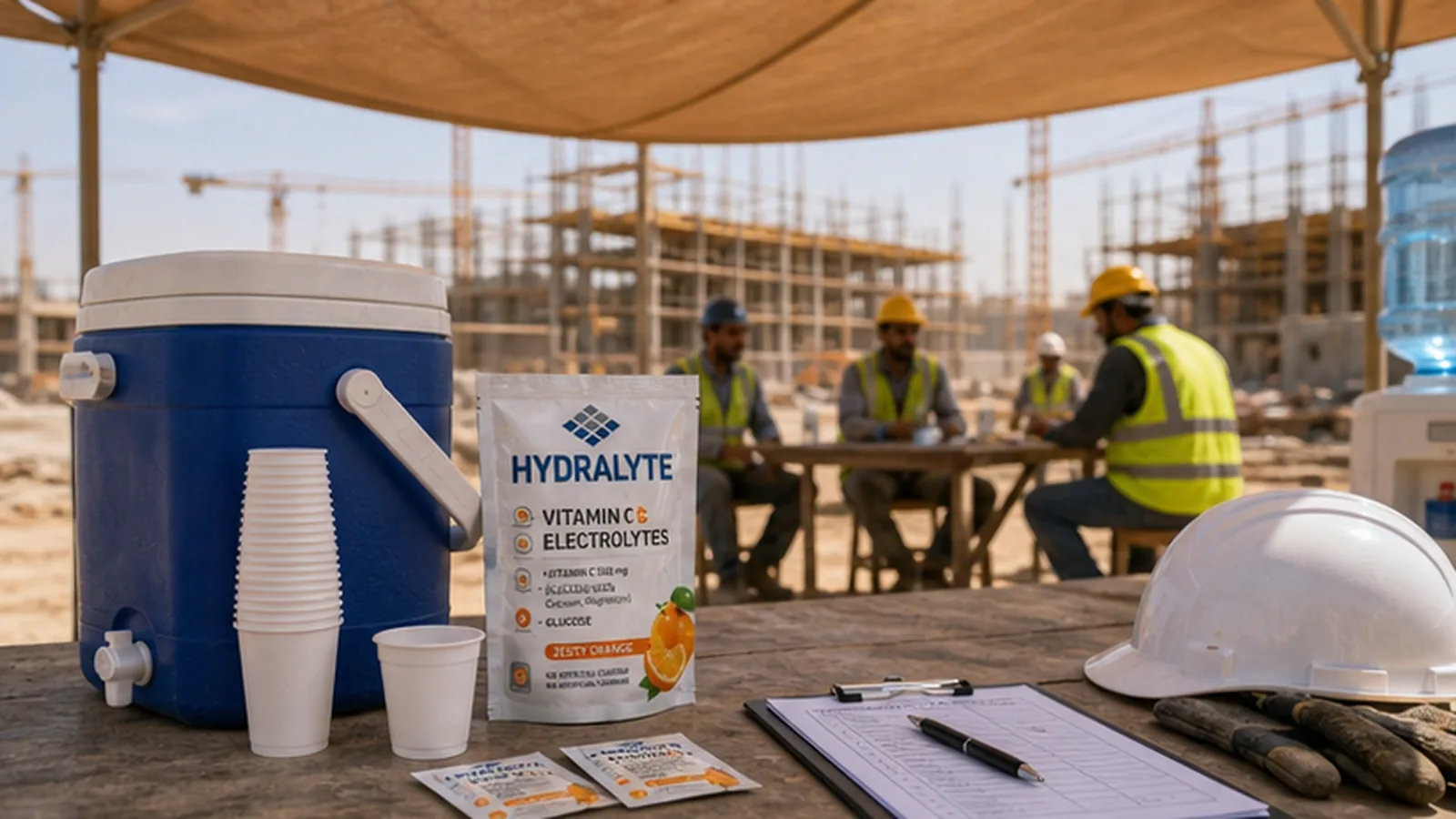
For HSE managers and welfare officers operating across the UAE, documentation is the bridge between safety intent and regulatory compliance. The Ministry of Human Resources and Emiratisation (MOHRE) mandates rigorous <a href="/tools/heat-stress-assessment">heat stress</a> prevention measures, but providing electrolytes is insufficient without a verifiable audit trail. Implementing a standardized welfare station log template in the UAE ensures:
- Accurate recording of every Hydralyte distribution
- Provision of necessary evidence for MOHRE inspectors
- Workforce protection during extreme summer months
- Execution of hydration protocols systematically across the site
Essential Data Points for a MOHRE-Compliant Distribution Log
A MOHRE-compliant distribution log must provide a clear, chronological account of hydration activities. To meet regional standards, each log entry should meticulously record:
- Date, specific site location, and designated station number
- Exact time of each distribution interval
- Total number of servings provided (e.g., Hydralyte 800g pouches or individual stick packs)
- Welfare monitor's initials for validation
- An observations column to track early signs of heat fatigue
While some managers record individual worker names, a total serving count per interval is generally sufficient for MOHRE purposes, provided it demonstrates consistent, scheduled provision.
Log Format Design for Practical Site Compliance
The effectiveness of a welfare station log template in the UAE depends on its ease of use in high-intensity environments. Best practices for practical site compliance include:
- Using simple A4 paper logs pre-printed with site and station details
- Designing weekly sheets rather than daily sheets to streamline archiving
- Protecting logs with waterproof plastic sleeves or waterproof paper to resist sweat, humidity, and dust
- Ensuring the design is universal for all formats, including 800g pouches, 200g jars, or portable 20g sachets
Archiving Logs for MOHRE Audit and Investigation Purposes
Effective archiving is just as critical as documenting distribution. HSE managers should implement the following workflow:
- Collect completed logs weekly and date them upon receipt
- File records systematically in a dedicated heat stress compliance binder organized by month
- Retain all logs through at least December 31 of the current year (Mandatory)
- Maintain records for longer durations to prepare for post-incident investigations
To secure your supply of Hydralyte and receive further guidance on building a compliant safety program, contact our team.
Why Proactive Hydration Outperforms Reactive Treatment
The fundamental shift in modern occupational health is from reactive treatment to proactive prevention. Traditional approaches wait for dehydration symptoms to appear before intervening — by which point cognitive impairment, reduced coordination, and heat illness risk are already elevated.
Proactive hydration with Hydralyte maintains electrolyte balance throughout the workday, preventing the dehydration-impairment cascade from ever beginning. This is particularly critical in the UAE where ambient conditions can cause 1–2% body weight fluid loss within 60–90 minutes of outdoor work.
The economic case is equally compelling. Proactive electrolyte provision costs approximately AED 2–4 per worker per day. A single heat-related medical incident costs AED 20,000–50,000. A single MoHRE fine costs AED 5,000 per worker. The mathematics overwhelmingly favour prevention — and every employer who runs the numbers through the Hydralyte ROI Calculator reaches the same conclusion.
🏗 Protecting Outdoor Workers? Hydralyte supplies bulk electrolyte programs for construction, oil & gas, logistics, and manufacturing companies across the GCC — with full MoHRE compliance documentation. See Industry Hydration Programs →
The SGLT1 Mechanism: How Electrolyte Drinks Actually Work
Understanding why electrolyte drinks work requires understanding the sodium-glucose co-transport mechanism (SGLT1) in the small intestine. This mechanism transports sodium and glucose molecules together across the intestinal wall, pulling water along by osmosis. This is why plain water alone — without electrolytes and glucose — is absorbed significantly slower.
Hydralyte's isotonic formula is specifically calibrated to optimise SGLT1 transport. The precise ratio of sodium, glucose, potassium, chloride, and calcium matches the body's natural fluid osmolality (280–295 mOsm/L), enabling absorption up to 3× faster than water alone.
This is fundamentally different from hypotonic solutions (which have lower osmolality than body fluids) and hypertonic solutions (which have higher osmolality). While hypotonic solutions may absorb slightly faster in the intestine, they provide less complete electrolyte replacement — meaning workers need to consume more volume to achieve the same rehydration effect.
Why Potassium-Rich Formulas Are Safer for Daily Use
Most traditional ORS formulas are high in sodium because they were originally designed for treating acute dehydration from diarrhoea and cholera. Consuming high-sodium formulas daily across a 3-month UAE summer season can contribute to elevated blood pressure, cardiovascular strain, and kidney stress.
Hydralyte reverses this ratio — high potassium, low sodium. Potassium supports muscle function, heart health, and cellular hydration. This makes Hydralyte safe for proactive daily use rather than just reactive emergency treatment. For workers consuming electrolyte drinks 6–8 times per day during summer, this distinction is significant.
Frequently Asked Questions
Q: Does MOHRE require individual worker names on every welfare station distribution log entry?
A: No. MOHRE does not prescribe a specific format, but a count of servings distributed per interval is the minimum requirement. The key is demonstrating systematic scheduled distribution rather than ad hoc provision.
Q: How long should UAE employers retain welfare station distribution logs?
A: Retain logs for the full summer season plus a minimum of 12 months beyond the season's end. Permanent digital archiving of scanned logs is considered a best practice for future MOHRE investigations.
Q: Can welfare station logs be maintained digitally on UAE construction sites?
A: Yes. Digital logs via tablet apps, QR-scan systems, or shared spreadsheets are acceptable. They must include timestamped entries, the identified welfare monitor, and a retrievable record for MOHRE inspections.
🛒 Ready to try Hydralyte? Available in three refreshing flavours across multiple pack sizes — from individual sachets to 800g bulk pouches. Shop Hydralyte Online → or request a corporate quote.