Managing Heat Stress for Concrete Workers in the UAE: Protecting High-Risk Specialist Teams
On UAE construction sites, concrete pour crews occupy a unique risk profile. While all outdoor roles face the challenge of extreme ambient temperatures, concrete workers contend with a secondary, localized heat source: the exothermic curing reaction of fresh concrete. Effectively managing heat stress for concrete workers in the UAE requires a specialized safety protocol that accounts for this intense micro-environment.
The Unique Thermal Burden of Concrete Work
Concrete work creates exceptional heat stress because fresh concrete is not a passive material. As it sets, the chemical hydration process releases significant energy. Workers find themselves trapped in a three-way heat trap:
- Solar radiation from above during peak UAE summer hours
- High ambient air temperatures common to the region
- Intense thermal emission from the concrete below, with surface temperatures often exceeding 60-65°C
Operational Challenges: Timing and Isolation
A primary difficulty in addressing heat stress for concrete workers in the UAE is the time-critical nature of the work. Once a pour begins, it cannot be interrupted without risking structural integrity. Key operational constraints include:
- Continuous, high-intensity activity for windows of 1-3 hours
- Physical impossibility of visiting traditional welfare stations during the pour
- A mandatory requirement for personal sachet carry in PPE vest pockets
- The need for hydration sources to be as mobile as the crew
The "Sandwich" Hydration Protocol
To mitigate the risk of heat-related incidents, sites must implement a structured electrolyte protocol:
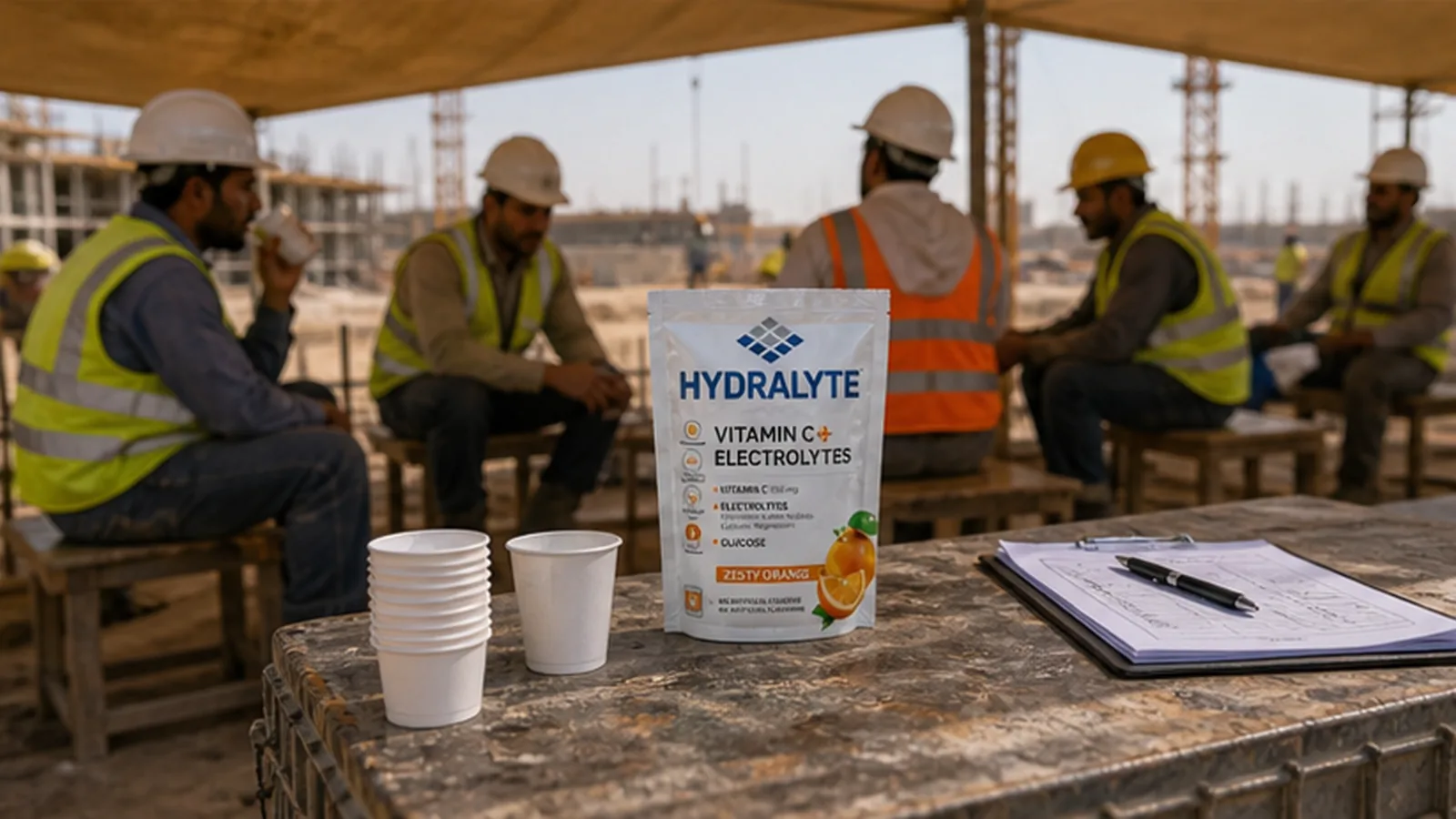
- Pre-Pour: Consume a full serving of Hydralyte (prepared from 800g pouches) immediately before the pour starts to ensure optimal electrolyte levels.
- During Pour: Supervisors must distribute additional individual sachets at the earliest safe break point to arrest physiological decline.
- Post-Pour: Provide an immediate recovery serving of Hydralyte to replenish the massive loss of salts and minerals.
To implement a specialized hydration program for your concrete teams, contact our team.
Why Proactive Hydration Outperforms Reactive Treatment
The fundamental shift in modern occupational health is from reactive treatment to proactive prevention. Traditional approaches wait for dehydration symptoms to appear before intervening — by which point cognitive impairment, reduced coordination, and heat illness risk are already elevated.
Proactive hydration with Hydralyte maintains electrolyte balance throughout the workday, preventing the dehydration-impairment cascade from ever beginning. This is particularly critical in the UAE where ambient conditions can cause 1–2% body weight fluid loss within 60–90 minutes of outdoor work.
The economic case is equally compelling. Proactive electrolyte provision costs approximately AED 2–4 per worker per day. A single heat-related medical incident costs AED 20,000–50,000. A single MoHRE fine costs AED 5,000 per worker. The mathematics overwhelmingly favour prevention — and every employer who runs the numbers through the Hydralyte ROI Calculator reaches the same conclusion.
🏗 Protecting Outdoor Workers? Hydralyte supplies bulk electrolyte programs for construction, oil & gas, logistics, and manufacturing companies across the GCC — with full MoHRE compliance documentation. See Industry Hydration Programs →
Implementing a Construction Site Hydration Protocol
A structured hydration protocol is the most effective way to reduce heat-related incidents on UAE construction sites. This requires more than simply placing water coolers — it demands a systematic approach to electrolyte provision timed around work-rest cycles.
Start by mapping your site's thermal exposure zones. Areas with direct solar radiation, reflective surfaces (steel decking, concrete pours), and enclosed spaces all create different dehydration risk profiles. Workers in these high-risk zones should receive Hydralyte at each mandatory rest break, not just water.
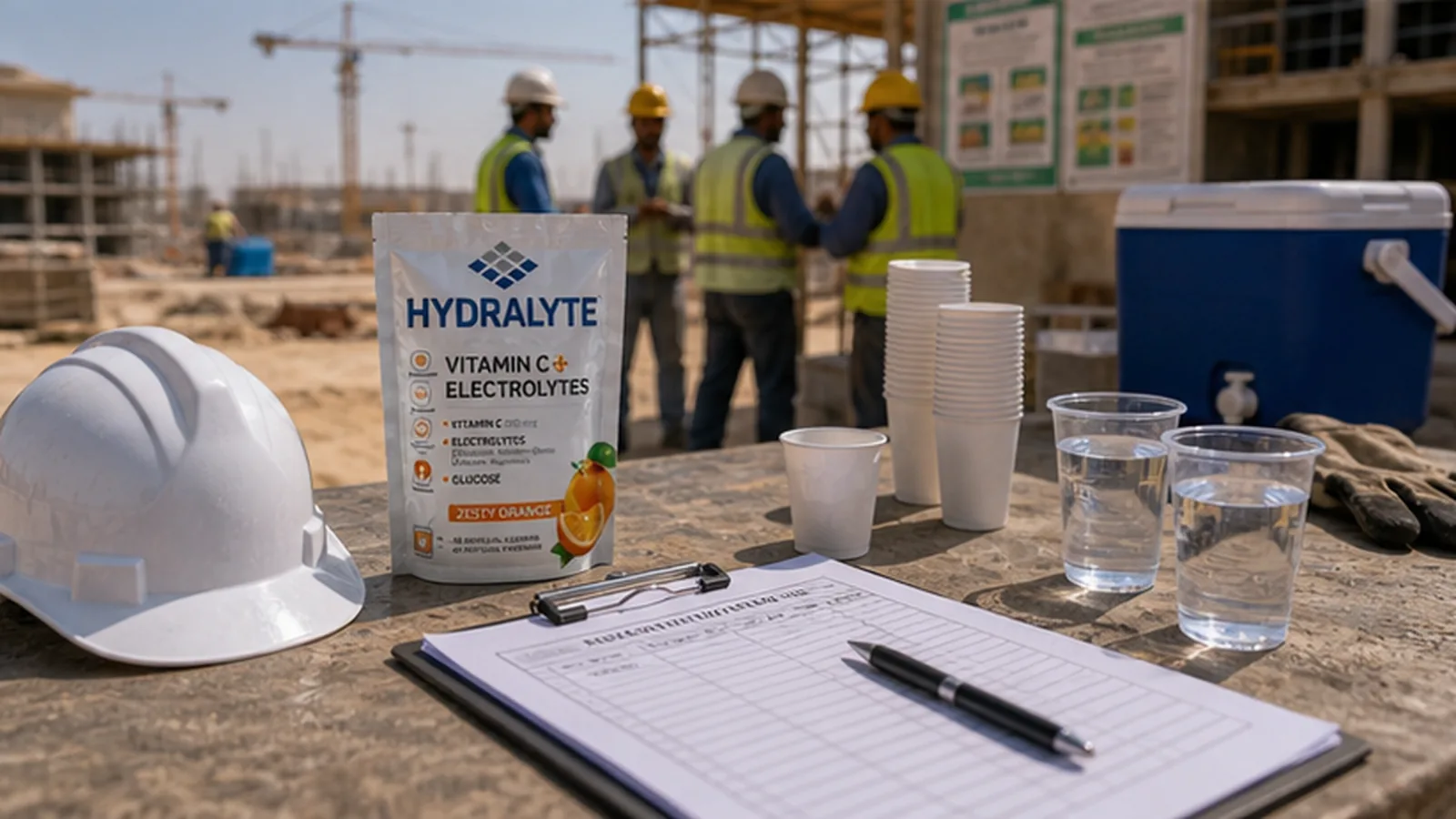
Hydration stations should be placed within 50 metres of every active work zone, stocked with Hydralyte 800g pouches for mixing at volume. For workers in mobile roles (crane operators, surveyors, scaffolders), provide individual 20g sachets that can be carried in PPE pockets and mixed with any available water source.
Document every aspect of your hydration program — from procurement receipts to distribution logs. This documentation becomes critical evidence during MoHRE inspections and any heat illness incident investigations. A well-documented program demonstrates duty of care and can significantly reduce employer liability.
Heat Acclimatisation and Hydration for New Workers
New workers arriving on UAE construction sites face the highest dehydration risk. Research shows that heat acclimatisation takes 7–14 days of gradual exposure. During this period, new workers lose significantly more electrolytes through sweat as their bodies haven't yet adapted to the thermal environment.
Implement a graduated work schedule: 50% workload in week one, 75% in week two, with increased electrolyte provision during the entire acclimatisation period. Providing Hydralyte during induction sends a clear signal that your site takes heat safety seriously — and reduces the risk of losing new workers to heat-related illness in their first fortnight.
Frequently Asked Questions
Q: Why do concrete finishers face higher heat stress risk than other UAE construction workers?
A: Concrete finishers work crouched close to surfaces undergoing an exothermic curing reaction. They receive heat from three directions—solar radiation, the ambient environment, and the 60°C+ concrete surface—creating one of the most extreme individual heat stress exposures on-site.
Q: How should concrete pour crews carry their Hydralyte during a pour?
A: Issue each crew member 2-3 individually sealed sachets to be kept in PPE vest pockets before the pour commences. This allows for consumption during brief natural pauses when leaving the work area is not an option.
Q: What is the optimal time to schedule large UAE concrete pours?
A: Schedule pours for early morning starts (5:00-6:00 am) to ensure intensive work is completed before temperatures peak. Avoid scheduling pours that run through the 10:00 am - 12:30 pm window to dramatically reduce the heat stress burden.
🛒 Ready to try Hydralyte? Available in three refreshing flavours across multiple pack sizes — from individual sachets to 800g bulk pouches. Shop Hydralyte Online → or request a corporate quote.