Heat Stress in High-Rise Construction UAE — Elevated Risk Guide
On complex UAE construction projects involving dozens of different employers on a single site, determining specific legal responsibility for heat stress protection is critical. Clear accountability regarding contractor and subcontractor electrolyte UAE obligations ensures every outdoor worker remains protected during peak summer months. Under UAE Labor Law, the responsibility for providing medical-grade hydration is not a divisible or transferable duty; it is a fundamental part of the employer-employee relationship that must be strictly maintained to ensure MOHRE compliance.
Primary Employer Obligations Under Federal Decree-Law No. 33 of 2021
The legal framework in the UAE places the primary duty of care squarely on the employing entity. For subcontractors who directly employ outdoor workers, the responsibility for contractor and subcontractor electrolyte UAE provision includes:
- Direct Accountability: Subcontractors cannot legally outsource their duty to protect employees from heat stress to a main contractor.
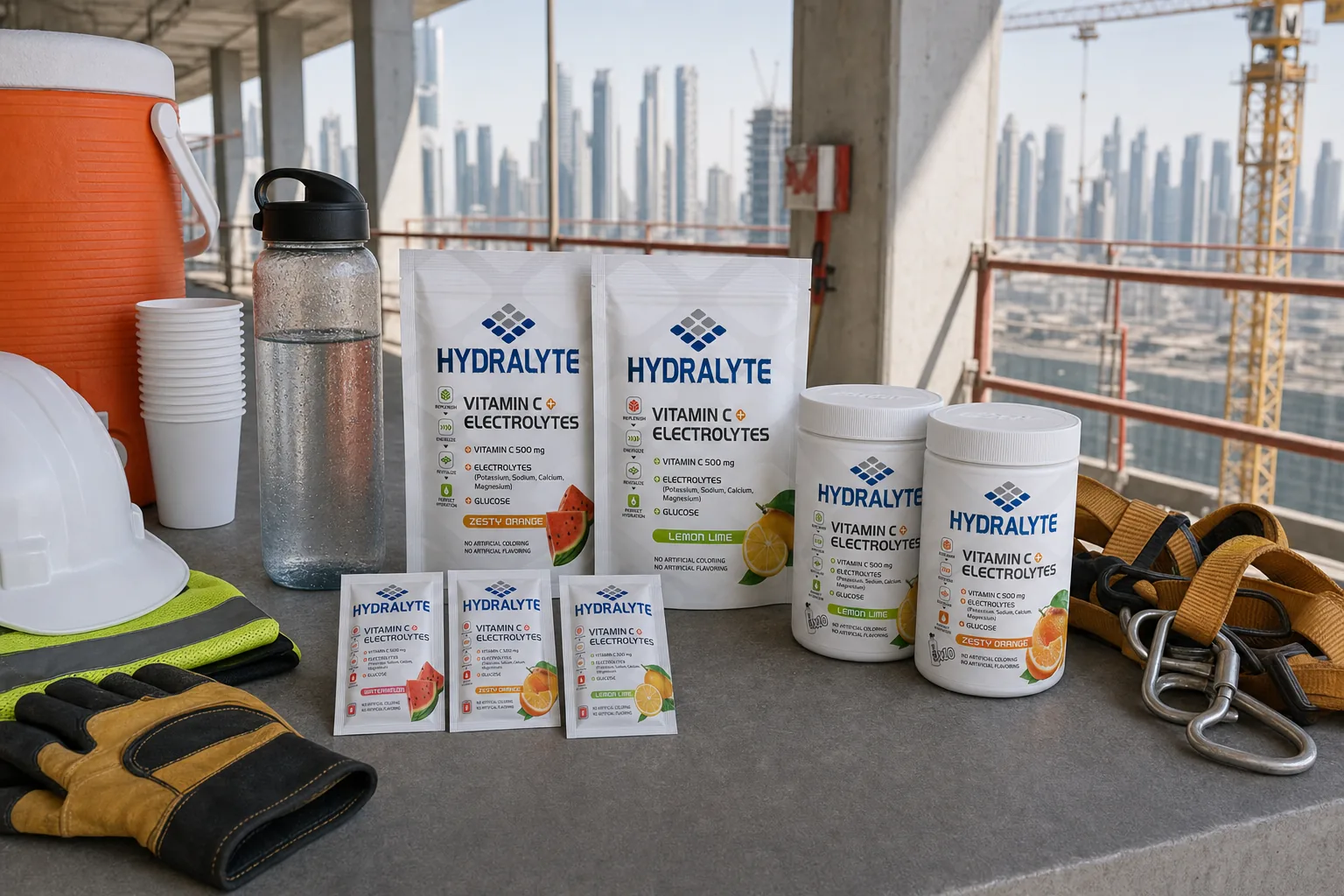
- Personal Issue Items: Providing Hydralyte sachets ensures the <a href="/industries">workforce</a> has direct access to international established oral rehydration.
- Legal Sufficiency: Relying solely on a main contractor's <a href="/industries">welfare station</a> is insufficient to discharge this legal duty.
Main Contractor Responsibilities for Site Infrastructure
While the direct employer holds the primary duty, the main contractor maintains overall site management responsibility. MOHRE expects main contractors to provide necessary welfare infrastructure, including:
- Site-Wide Facilities: Installation of chilled water stations accessible to everyone under their management.
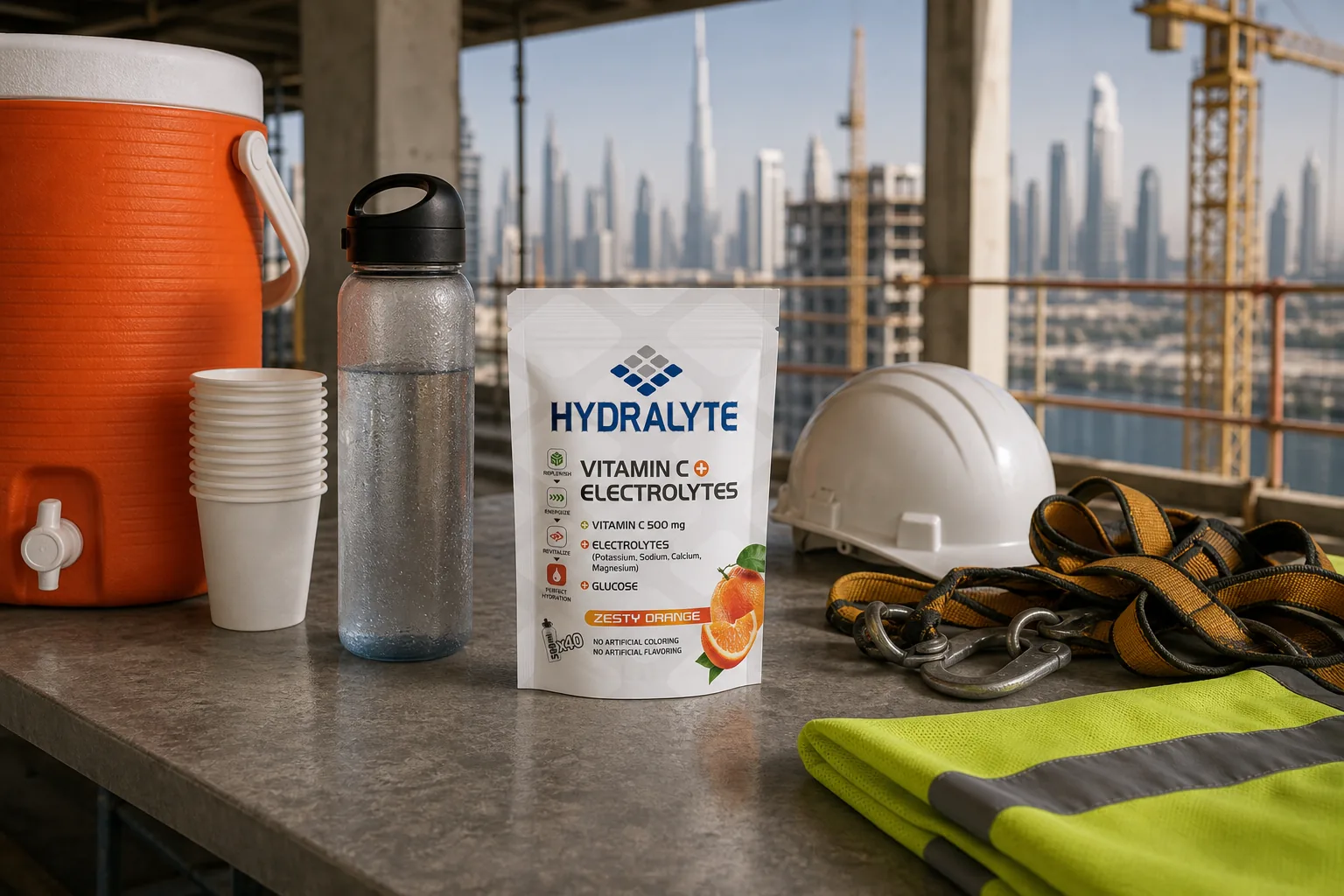
- Bulk Provision: Providing Hydralyte 800g pouches at designated welfare areas to support the wider site population.
- Compliance Monitoring: Ensuring subcontractors utilize scheduled electrolyte provision, backed by documented distribution logs.
The Shared-Site Solution for Contractor and Subcontractor Electrolyte UAE
The most legally robust model for multi-contractor sites is a collaborative, two-tier approach:
- Tier 1 (Main Contractor): Funds and maintains shared infrastructure, stocking bulk Hydralyte 800g pouches at central points for constant availability.
- Tier 2 (Subcontractor): Manages personal provision programs, issuing Hydralyte sachets to workers at the start of each shift.
- Documentation: Subcontractors maintain individual logs for MOHRE inspections, while main contractors raise the baseline safety standard for the entire project.
To implement a compliant shared-site hydration program or to discuss bulk supply requirements for your project, contact our team.
Implementing a Construction Site Hydration Protocol
A structured hydration protocol is the most effective way to reduce heat-related incidents on UAE construction sites. This requires more than simply placing water coolers — it demands a systematic approach to electrolyte provision timed around work-rest cycles.
Start by mapping your site's thermal exposure zones. Areas with direct solar radiation, reflective surfaces (steel decking, concrete pours), and enclosed spaces all create different dehydration risk profiles. Workers in these high-risk zones should receive Hydralyte at each mandatory rest break, not just water.
Hydration stations should be placed within 50 metres of every active work zone, stocked with Hydralyte 800g pouches for mixing at volume. For workers in mobile roles (crane operators, surveyors, scaffolders), provide individual 20g sachets that can be carried in PPE pockets and mixed with any available water source.
Document every aspect of your hydration program — from procurement receipts to distribution logs. This documentation becomes critical evidence during MoHRE inspections and any heat illness incident investigations. A well-documented program demonstrates duty of care and can significantly reduce employer liability.
Heat Acclimatisation and Hydration for New Workers
New workers arriving on UAE construction sites face the highest dehydration risk. Research shows that heat acclimatisation takes 7–14 days of gradual exposure. During this period, new workers lose significantly more electrolytes through sweat as their bodies haven't yet adapted to the thermal environment.
Implement a graduated work schedule: 50% workload in week one, 75% in week two, with increased electrolyte provision during the entire acclimatisation period. Providing Hydralyte during induction sends a clear signal that your site takes heat safety seriously — and reduces the risk of losing new workers to heat-related illness in their first fortnight.
Frequently Asked Questions
Q: Is a subcontractor responsible for electrolyte provision on a UAE site with a main contractor program?
A: Yes. The legal obligation attaches to the employment relationship. Access to a main contractor station satisfies access requirements but does not discharge the subcontractor's duty to ensure scheduled provision and maintain distribution records.
Q: Can a main contractor be held liable for a subcontractor's worker heat illness on a UAE site?
A: Yes. Main contractors face secondary liability if inadequate site infrastructure contributed to an incident. Management is best protected by requiring subcontractors to demonstrate their own compliant provision programs.
Q: How should UAE main contractors structure electrolyte requirements in subcontract agreements?
A: Main contractors should include clauses requiring each subcontractor to:
- Demonstrate a MOHRE-compliant heat stress program.
- Produce distribution logs on request.
- Provide evidence of supervisor heat safety training.
- Confirm use of a standard ORS-standard-compliant electrolyte product.
🛒 Ready to try Hydralyte? Available in three refreshing flavours across multiple pack sizes — from individual sachets to 800g bulk pouches. Shop Hydralyte Online → or request a corporate quote.
Why Proactive Hydration Outperforms Reactive Treatment
The fundamental shift in modern occupational health is from reactive treatment to proactive prevention. Traditional approaches wait for dehydration symptoms to appear before intervening — by which point cognitive impairment, reduced coordination, and heat illness risk are already elevated.
Proactive hydration with Hydralyte maintains electrolyte balance throughout the workday, preventing the dehydration-impairment cascade from ever beginning. This is particularly critical in the UAE where ambient conditions can cause 1–2% body weight fluid loss within 60–90 minutes of outdoor work.
The economic case is equally compelling. Proactive electrolyte provision costs approximately AED 2–4 per worker per day. A single heat-related medical incident costs AED 20,000–50,000. A single MoHRE fine costs AED 5,000 per worker. The mathematics overwhelmingly favour prevention — and every employer who runs the numbers through the Hydralyte ROI Calculator reaches the same conclusion.