Electrolyte Drinks vs Sports Drinks: Which Is Right for You?
When you reach for a conventional sports drink, you're consuming far more than just water and electrolytes. Most high-sugar sports drinks contain 21–34 grams of sugar per serving—equivalent to a sugary soft drink. This high carbohydrate load is engineered specifically for one purpose: fueling muscles during extended, high-intensity workouts lasting over 60 minutes.
Beyond sugar, many conventional sports drinks include:
• Artificial colours and dyes (often synthetic, brightly pigmented)
• Citric acid and phosphoric acid (for preservation and taste)
• Natural and artificial flavours
• Sodium (typically 200–300mg per serving for taste appeal)
• Potassium (minimal amounts compared to electrolyte formulations)
For a casual gym session, a weekend walk, or everyday living—especially in the UAE climate—this sugar volume is unnecessary and can contribute to excess calorie intake over time.
What's in a Proper Electrolyte Drink?
A proper electrolyte drink formulated to Oral Rehydration Solution (ORS) standards takes a fundamentally different approach. These drinks are engineered based on decades of medical research into how the human body actually absorbs fluids and electrolytes.
ORS-standard electrolyte drinks contain:
• Minimal sugar (2.5–3 grams per serving)
• Optimized sodium and potassium ratios (aligned to published medical guidance)
• Glucose in precise ratios designed for efficient water absorption in the small intestine
• Chloride and other essential minerals
• Natural colours (if any) with no artificial dyes
• Simple, clean ingredient lists
This formulation ensures efficient rehydration without unnecessary calories. It's the same science used in medical rehydration protocols globally—proven in hospital settings for decades.
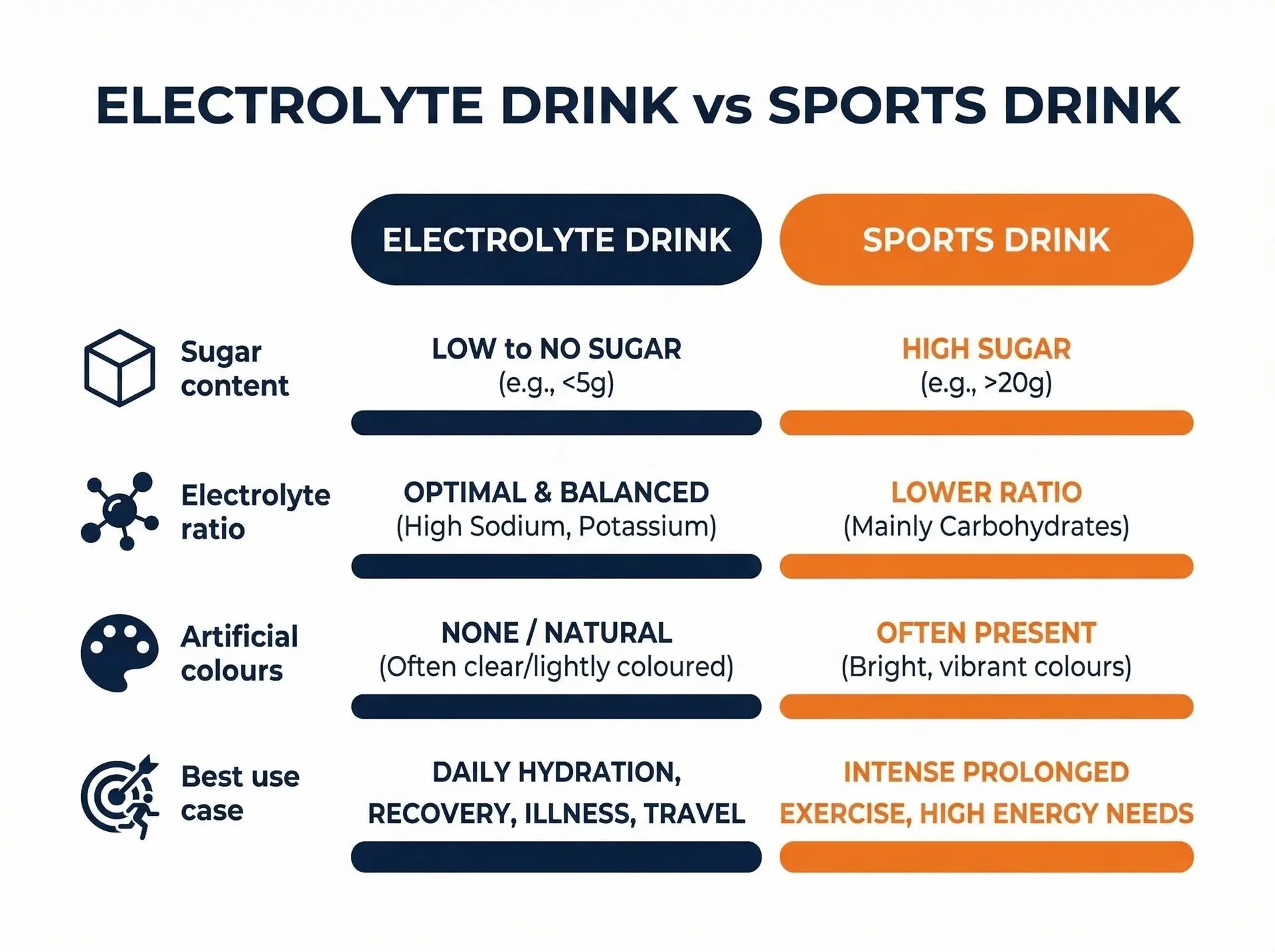
Head-to-Head Comparison
| Feature | Electrolyte Drink (ORS-Standard) | Conventional Sports Drink |
| Sugar content (per serving) | 2.5–3 grams | 21–34 grams |
| Primary use case | Everyday hydration, mild-to-moderate activity, recovery from minor illness | High-intensity sport, prolonged exertion (60+ minutes) |
| Electrolyte formulation | established oral rehydration science (optimized sodium/glucose ratio for absorption) | Sports drink formula (lower sodium than ORS, higher sugar for taste) |
| Artificial colours | None | Often contains artificial colours and dyes |
| Best use case in UAE heat | Daily hydration, everyday fluid loss, outdoor activities | Competitive athletic events, extended high-intensity training |
| Suitable for children | Yes—lower sugar, medical-grade formulation | Not recommended—unnecessary sugar load |
When to Choose Each Drink
Choose an Electrolyte Drink (ORS-Standard) If:
• You exercise for under 60 minutes at moderate intensity
• You want everyday hydration without excess sugar
• You're recovering from mild illness or dehydration
• You prefer lower-calorie hydration options
• You're managing sugar intake due to health or dietary choices
• You live in a hot climate and sweat regularly from daily activities
• You need rehydration for children during outdoor play or illness
• You want a cleaner ingredient list with no artificial colours
Choose a Conventional Sports Drink If:
• You engage in high-intensity sport or training lasting over 60 minutes
• You need rapid carbohydrate fuel for muscle endurance during competition
• You're a competitive athlete with specific performance needs
• You're doing intense interval training or endurance events
What Matters Most in the UAE Climate
In the Middle East, hydration isn't just about exercise—it's about climate reality. Temperatures routinely exceed 40°C (104°F), and even light outdoor activity causes significant fluid loss. You're losing fluids simply walking from a car into a building, regardless of sport or fitness activity.
This changes the hydration equation entirely. In hot climates:
• Your body loses sodium through sweat at a higher rate than in temperate climates
• You need consistent, everyday rehydration—not just during workouts
• Excess sugar from conventional sports drinks becomes counterproductive, adding calories without hydration benefit
• An ORS-standard electrolyte drink's higher sodium (aligned to ORS-style formulations) replaces what you're actually losing
For everyday UAE living, an ORS-standard electrolyte drink's lower sugar content and scientifically optimized electrolyte ratio is far more practical than a high-sugar sports drink designed for athletes in temperate climates.
FAQ
Is an electrolyte drink better than a conventional sports drink?
Neither is objectively "better"—it depends on your use case. High-sugar sports drinks excel for competitive athletes during intense workouts lasting over 60 minutes. ORS-standard electrolyte drinks excel for everyday hydration, mild activity, and climate-driven fluid loss. For the UAE context, an electrolyte drink's lower sugar and balanced formulation make it more practical for daily use.
Can I use an electrolyte drink if I'm an athlete?
Yes, absolutely. For workouts under 60 minutes or moderate activity, an ORS-standard electrolyte drink is perfectly adequate and offers far better sugar balance than conventional sports drinks. For endurance sport or high-intensity training over an hour, a high-sugar sports drink's carbohydrate content may provide a performance edge for fuel. Many athletes use ORS-standard electrolyte drinks for recovery instead.
Which drink is better for children?
An ORS-standard electrolyte drink is the better choice for children. Its lower sugar content prevents unnecessary calorie intake, and it's specifically formulated for mild dehydration—common when kids are ill or playing outdoors in hot weather. Neither drink should replace water as a child's primary hydration source, but for rehydration during illness or outdoor activity in heat, an electrolyte drink is far more appropriate than a high-sugar sports drink.
Discover the Right Hydration for You
Understanding the difference between conventional sports drinks and ORS-standard electrolyte drinks empowers you to make informed hydration choices for your lifestyle, activity level, and climate. Whether you're navigating the UAE heat, recovering from activity, or supporting your family's wellness, the right drink matters.
Ready to choose a hydration solution that works for you? Browse our electrolyte drink options or contact our team with any questions about which product suits your needs.
Disclaimer: This article is for informational purposes only and does not constitute medical advice. Consult a healthcare professional for personalised guidance.
PPE and Dehydration: The Compounding Effect in Oil & Gas
Oil and gas workers face a unique hydration challenge: the mandatory PPE that protects them from chemical and fire hazards simultaneously traps body heat. Fire-resistant coveralls, hard hats, safety goggles, and steel-toe boots create a microclimate that can elevate core body temperature by 2–3°C above ambient conditions.
This means that even when ambient temperatures are 38°C, workers inside full PPE may be experiencing effective temperatures of 40–41°C. Sweat rates under these conditions can reach 1.5–2 litres per hour, rapidly depleting not just water but critical electrolytes including potassium, sodium, chloride, and calcium.
Hydralyte's potassium-rich isotonic formula is specifically advantageous in these conditions. Unlike high-sodium reactive formulas, Hydralyte replaces all four key electrolytes in ratios appropriate for daily consumption throughout long shift rotations — typically 12-hour shifts on a 2-weeks-on, 2-weeks-off rotation in GCC oil fields.
Emergency Hydration Protocols for Rig Operations
Every rig and pipeline operation should have a <a href="/tools/heat-stress-assessment">heat stress</a> emergency response protocol that includes electrolyte provision as a first-line intervention. When a worker shows signs of heat exhaustion — confusion, heavy sweating, rapid pulse — providing Hydralyte alongside cooling measures can prevent escalation to heat stroke.
Keep emergency hydration kits at every muster station containing Hydralyte sachets, cooled water, and a mixing vessel. Train all safety officers in the signs of electrolyte depletion versus simple overheating — the treatment protocols differ significantly.
🏗 Protecting Outdoor Workers? Hydralyte supplies bulk electrolyte programs for construction, oil & gas, logistics, and manufacturing companies across the GCC — with full MoHRE compliance documentation. See Industry Hydration Programs →