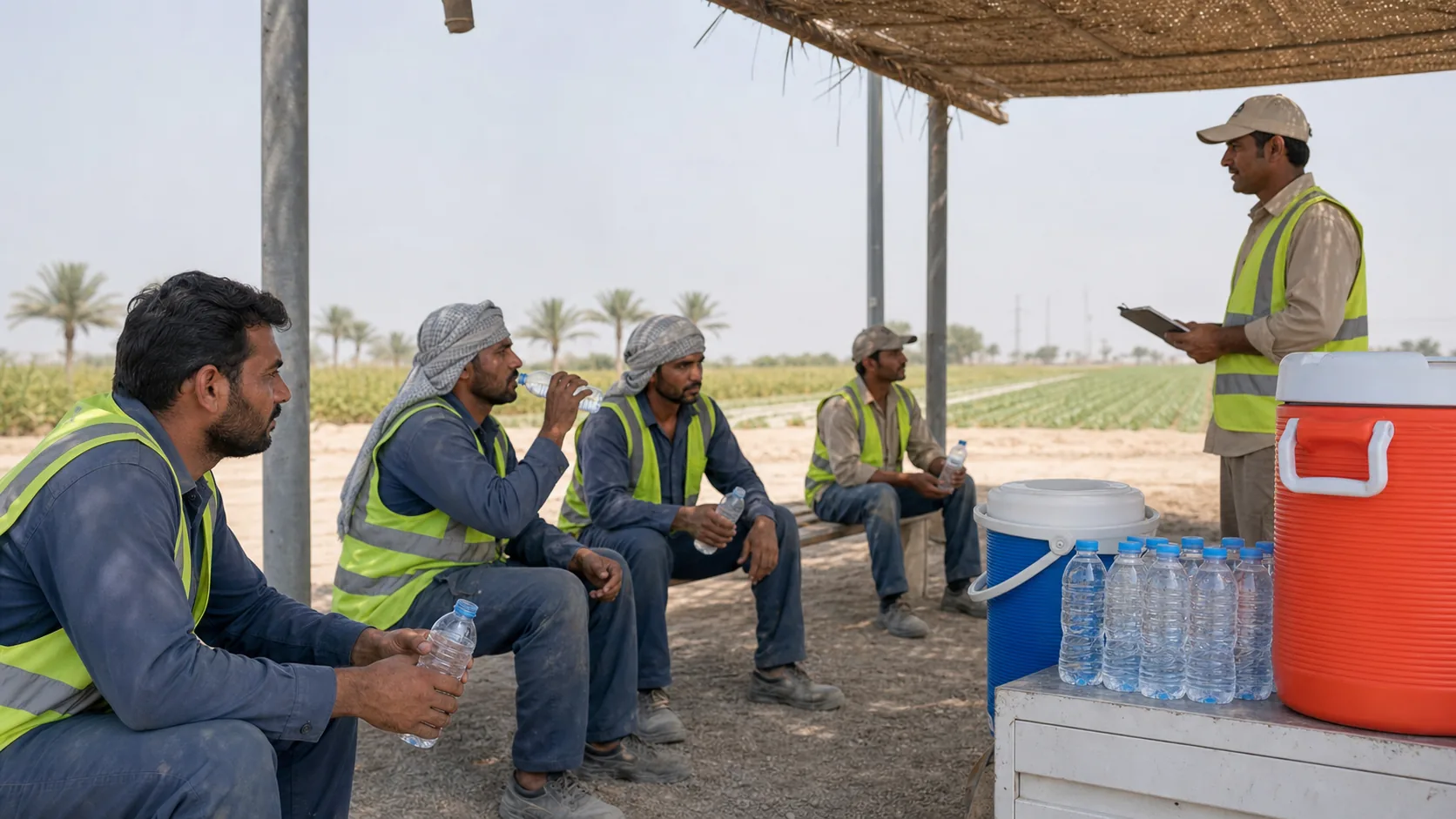
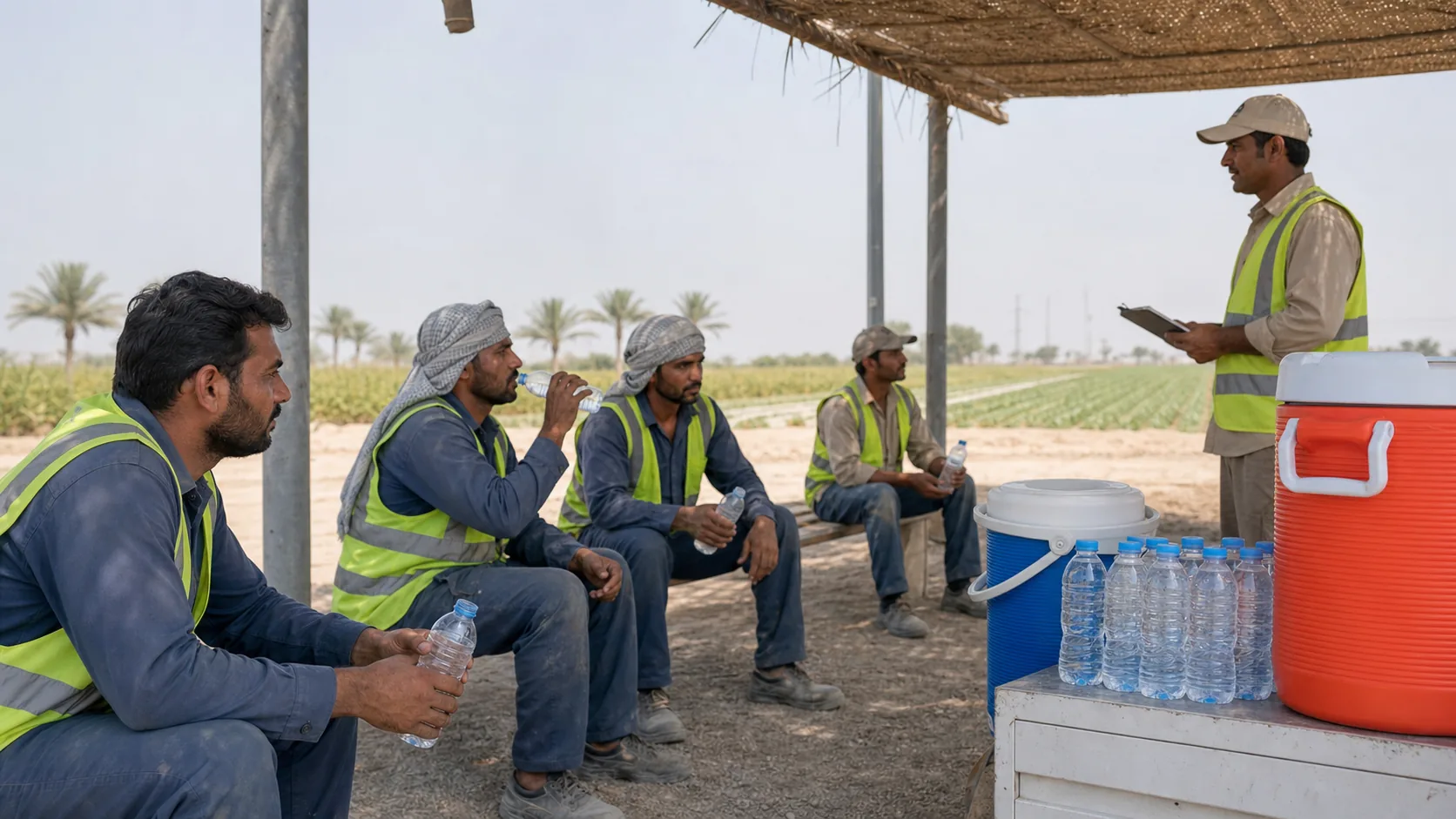
Hydration for Farm and Agricultural Workers in UAE & GCC
Agricultural workers in the GCC face uniquely intense <a href="/tools/heat-stress-assessment">heat stress</a>, yet their hydration needs are often overlooked compared to more visible industrial sectors. This gap in attention creates significant occupational health risks.
The core exposure is relentless. Unlike workers in warehouses, offices, or enclosed facilities who can access shade or climate-controlled spaces, farm workers operate in direct sunlight for extended periods—often 8–12 hours per day during peak seasons. There is no escape to cooler environments; the work itself requires continuous presence in the field.
The physical demands are substantial. Agricultural work is manually intensive—planting, harvesting, weeding, hauling, tending—involving sustained physical effort that generates high metabolic heat. A worker doesn't simply experience ambient temperature; they experience the combination of direct solar radiation, reflected heat from soil and crops, and internal heat generated by physical labour.
Infrastructure limitations compound the problem. Unlike urban industrial worksites with established hydration stations and facilities, many farms operate in remote or semi-remote settings with limited access to water, shade structures, or rest facilities. A worker may be hours from the nearest shelter. This physical separation makes regular hydration—critical in heat—logistically difficult.
Seasonal intensity adds urgency. The primary harvest seasons (spring and autumn in the GCC) coincide with warmer periods. Demand for labour peaks precisely when heat stress is highest. A farmer cannot postpone harvest because workers are dehydrated; the work must proceed, often with labour pushing through early-stage heat stress symptoms.
Workforce characteristics amplify vulnerability. Many farm workers are migrant workers with limited health literacy, variable acclimatisation to GCC heat, and potential hesitance to report heat stress symptoms if they fear consequences. Farm management may not recognise or prioritise heat stress as formally as larger industrial operations.
How the GCC Climate Compounds the Risk
The GCC climate creates conditions that far exceed typical occupational heat stress scenarios found elsewhere.
From April through October, temperatures across much of the region regularly exceed 40°C, with many areas experiencing 45°C+ during peak months (June through August). This is not brief temperature fluctuation; it is sustained ambient heat persisting throughout the working day. In direct sunlight, surface temperatures of soil, crops, and equipment can reach 60–70°C.
Humidity adds complexity. Coastal regions and areas near water sources experience high humidity alongside high temperature, which severely reduces the body's ability to cool through evaporation. A worker sweating profusely cannot shed heat effectively when the air is already moisture-saturated. This combination of heat and humidity is more physiologically taxing than dry heat of equivalent temperature.
Dust and air quality create secondary stressors. Dust from arid soil can impair respiratory function and reduce fluid intake (workers reduce drinking to avoid dust inhalation), creating a feedback loop of inadequate hydration. Air quality variability across seasons affects worker stress levels.
The GCC agricultural season is fixed by climate and crop calendars. Farmers cannot alter the season to avoid peak heat; the work schedule is determined by biological and market factors. This means the most physically demanding agricultural periods (planting and harvest) often coincide with the highest heat stress periods.
What Happens to the Body During Agricultural Work in the Heat
To understand why agricultural workers need structured hydration support, it helps to understand the physiological cascade occurring during extended physical work in GCC heat.
As ambient temperature and solar radiation increase, the body compensates by increasing sweat production. This is the primary cooling mechanism—evaporative cooling of sweat draws heat from the skin. However, during sustained agricultural work in GCC conditions, sweat production can reach 1–2 litres per hour. This is not simply water loss; it is loss of water, sodium, potassium, and other essential minerals.
If workers drink only water—even large quantities—they replace fluid volume but not electrolytes. Progressive electrolyte depletion impairs the body's ability to retain fluid and maintain proper cellular function. Muscle cramps, weakness, and reduced work capacity emerge. A worker may drink extensively yet still experience progressive fatigue and performance decline because electrolyte balance is disrupted.
Over hours, cumulative fluid loss leads to dehydration. The body's blood volume decreases, making it harder to circulate blood to both working muscles and the skin's surface (where heat dissipation occurs). Core temperature rises. Cognitive function declines—concentration falters, decision-making slows, attention drifts. Physical performance degrades—strength drops, coordination becomes clumsy, movements slow.
If a worker ignores these early signs and continues working, heat stress escalates. Heat exhaustion emerges (dizziness, nausea, weakness, confusion). In severe cases, heat stroke develops—a medical emergency characterised by core temperature exceeding 40°C and loss of consciousness. Heat stroke is a life-threatening condition requiring immediate medical intervention.
For farm managers, the practical implication is clear: early intervention through proactive hydration and rest prevents these progressions. Learn more about how hydration supports physical and cognitive performance in our guide to why hydration matters for outdoor workers.
Practical Hydration Guidance for Field Workers
Effective hydration for farm workers is straightforward but requires structure and clarity.
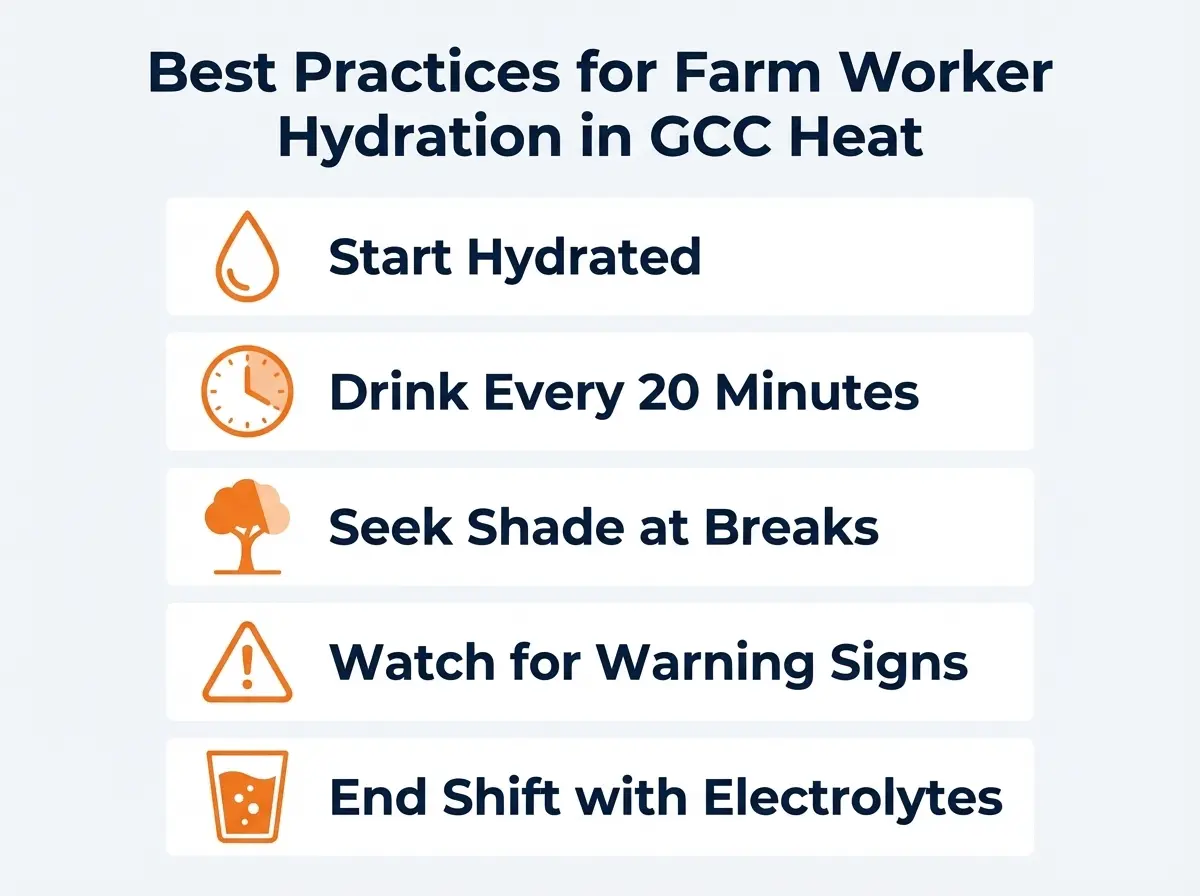
Drinking schedule: Rather than relying on thirst (which is an unreliable indicator once dehydration begins), implement a proactive drinking schedule. Workers should drink approximately 200–300 mL (a standard glass) every 20–30 minutes during active work in warm conditions. This may seem frequent, but it matches the physiological fluid loss during sustained outdoor labour in GCC heat. Supervisors should monitor and remind workers to drink on schedule.
Early morning starts: Begin work as early as feasible in cooler morning hours. Starting at 5–6 AM rather than 8–9 AM captures 2–3 hours of cooler working conditions, reducing cumulative heat exposure. Workers can complete more work in safer thermal conditions and rest during the hottest afternoon hours.
Shade and rest protocols: Build formal rest periods into the work schedule, not as informal breaks but as structured pauses. During these breaks (typically 30–60 minutes mid-morning and afternoon), workers should rest in genuinely shaded areas (not just partial shade). Provide water and electrolyte drinks. The goal is for core body temperature to recover, not simply to pause work. Without genuine shade, rest periods provide limited thermal benefit.
Hydration before, during, and after: Workers should start the day well-hydrated (drink water or electrolyte drink 30–60 minutes before starting). During the work day, maintain regular fluid intake on schedule. After the shift, continue drinking—rehydration continues after work ends, particularly after intense or extended shifts.
How Farm Managers Can Implement a Hydration Programme
Building a hydration programme for your farm operation requires modest investment and clear communication but yields substantial benefits in worker safety, productivity, and retention.
Portable hydration stations: Do not rely on workers to provide their own water. Establish portable hydration stations positioned throughout working areas. These can be as simple as coolers with water and electrolyte drinks, positioned at regular intervals. Ensure sufficient quantity—station runs should not create bottlenecks or delays. Position stations at natural break points and at the start and end of major work areas.
Bulk supply logistics: Source hydration drinks in bulk from suppliers who can reliably deliver to your farm. Establish a rotation system to ensure fresh supplies. If implementing electrolyte drinks, provide clear guidance to workers about when to use them (during extended physical work and peak heat periods) versus water (lighter activities and cooler periods).
Worker training and communication: Explain to workers why hydration matters—not as an abstract safety requirement but as practical support for their performance, comfort, and health. Workers who understand the benefit hydrate more consistently. Communicate in workers' primary languages. Emphasise that hydration is your responsibility as a farm manager to provide, not the worker's obligation to seek out.
Language and cultural considerations: If your workforce includes workers for whom Arabic or English are not primary languages, communicate hydration guidance in accessible ways—simple visual reminders, verbal briefings in workers' languages, demonstrations by supervisors. Ensure cultural practices (e.g., specific preferences regarding types of drinks or timing of fluid intake) are accommodated where feasible.
Monitor and adjust: Observe worker hydration practices during work. If workers seem reluctant to drink, investigate—perhaps the station is inconveniently located, water temperature is unacceptable, or workers are concerned about time away from tasks. Adjust based on feedback. Track any heat-related incidents and adjust hydration protocols to prevent recurrence.
FAQ
Q: How much should a farm worker drink per hour in GCC heat?
A: During physical agricultural work in GCC conditions (April–October), workers should consume approximately 600–900 mL (roughly 3 glasses) per hour, distributed as 200–300 mL every 20–30 minutes rather than in one large intake. This matches typical sweat rates during sustained outdoor labour. Exact amounts vary based on individual factors (body size, fitness, acclimatisation), environmental conditions (temperature, humidity, sun exposure), and work intensity. The key principle is regular, consistent fluid intake rather than calculating exact volumes. Supervisors should establish a drinking schedule and monitor compliance.
Q: What are early heat stress signs to watch for in field workers?
A: Early signs include excessive sweating, flushed or pale skin, dizziness or light-headedness, nausea, reduced coordination, and behavioural changes (confusion, irritability, uncharacteristic slowness, reduced responsiveness). If a worker displays these signs, move them to shade immediately, provide cool water or electrolyte drink, and allow extended rest. If symptoms worsen (confusion increases, worker loses consciousness, or symptoms don't improve with rest and fluids), seek immediate medical help. Do not push workers to continue after displaying heat stress symptoms. Early intervention prevents escalation to heat exhaustion or heat stroke.
Q: Are electrolyte drinks better than water for outdoor physical labour?
A: For brief outdoor activity or light work, water is adequate. For sustained physical labour extending 2+ hours in hot conditions—typical of agricultural work in the GCC—electrolyte drinks are more effective than water alone. Electrolyte drinks replace not only fluid but also sodium and potassium lost through sweat, supporting more complete rehydration and maintaining performance over extended periods. Workers undertaking intensive agricultural labour (harvest, planting, hauling) in peak heat benefit from electrolyte drinks. For workers in lighter roles or cooler periods, water is sufficient. Providing both options allows workers to choose appropriately based on their specific activity and conditions.
Bulk Hydration for Your Farm or Agri-Business
If you manage a farm, agricultural cooperative, or agri-business operation in the UAE or broader GCC, implementing a hydration programme is a practical, evidence-supported investment in worker safety and operational performance.
Hydralyte supplies hydration drinks designed for outdoor and agricultural environments—practical, cost-effective when purchased in bulk, and formulated to support workers undertaking sustained physical effort in warm conditions. Browse our product range at /shop, or contact our team to discuss bulk supply options tailored to your farm size, worker numbers, and seasonal demand at /contactus.
Whether you manage a small family farm, a commercial agricultural operation, or an agri-business cooperative, we're here to support your worker hydration and wellbeing programme.
Disclaimer: This article is for informational purposes only and does not constitute medical advice. Consult a healthcare professional for personalised guidance.
External Citation: Food and Agriculture Organization (FAO) – Heat Stress and Agricultural Workers. Available at: https://www.fao.org/documents/card/en/c/CA10205EN/
🏗 Protecting Outdoor Workers? Hydralyte supplies bulk electrolyte programs for construction, oil & gas, logistics, and manufacturing companies across the GCC — with full MoHRE compliance documentation. See Industry Hydration Programs →