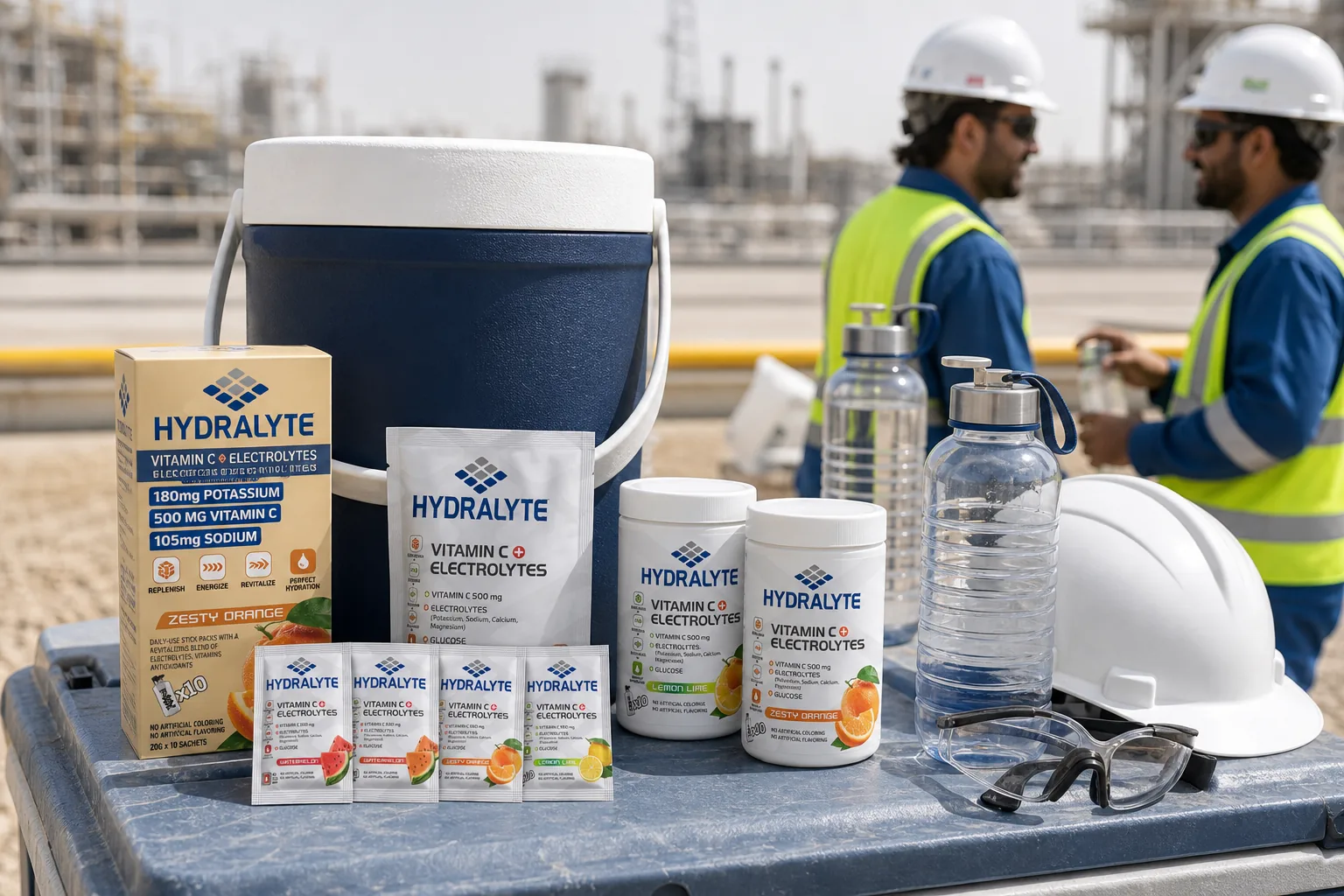
Hydration for Oil & Gas Workers in the Gulf: Heat, Humidity, and Performance
Working in oil and gas operations across the Gulf presents one of the most demanding hydration environments in the world. Unlike standard industrial or outdoor roles, petroleum sector workers face a convergence of extreme factors that create exceptional physiological stress.
The primary challenge is compound heat exposure. Ambient temperatures across onshore oil fields, refineries, and processing plants in the Gulf regularly exceed 45°C during peak summer (May through September). Equipment itself—compressors, furnaces, hot pipes, and process systems—generates additional thermal load that can push localised temperatures well above ambient. A worker standing near an active manifold or working on exposed pipework is not simply exposed to 45°C air; they're exposed to radiant heat from equipment that may be operating at 70°C or higher.
Humidity amplifies this stress. Coastal regions and offshore platforms experience high humidity alongside high temperature, reducing the body's ability to cool through evaporative sweating. A worker in full flame-resistant PPE (coveralls, gloves, hard hat, often with face shield) cannot evaporate sweat efficiently. The protective equipment, essential for safety, becomes a thermal insulator.
Long work rotations compound the problem. Many Gulf oil and gas operations run 12-hour shifts, with some roles involving sustained physical effort—valve maintenance, pipe assembly, equipment inspection, manual labour on rigs. The combination of heat, equipment hazards, extended duration, and psychological demands of safety-critical work creates a uniquely demanding hydration scenario.
Offshore and remote operations add isolation factors. Workers on platforms or in remote desert facilities may have limited access to hydration stations and medical support. Dehydration in these settings carries elevated risk.
How Heat and Dehydration Affect Cognitive and Physical Performance
In oil and gas operations, the consequences of dehydration extend beyond discomfort. <a href="/tools/heat-stress-assessment">Heat stress</a> and dehydration directly impair the cognitive and physical performance required for safety-critical work.
The oil and gas sector is inherently hazardous. Workers operate complex equipment, manage high-pressure systems, follow strict safety protocols, and respond to emerging hazards. These roles demand sustained attention, rapid decision-making, and precise motor control. Dehydration undermines all three.
Research on occupational heat stress shows that dehydration progressively reduces cognitive function. Mental fatigue, reduced concentration, slower reaction times, and impaired judgment—the exact opposite of what safety-critical work demands—emerge at dehydration levels that workers may not consciously recognise. A supervisor making a critical decision about equipment operation, a technician diagnosing a system fault, or a rig worker responding to an unexpected situation—all face degraded cognitive performance when dehydrated.
Physical performance suffers equally. Muscle strength and endurance decline with fluid loss, meaning workers tire more quickly during physically demanding tasks. This combination—cognitive impairment plus physical fatigue—creates compounding safety risks. An already hazardous environment becomes significantly more dangerous.
For HSE teams and operators across the Gulf, the equation is straightforward: hydration directly supports safety-critical performance. Learn more about the relationship between hydration and cognitive function in our guide to why hydration matters for industrial workers.
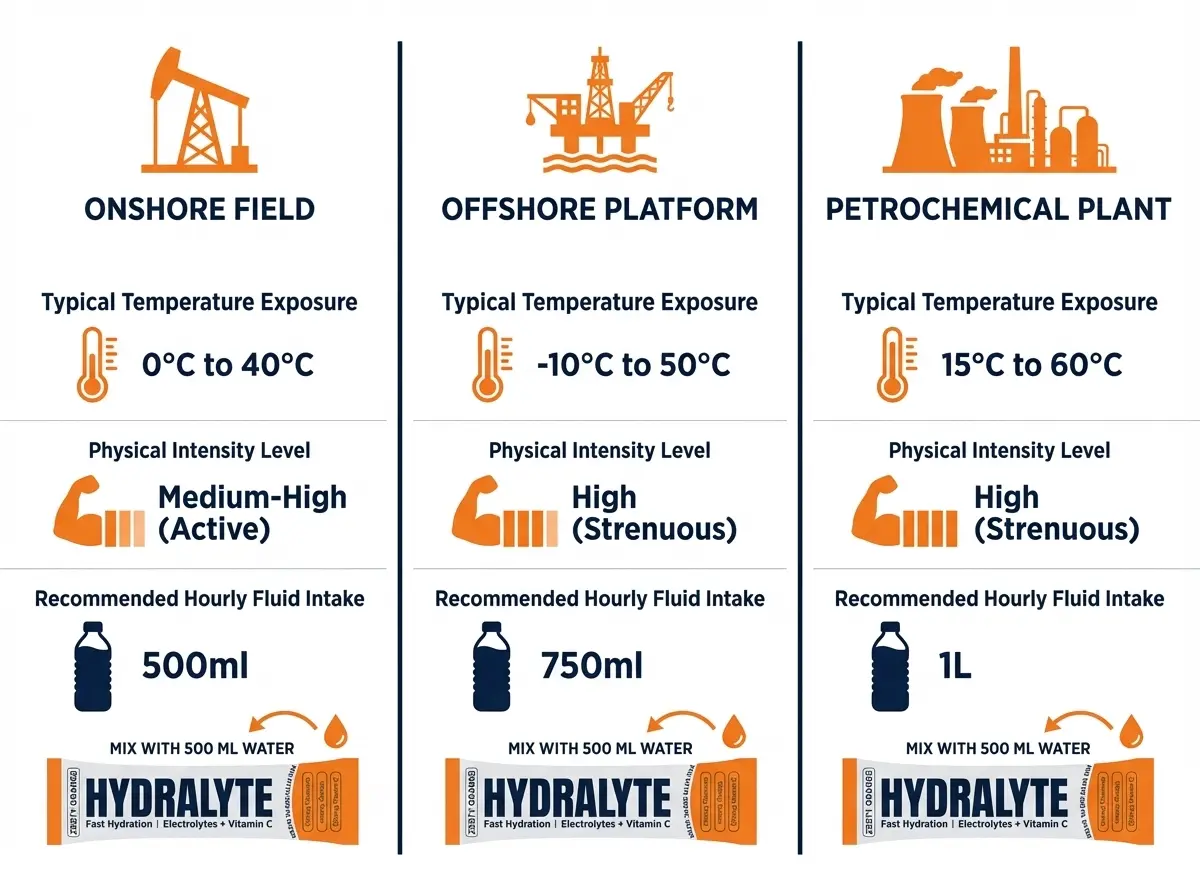
Hydration Requirements by Role
Oil and gas operations span diverse environments and roles, each with distinct hydration demands. A one-size-fits-all approach fails to address these variations.
Onshore field operations: Workers on onshore fields, processing facilities, and drilling sites face direct sun, ambient heat, and equipment-generated thermal stress. Physical roles (equipment maintenance, manual assembly, pipeline work) involve sustained effort. Recommended fluid intake: 300–400 mL every 20–30 minutes during active work in peak summer. Electrolyte replacement is important due to high sweat rates and extended shifts.
Offshore platforms: Offshore workers face extreme conditions: high ambient temperature combined with high humidity, limited ability to escape to cooler areas, extended 12-hour shifts, and psychological stress from isolation. PPE requirements remain full. Physical intensity varies by role but often includes maintenance and manual labour. Recommended fluid intake: 250–350 mL every 20–30 minutes. Electrolyte drinks are critical due to sustained sweating in high-humidity environments and longer duration between adequate rest periods.
Petrochemical and refinery plants: Workers in these facilities experience variable thermal stress depending on specific location within the plant. Some areas are air-conditioned or operate at lower temperature; others involve high-temperature processes. Physical demands vary from desk-based supervision to manual maintenance. These operations benefit from role-specific hydration planning. General guidance: 200–300 mL every 30–45 minutes for physical roles, adjusted for environmental temperature at the specific work location.
Across all roles, supervisors and HSE teams should assess individual worker needs based on the specific task, location, and seasonal conditions. Workers new to the Gulf environment should increase hydration intake during their acclimatisation period.
Electrolytes on the Job: Why Water Alone Is Insufficient for Heavy Sweating
In Gulf oil and gas operations, many workers and supervisors assume that water is sufficient for hydration during extended work in high heat. This assumption is incomplete.
During sustained physical work in high heat, particularly in humid environments, sweat rates can exceed 1–2 litres per hour. Sweat is not pure water—it contains dissolved minerals (electrolytes), primarily sodium and potassium. Drinking water alone replaces fluid volume but not the mineral content. Over extended shifts, this creates progressive electrolyte depletion.
Electrolyte depletion has direct physiological consequences. Sodium loss reduces the body's ability to retain fluid, meaning water alone becomes less effective at rehydrating cells. Potassium depletion affects muscle function and contributes to fatigue and cramping. These effects emerge progressively during longer shifts, meaning a worker may feel fine at hour 4 but experience significant performance degradation by hour 10.
For oil and gas workers undertaking 12-hour rotations with significant physical effort and heat exposure, electrolyte-containing drinks are not optional add-ons—they're a necessary component of effective hydration strategy. Water supports hydration during short activities or lower-intensity work; electrolyte drinks support complete rehydration during extended operations in the Gulf's demanding thermal environment.
Building a Site-Wide Hydration Programme
Effective hydration in oil and gas operations requires structured, site-wide commitment. Hydration cannot be an incidental aspect of operations—it must be integrated into HSE policy and daily practice.
HSE policy integration: Formalise hydration as part of your site HSE policy. Define minimum hydration standards for different roles and environments, set expectations for supervisor monitoring, and establish protocols for recognising and responding to heat stress signs. Include hydration in pre-shift briefings, toolbox talks, and incident investigations when dehydration may have been a contributing factor.
Hydration station placement: Position stations at strategic locations—near work areas, rest zones, crew gathering points, and areas where access to water would otherwise require significant travel time. On large sites, multiple stations reduce the time workers spend away from their roles. Ensure sufficient capacity to serve shift populations without running low mid-shift.
Rotation and rest schedules: Build hydration breaks into formal rotation schedules. Workers required to drink on a schedule are more likely to stay hydrated than those relying on ad hoc breaks. For extended rotations, schedule work intensity such that maximum physical effort occurs during cooler periods (early morning or night shifts for onshore; consider internal scheduling for offshore). Provide genuinely cool rest areas—not just shade, but air-conditioned or ventilated spaces—where workers can recover.
Monitoring and accountability: Assign supervisors to monitor hydration compliance and worker appearance (early signs of heat stress include flushing, reduced sweating, confusion). Track hydration station usage and adjust supplies based on demand. Include hydration metrics in HSE performance monitoring and crew briefings.
FAQ
Q: How much should an oil field worker drink during a 12-hour shift?
A: During a 12-hour shift with moderate to high physical activity in Gulf heat, workers should consume approximately 3–5 litres of fluid total, which translates to 250–400 mL every 20–30 minutes during active work periods and less during lower-intensity or rest periods. Exact amounts depend on individual factors (body size, acclimatisation, specific activity), environmental conditions (temperature, humidity, equipment proximity), and PPE type. Supervisors should encourage consistent drinking rather than calculating exact volumes. If workers are working extended periods, consider incorporating scheduled rest periods with fluid intake to maintain performance.
Q: Can dehydration affect safety-critical decision making?
A: Yes, significantly. Dehydration impairs cognitive function—concentration, reaction time, and judgment—all essential for safety-critical work in oil and gas. A dehydrated supervisor approving equipment operation, a dehydrated technician diagnosing a system, or a dehydrated worker responding to an emergency faces degraded decision-making capacity. In an inherently hazardous industry, this is not a minor concern. Maintaining hydration is part of maintaining the cognitive capacity required for safe operations.
Q: How do electrolytes compare to water for workers in full PPE?
A: Water hydrates but does not replace minerals lost through sweat. For workers in full PPE undertaking 8+ hours of work in high heat and humidity, electrolyte drinks are more effective than water alone at supporting complete rehydration and maintaining performance. Water is useful for shorter activities or lower-intensity work; electrolyte drinks are necessary for extended operations where sweat loss (and electrolyte loss) is substantial. Workers should have access to both water and electrolyte options, with guidance to choose electrolyte drinks for longer, more intense work periods.
Supply Hydration for Your Operations
Managing hydration for oil and gas operations across the Gulf requires reliable, scalable supply. Whether you operate onshore fields, offshore platforms, or processing facilities, integrating effective hydration into your HSE programme is both a safety priority and an operational investment.
Hydralyte supplies hydration drinks specifically formulated for high-intensity industrial environments—practical, easy to distribute across sites, and designed to support workers undertaking sustained effort in Gulf heat conditions. Browse our product range at /shop, or contact our team to discuss bulk supply and site-specific hydration programmes at /contactus.
From onshore operations to offshore platforms, from processing plants to remote facilities, we support Gulf oil and gas operators in building hydration programmes that protect worker safety and support operational excellence.
Disclaimer: This article is for informational purposes only and does not constitute medical advice. Consult a healthcare professional for personalised guidance.
External Citation: International Labour Organization (ILO) – Occupational Safety and Health: Heat Stress in the Workplace. Available at: https://www.ilo.org/safework/areasofwork/heat-stress/lang--en/index.htm
🏗 Protecting Outdoor Workers? Hydralyte supplies bulk electrolyte programs for construction, oil & gas, logistics, and manufacturing companies across the GCC — with full MoHRE compliance documentation. See Industry Hydration Programs →