Addressing Delivery Rider <a href="/tools/heat-stress-assessment">Heat Stress</a> UAE: A Strategic Protection and Provision Guide
The rapid growth of the logistics and last-mile sector has placed thousands of individuals in high-risk environmental conditions, making delivery rider heat stress UAE a critical priority for platform operations managers. Unlike stationary outdoor roles, delivery riders face a unique set of physiological and environmental variables that accelerate dehydration and heat exhaustion. Implementing a robust electrolyte provision strategy is no longer a secondary consideration but a fundamental operational requirement to ensure workforce stability and safety during the extreme summer months.
The Impact of Cumulative Exposure on Delivery Rider Heat Stress UAE
The primary driver of delivery rider heat stress UAE is the relentless nature of the urban delivery cycle. Riders spend the entirety of their productive hours outdoors in direct sun, often without the scheduled shade breaks common in construction sectors. A significant factor is the safety helmet, which, while essential, traps substantial heat around the head and prevents efficient thermoregulation. Furthermore, riders frequently wear branded uniforms or protective jackets that add an insulating layer, while the motorcycles themselves generate engine heat. This environment is exacerbated by city heat reflected from asphalt roads and glass buildings. With multiple stops per hour, the constant transition from motion to standing in the sun means the body has minimal opportunity for recovery, leading to a dangerous accumulation of thermal stress.
Navigating the Gig Economy Duty of Care
The UAE delivery sector, dominated by major platforms like Talabat, Deliveroo, and Careem NOW, relies heavily on a gig economy model. While the legal classification of these workers differs from traditional employment, there is an intensifying national conversation regarding the moral and regulatory duty of care for platform workers. Operations managers must recognize that the welfare of riders is inextricably linked to platform performance and brand reputation. Proactive provision of Hydralyte sachets demonstrates a commitment to safety that aligns with evolving UAE labor standards. By supporting the health of the rider workforce, platforms mitigate the risks of transit accidents and service disruptions caused by heat-induced fatigue or medical emergencies.
The Depot Distribution Model for Practical Hydration
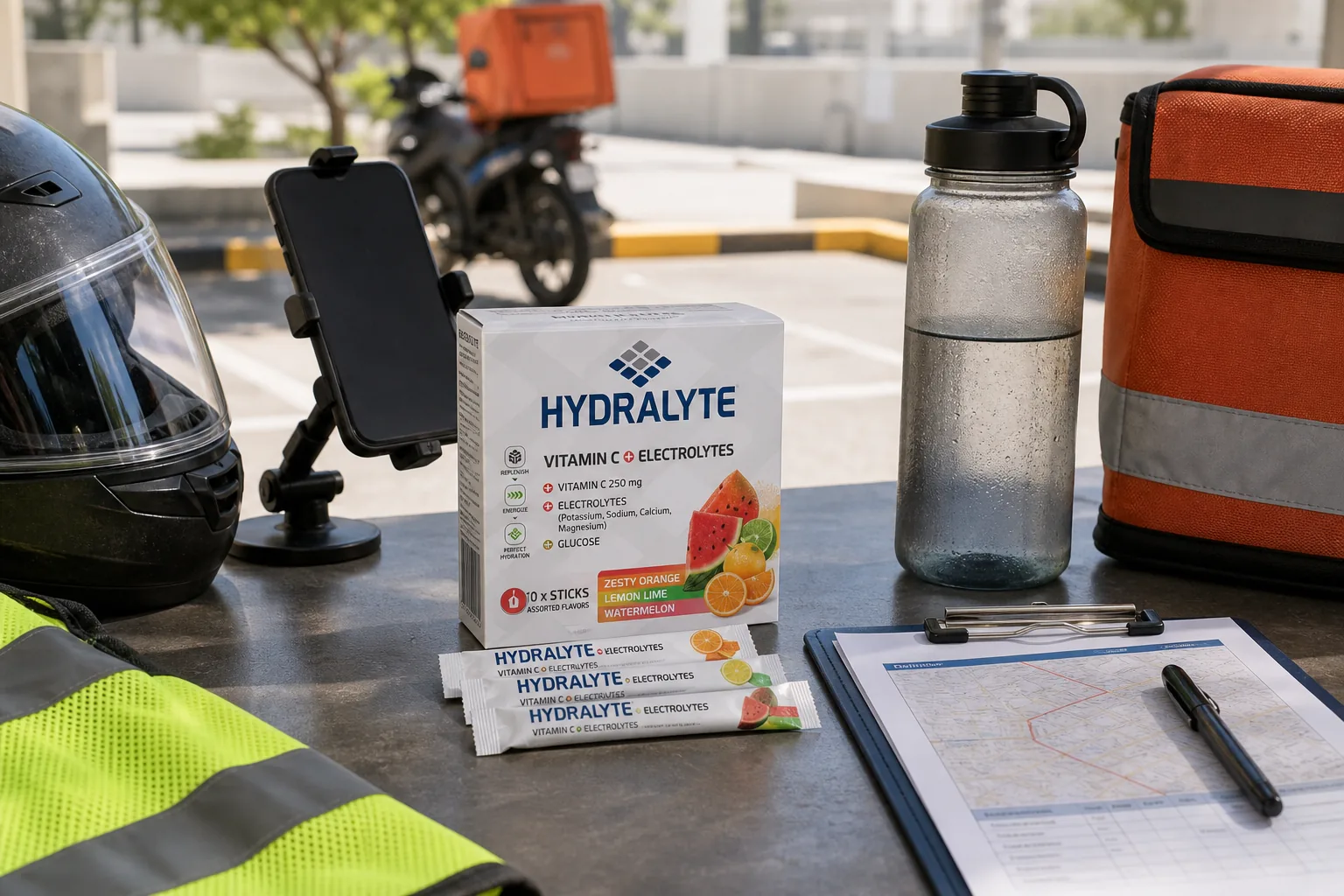
For large-scale logistics operators, the most efficient method for distributing electrolytes is the depot-based model. Since riders must frequently visit dark kitchens or collection depots to pick up orders, these locations serve as ideal touchpoints for hydration support. Establishing a sachet issue station at each depot allows for the seamless distribution of Hydralyte sachets without interrupting the delivery workflow. Issuing one sachet per rider during each visit or at the start of a shift ensures that every active individual has the means to maintain their electrolyte balance throughout the day. This portable format is more practical for the mobile nature of the job than bulk water stations, as riders can easily mix the formula into their personal water bottles during transit.
Understanding the Motorcycle Heat Factor and Physiological Risk
The mechanical and physical demands of riding present a compound risk for heat illness. Both motorcycles and bicycles generate heat—either through internal combustion engines or the physical exertion required for cycling—which contributes to a faster rise in core body temperature. When riders stop at traffic lights or for deliveries, they lose the cooling effect of wind resistance while remaining in full sun exposure. This creates a volatile internal environment where dehydration can set in rapidly. Utilizing Hydralyte stick packs as an alternative to standard sachets provides riders with a highly concentrated electrolyte solution that is specifically formulated for rapid rehydration. Ensuring consistent intake of these oral rehydration salts is the most effective way to protect riders against the debilitating effects of urban heat. For a tailored hydration program for your logistics workforce, visit our team at contact our team.
Frequently Asked Questions
Why are UAE delivery riders particularly vulnerable to heat illness compared to other outdoor workers?
Delivery riders have almost no shade access during their working hours — they ride between stops in direct UAE summer sun continuously. Helmets retain significant head heat. Many riders wear branded uniform jackets regardless of temperature. Unlike construction workers who rotate to shaded rest areas, riders are in motion in direct sun for their entire productive shift.
What is the most practical way for delivery platforms to provide Hydralyte to riders?
Depot-based issue is the most effective model: at each depot or dark kitchen collection point, a sachet issue station provides one Hydralyte sachet per rider per visit or per shift check-in. This integrates into the existing rider workflow without requiring a separate visit and ensures every active rider has a current personal supply.
Do UAE gig platform operators have MOHRE obligations for rider welfare?
UAE labor law obligations attach to employment relationships, which are differently structured for gig economy workers. However, responsible platform operators increasingly recognize a duty of care for rider welfare — and UAE regulators are progressively increasing oversight of platform worker welfare standards. Proactive electrolyte provision protects both riders and platforms.
The Hidden Heat Risk in Logistics Operations
Logistics and warehousing operations in the UAE face a dehydration risk that is often underestimated because much of the work happens inside structures. However, non-air-conditioned warehouses in the GCC routinely reach internal temperatures of 50°C or higher during summer months. Delivery vehicles parked in direct sun can exceed 60°C internally.
Forklift operators, pickers, packers, and delivery drivers all face sustained heat exposure without the cooling effects of wind movement. The physical demands of lifting, carrying, and loading compound the dehydration risk — these workers can lose 1–1.5 litres of sweat per hour during peak operations.
Positioning Hydralyte 200g jars at loading docks, break rooms, and vehicle staging areas ensures workers have access to proper electrolyte replacement throughout their shifts. For delivery drivers who spend extended periods away from base, individual Hydralyte sachets provide a portable solution that fits in a vehicle door pocket.
Shift-Based Hydration Planning for Warehouse Teams
Design your hydration program around shift patterns rather than fixed schedules. Night shift workers in non-AC facilities face cumulative heat that builds throughout the evening as warehouse structures radiate absorbed daytime heat. These workers often receive less hydration attention than day shift crews, despite facing comparable dehydration risks.
Provide Hydralyte at shift handovers and at each scheduled break. Track consumption — if a team consistently uses less than the recommended volume, it indicates either inadequate access or insufficient awareness training, both of which need addressing.
🏗 Protecting Outdoor Workers? Hydralyte supplies bulk electrolyte programs for construction, oil & gas, logistics, and manufacturing companies across the GCC — with full MoHRE compliance documentation. See Industry Hydration Programs →
🛒 Ready to try Hydralyte? Available in three refreshing flavours across multiple pack sizes — from individual sachets to 800g bulk pouches. Shop Hydralyte Online → or request a corporate quote.