Eliminating Dehydration and Workplace Accidents in the UAE: The Critical Safety Link
In the high-stakes environment of UAE construction and industrial sectors, safety protocols typically focus on physical barriers, fall protection, and machinery guards. However, cognitive impairment remains an invisible hazard and a primary driver of site incidents. Addressing dehydration-related workplace accidents in the UAE is a fundamental requirement for maintaining the mental acuity necessary for safety-critical operations.
The Science Connecting Dehydration to Accident Risk
Clinical research indicates that even mild dehydration leads to a significant decline in cognitive performance. Key risks include:
- Fluid loss of just 1-2% of body weight
- Measurable reduction in reaction time and working memory
- Decreased decision-making quality
- Lapses in judgment for crane operators, scaffolders, and forklift drivers
During the UAE summer, the rate of fluid and electrolyte loss is so aggressive that workers can reach this threshold of impairment within hours.
Analyzing the Pattern of Dehydration and Workplace Accidents in the UAE
Occupational health data reveals a consistent correlation between rising ambient temperatures and increased accident frequency. This pattern is driven by the dehydration-impairment mechanism:
- Neurological function slows as essential salts are lost through sweat
- Higher incidence of trips, falls, and equipment mishandling
- Human factors are the variables most sensitive to extreme heat
Hydralyte as a Tool for Cognitive Safety and Accident Prevention
Systematic provision of Hydralyte serves as a proactive defense. Unlike plain water, which can lead to hyponatremia during heavy exertion, Hydralyte restores the specific electrolyte balance required for optimal brain function. Implementation strategies include:
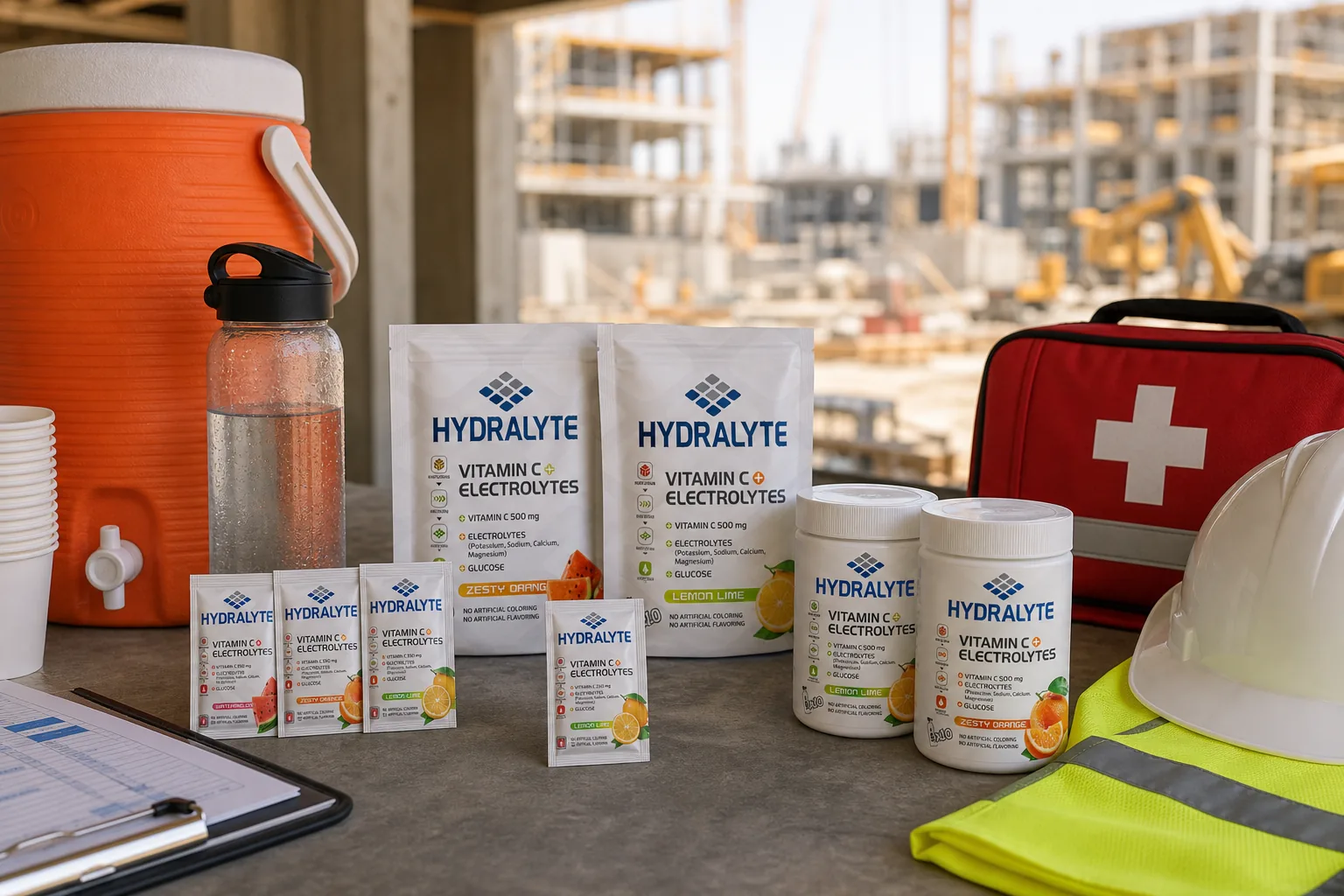
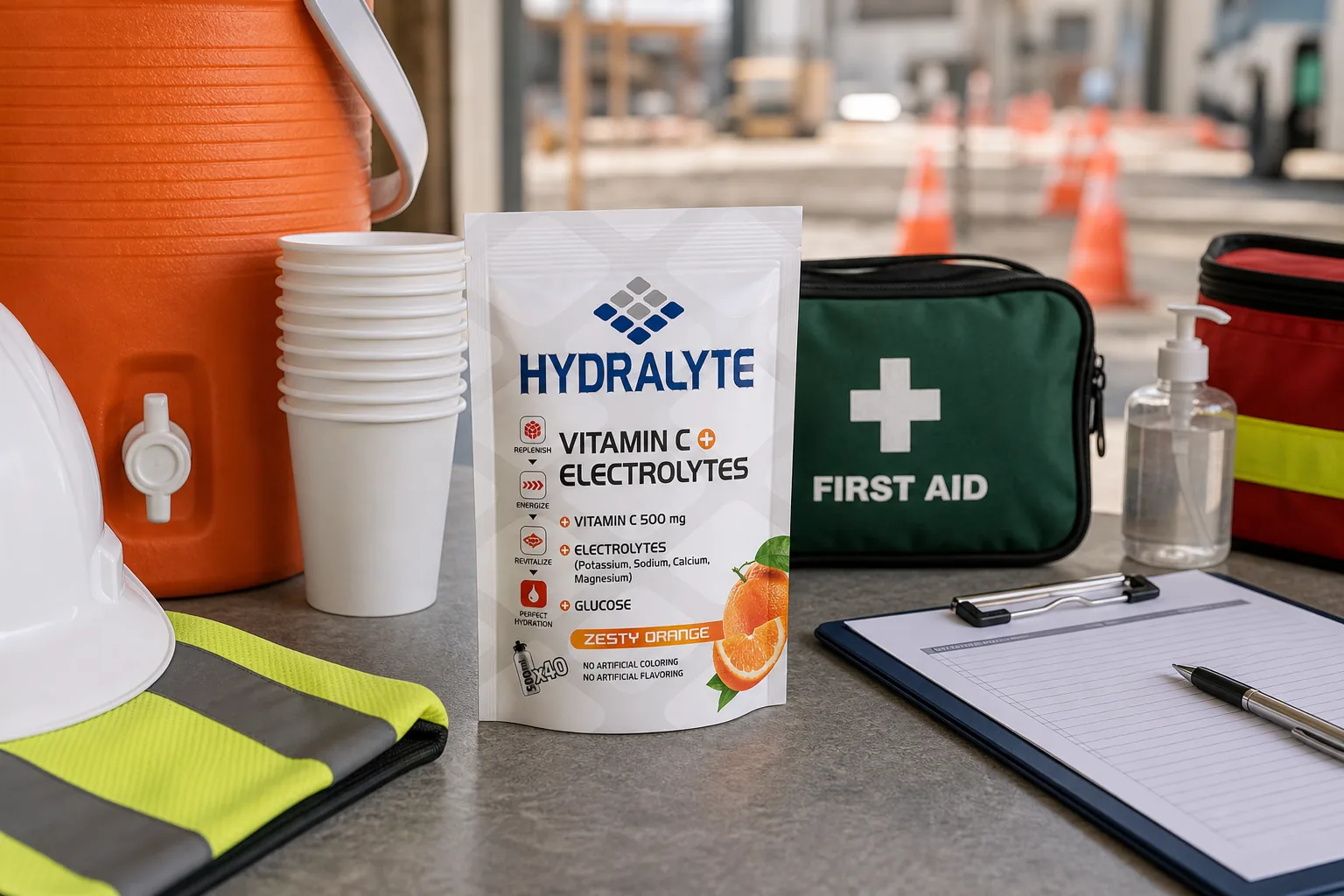
- Integrating Hydralyte 800g pouches into permanent welfare stations
- Providing portable sachets for workers in safety-critical roles
- Maintaining cognitive "uptime" for every operative on site
To implement a comprehensive cognitive safety program for your site, contact our team.
Recognising the Stages of Heat-Related Illness
Heat-related illness progresses through distinct stages, each requiring escalating intervention. Understanding these stages enables supervisors to intervene early — before a heat stress incident becomes a medical emergency.
- Stage 1 — Heat Cramps: Muscle spasms in legs, arms, or abdomen. Caused by electrolyte depletion. Intervention: Rest in shade, provide Hydralyte, stretch affected muscles.
- Stage 2 — Heat Exhaustion: Heavy sweating, weakness, cold/clammy skin, nausea, dizziness. Core temperature below 40°C. Intervention: Remove from heat immediately, cool actively, provide Hydralyte, monitor for 30 minutes.
- Stage 3 — Heat Stroke: Hot/dry skin, confusion, loss of consciousness, core temperature above 40°C. Medical emergency. Intervention: Call emergency services immediately, cool aggressively, do NOT give fluids if unconscious.
The critical window between heat exhaustion and heat stroke can be as short as 15–30 minutes. Proactive electrolyte hydration with Hydralyte throughout the workday prevents workers from ever reaching Stage 1.
Building a Site-Level Heat Stress Response Plan
Every outdoor work site in the UAE should have a documented heat stress response plan that includes: designated cool-down zones within 50m of work areas, trained first aiders on every shift, emergency cooling equipment (ice packs, misting fans), and pre-positioned Hydralyte electrolyte stocks at every welfare station and first aid point.
Train all workers — not just supervisors — to recognise heat stress symptoms in colleagues. Buddy-system monitoring is one of the most effective early warning mechanisms, especially during peak heat hours. Ensure your plan includes MoHRE compliance documentation requirements.
Frequently Asked Questions
Q: Does dehydration cause workplace accidents on UAE construction sites?
A: Yes. Dehydration of 1-2% body weight measurably slows reaction time. Workers operating heavy machinery in the UAE summer face a statistically higher accident risk than fully hydrated workers.
Q: How does heat stress increase accident risk beyond direct heat illness?
A: Heat stress triggers a dangerous cycle:
- Dehydration leads to cognitive impairment
- Reduced attention to safety protocols
- Increased distraction and irritability
Q: How can UAE employers frame Hydralyte provision as a safety investment?
A: Present the accident cost data: the cost of a single UAE construction accident investigation and recovery significantly exceeds the annual cost of a Hydralyte program. Position electrolyte provision as essential cognitive safety maintenance.
🛒 Ready to try Hydralyte? Available in three refreshing flavours across multiple pack sizes — from individual sachets to 800g bulk pouches. Shop Hydralyte Online → or request a corporate quote.
The Financial Impact of Dehydration-Related Incidents
The cost of a single dehydration-related workplace accident in the UAE extends far beyond the immediate medical expenses. A comprehensive cost analysis includes: emergency medical response (AED 15,000–50,000), investigation and reporting costs (AED 10,000–25,000), lost working days for the affected worker and witnesses, project delays while safety reviews are conducted, and potential MoHRE penalties of up to AED 50,000.
For a mid-sized construction company operating in Dubai, the annual cost of preventable dehydration incidents can reach AED 500,000–1,000,000 — ten to twenty times the cost of implementing a comprehensive Hydralyte workforce hydration program.
Progressive employers are now treating electrolyte provision not as a welfare cost but as a safety investment with measurable ROI. Use the Hydralyte Cost Calculator to model the return for your specific workforce size and risk profile.
Why Proactive Hydration Outperforms Reactive Treatment
The fundamental shift in modern occupational health is from reactive treatment to proactive prevention. Traditional approaches wait for dehydration symptoms to appear before intervening — by which point cognitive impairment, reduced coordination, and heat illness risk are already elevated.
Proactive hydration with Hydralyte maintains electrolyte balance throughout the workday, preventing the dehydration-impairment cascade from ever beginning. This is particularly critical in the UAE where ambient conditions can cause 1–2% body weight fluid loss within 60–90 minutes of outdoor work.
The economic case is equally compelling. Proactive electrolyte provision costs approximately AED 2–4 per worker per day. A single heat-related medical incident costs AED 20,000–50,000. A single MoHRE fine costs AED 5,000 per worker. The mathematics overwhelmingly favour prevention — and every employer who runs the numbers through the Hydralyte ROI Calculator reaches the same conclusion.