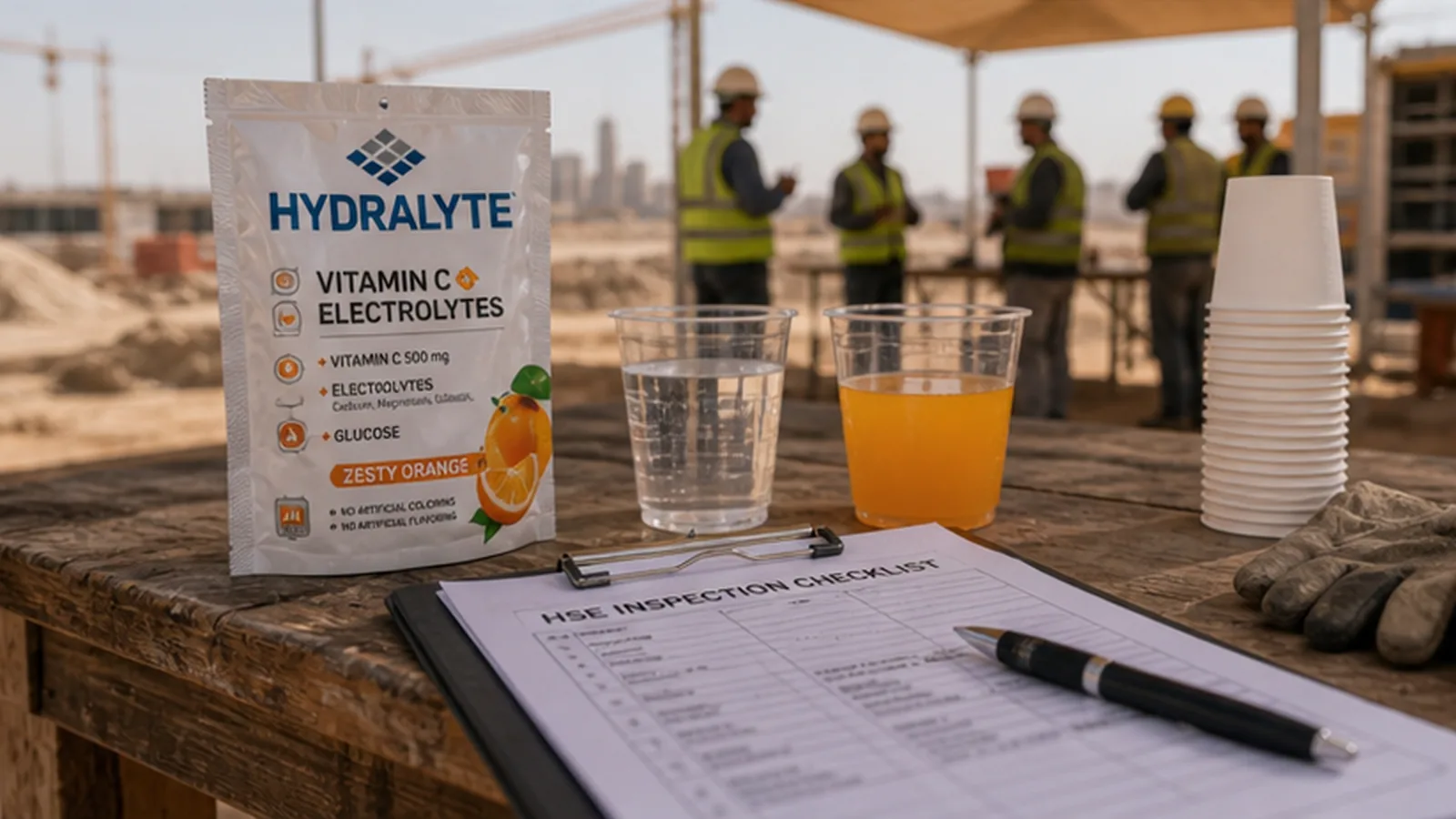
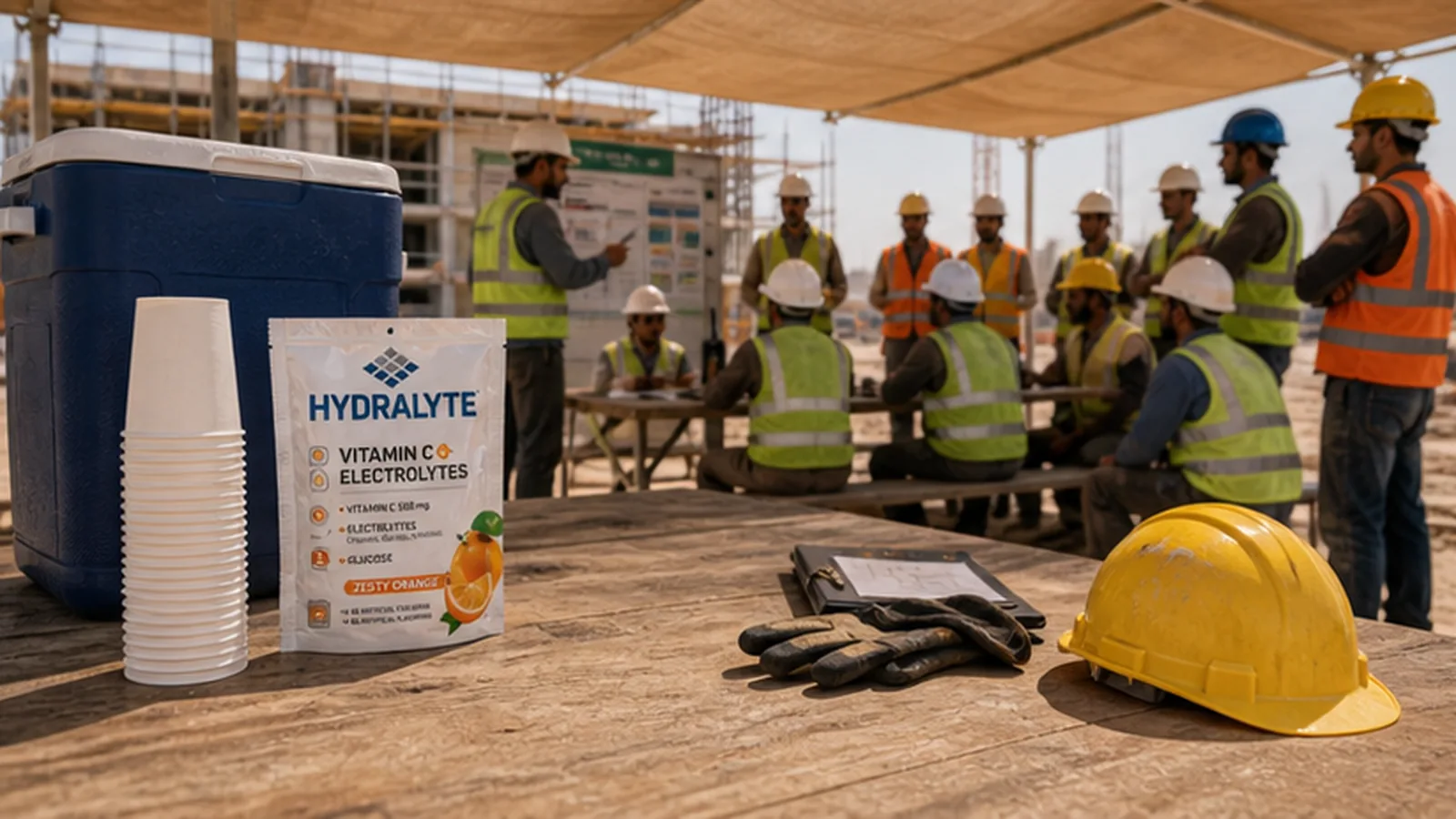
Hydralyte for HSE Managers UAE — Complete Operational Guide
For any large-scale industrial project in the Emirates, the onboarding process is the most critical window for risk mitigation. Statistical data show that a significant proportion of heat-related incidents occurs during a worker's first days or weeks on-site, often before full acclimatization has occurred.
Integrating UAE construction worker induction heat stress training into the standard onboarding flow is a foundational safety requirement for protecting new arrivals and ensuring site-wide compliance with federal labor standards.
Core Components of a Heat and Hydration Induction
Every new worker must receive a dedicated 10-15 minute heat safety induction before their first outdoor shift. To ensure absolute comprehension, the briefing must cover:
- Language Access: Delivery in the worker's primary language using visual aids.
- Facility Access: How to locate and use the site welfare station.
- Hydration Schedule: Specific serving intervals and timing throughout the shift.
- Product Preparation: How to mix Hydralyte 800g pouches and identify the correct serving size.
- Symptom Recognition: Identifying early symptoms of heat stress to report to supervisors.
- Acclimatization: The mandatory two-week schedule for all new starters.
- Emergency Response: Site-specific procedures for heat-related medical emergencies.
The Impact of the Day 1 Personal Hydralyte Kit
Issuing a physical, personal Hydralyte kit transforms hydration from a verbal instruction into a tangible reality. Key benefits include:
- Immediate Access: Providing 4-5 individually sealed sachets or stick packs ensures rapid rehydration before workers navigate large site layouts.
- Native Instructions: Inclusion of a mixing instruction card in the worker’s native language.
- Demonstrated Commitment: Shows a serious investment in worker welfare from the first hour.
- Improved Compliance: Workers with physical assets are significantly more likely to follow the established hydration schedule.
Mandatory Documentation for MOHRE Compliance
To satisfy regulatory inspections, induction training must be documented with the same rigor as technical training. For robust MOHRE-compliant records, each file must include:
- Worker Identity: Full name and site ID.
- Training Date: The exact date the briefing was delivered.
- Topic Checklist: Verification of coverage for acclimatization and electrolyte mixing.
- Verification: The worker’s signature confirming receipt of training and the personal sachet kit.
Maintaining these records in a centralized compliance binder allows site managers to demonstrate a proactive duty of care during MOHRE audits.
To implement a comprehensive heat safety induction program for your construction site, contact our team.
Choosing the Right Hydralyte Format for Your Needs
Hydralyte is available in four pack sizes, each designed for different use cases:
- 10g Sachet (makes 250ml) — Ideal for individual carry in PPE pockets, gym bags, or travel. One sachet per serve.
- 20g Sachet (makes 500ml) — The most popular format for individual daily hydration. One sachet makes a standard water bottle serving.
- 200g Jar (makes 5 litres) — Perfect for home use, small office teams, or supplementing welfare station supply.
- 800g Pouch (makes 20 litres) — Designed for welfare station bulk mixing on construction sites, warehouses, and industrial facilities.
All four formats are available in three flavours: Orange Blast, Lemon Lime, and Pineapple. Each serve delivers the same potassium-rich, low-sodium isotonic formula with 500mg Vitamin C for immune support.
Explore the full range at Hydralyte Online Shop or request bulk pricing for corporate orders.
Frequently Asked Questions
Q: What heat safety topics must be covered in a UAE construction worker induction?
A MOHRE-aligned induction must cover:
- Accessing welfare stations and the serving schedule.
- Recognizing early heat illness symptoms.
- The two-week acclimatization protocol.
- Reporting procedures and emergency protocols.
Q: Should every new UAE construction worker receive a personal Hydralyte kit at induction?
Yes. Providing 4-5 sachets and a mixing card on Day 1 is a best practice that ensures workers engage with the hydration program immediately, rather than waiting to visit a welfare station.
Q: How should UAE employers document heat and hydration induction for MOHRE compliance?
Records should capture the worker’s name and ID, start date, a checklist of safety topics, the trainer's name, and a confirmation signature. These should be stored in a heat stress compliance binder.
🛒 Ready to try Hydralyte? Available in three refreshing flavours across multiple pack sizes — from individual sachets to 800g bulk pouches. Shop Hydralyte Online → or request a corporate quote.
Operational Excellence: Integrating Hydralyte into Your HSE System
For HSE managers, electrolyte provision should be integrated into the broader occupational health management system rather than treated as an isolated welfare item. This means:
- Risk Assessment Integration: Include dehydration risk in your site-specific risk assessments. Document heat exposure levels by work zone and role, and map electrolyte provision requirements accordingly.
- KPI Tracking: Monitor electrolyte consumption rates per worker per day. Declining consumption may indicate access problems or worker reluctance — both require investigation.
- Incident Correlation: Cross-reference heat-related incident reports with hydration data. Sites with consistent electrolyte provision show measurably lower incident rates.
- Audit Readiness: Maintain a dedicated hydration compliance file with procurement records, distribution logs, training records, and product specifications. Hydralyte corporate programs include all documentation templates.
The most effective HSE managers treat Hydralyte as essential PPE — a non-negotiable daily requirement for every worker exposed to heat, not an optional refreshment.