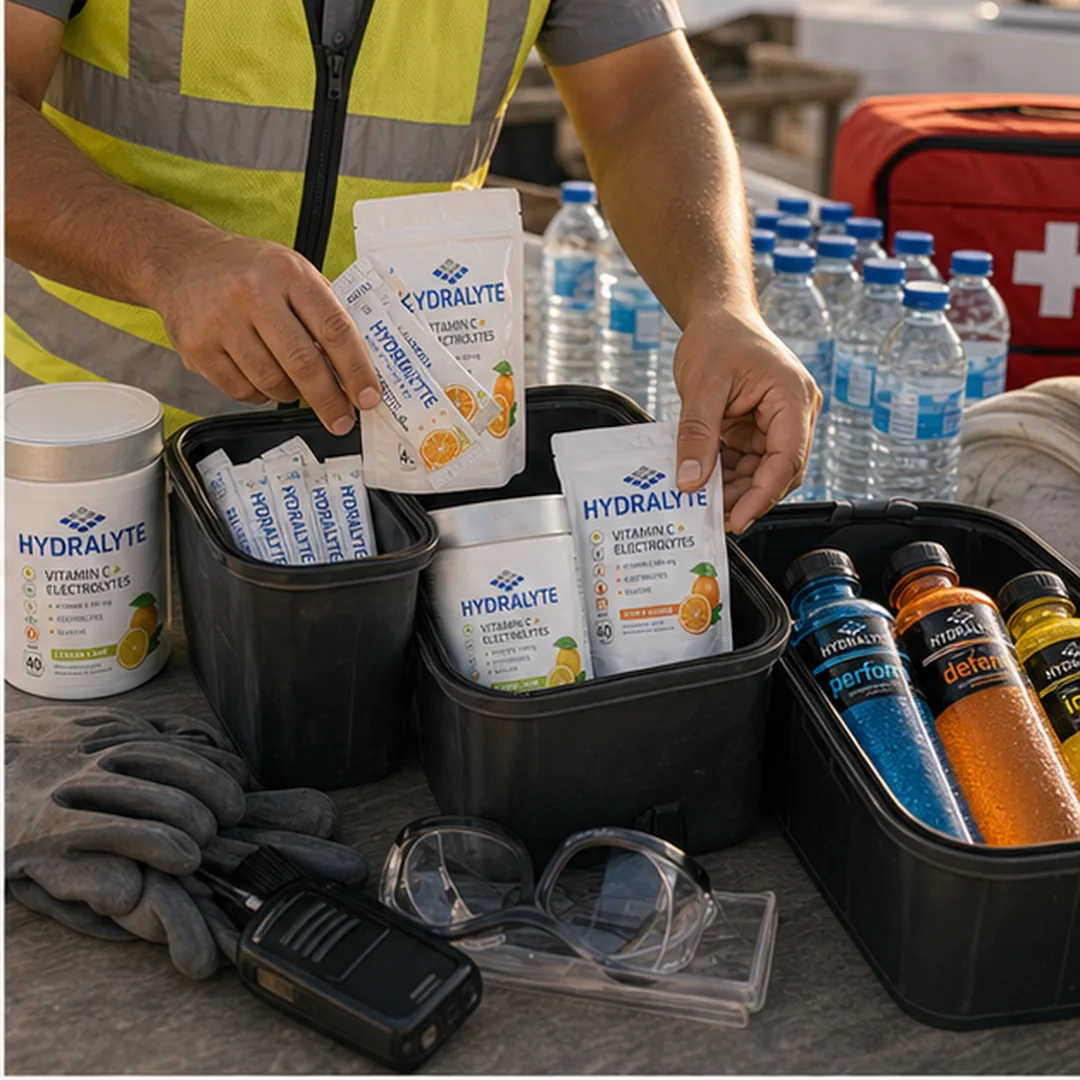
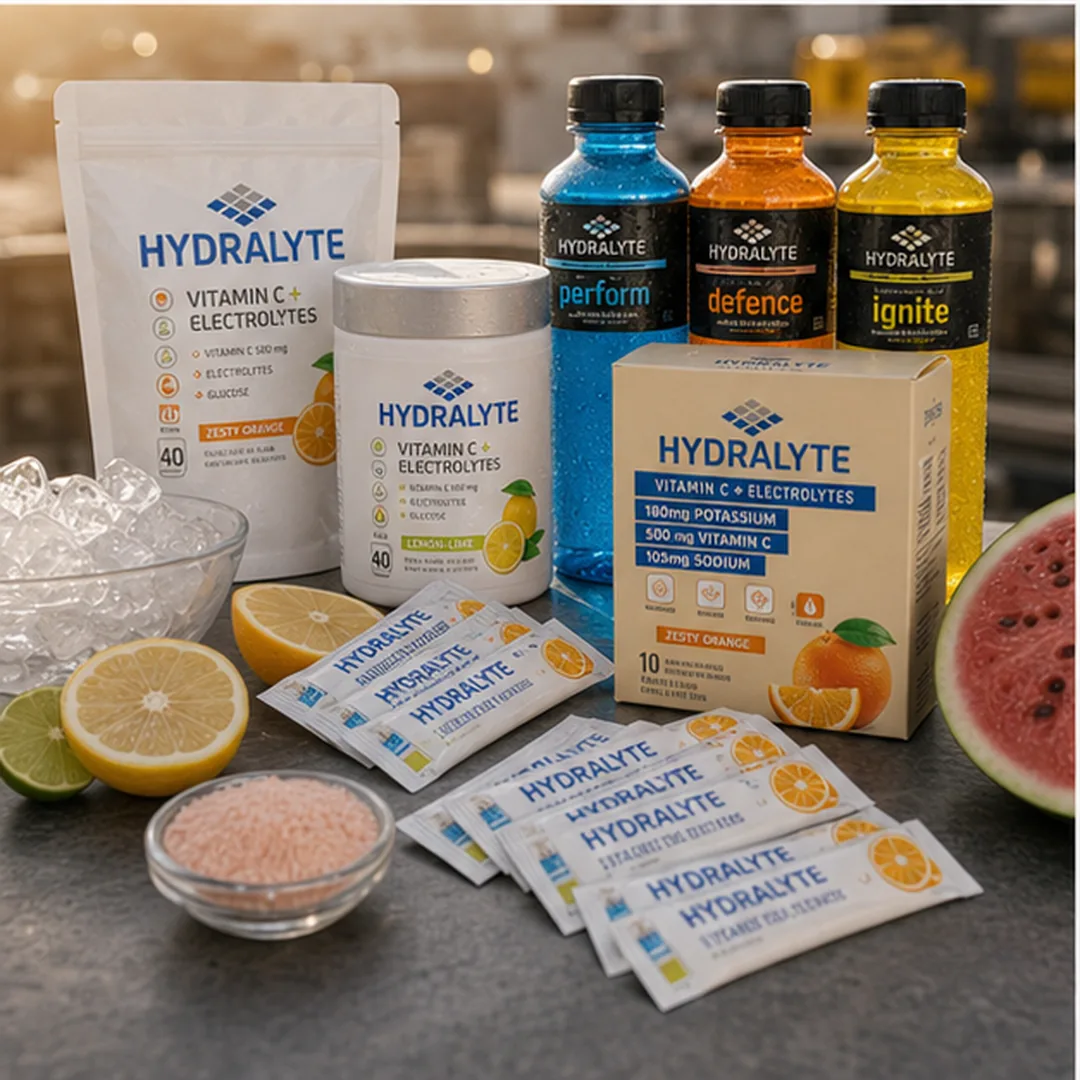
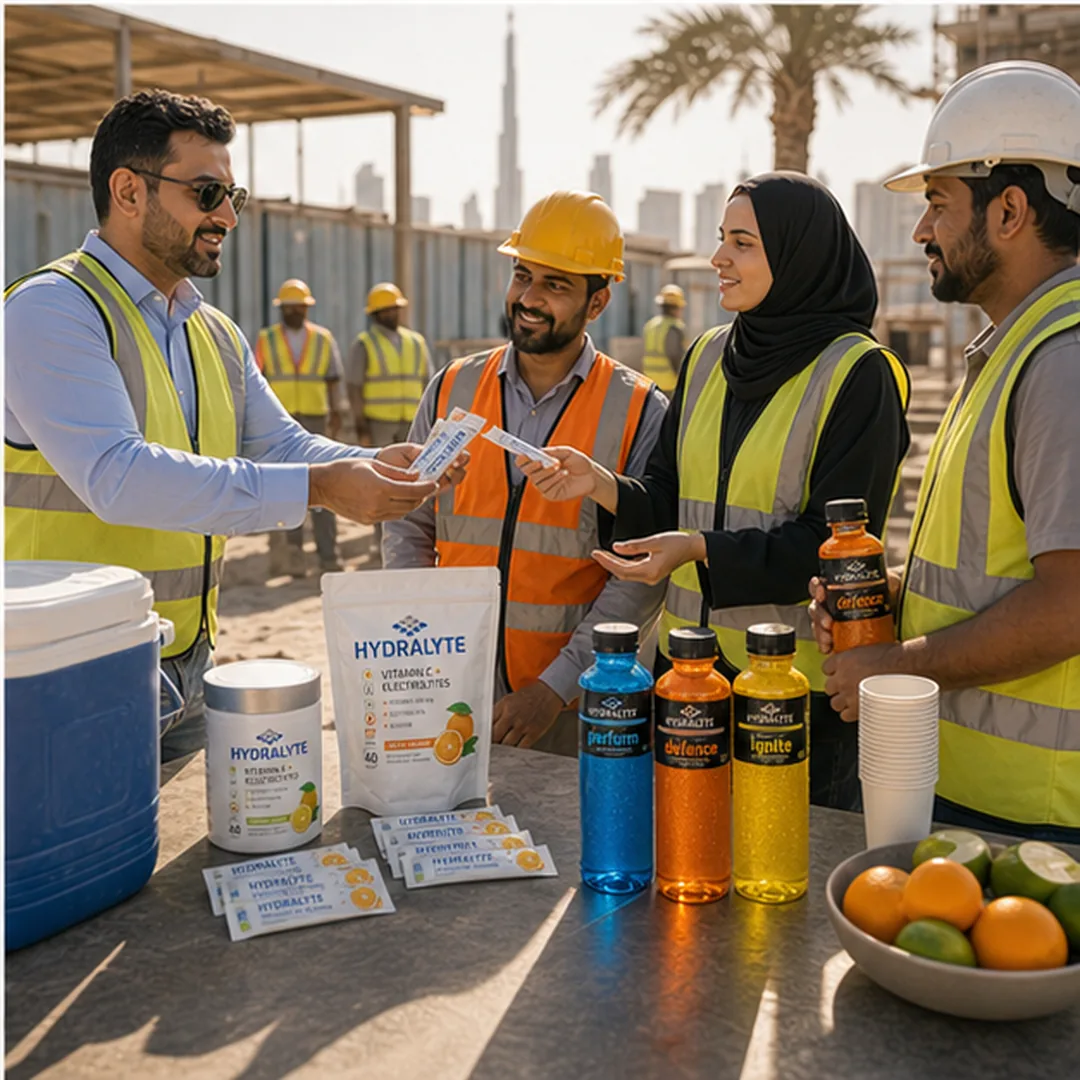
When employers in the UAE decide to take <a href="/industries">workforce</a> hydration seriously, the first question is almost always which electrolyte product to buy. The more useful question, and the one that determines whether the investment actually protects people, is which electrolyte format fits the way work genuinely happens on the ground. A product can carry an excellent formulation and still fail in practice if the format is awkward to store, slow to prepare, or inconvenient for a worker to use halfway through a demanding task in 45-degree heat. Choosing well means matching the format to your sites, your shifts and your people, not simply comparing the nutritional panels on competing labels.
Electrolytes for the workplace generally arrive in three broad formats: powders, tablets and ready-to-drink solutions. Each has genuine strengths and real trade-offs, and the best choice for one operation can easily be the wrong choice for another. A static yard team with a water cooler twenty metres away has very different needs from a fleet of drivers covering long routes between emirates, or a maintenance crew dispatched to a remote installation with no facilities at all. Understanding how the formats differ in daily use is the key to a hydration programme that workers actually adopt rather than one that looks complete on paper.
This guide walks through each format in turn, then steps back to the more important strategic question: how to combine formats into a single coherent supply that matches the full range of conditions your workforce faces across a UAE summer. Along the way it covers storage, shelf life, taste, supply continuity and the practical questions worth answering before you commit any budget. The aim is to leave you able to make a confident, evidence-based decision rather than defaulting to whichever product a supplier happens to push hardest.
Why format matters more than people expect
It is tempting to assume that, once you have selected a well-formulated electrolyte, the format is a minor logistical afterthought. In practice the opposite is true. The formulation determines whether a drink can rehydrate a worker effectively; the format determines whether the worker ever drinks it at all. A programme only delivers protection when fluid and minerals actually reach the bloodstream of a person working in the heat, and every step between the storeroom and that person is a point where uptake can quietly fall away.
Consider how many small frictions sit between intention and intake. Someone has to store the product somewhere accessible. Someone has to prepare it, or it has to be ready to drink. The worker has to have it within reach at the moment thirst, or better still the schedule, prompts a drink. They have to find the taste acceptable enough to finish it rather than tip it out. Each of these is a place where the wrong format adds resistance, and in the brutal conditions of a UAE summer even small amounts of resistance compound into meaningful under-consumption across a shift.
This is why format selection deserves the same scrutiny as formulation. The most sophisticated electrolyte profile in the world is worthless if it sits unprepared in a sealed sachet because the nearest clean water is a ten-minute walk away. Getting the format right removes friction; getting it wrong builds friction into every single drink, every single day, across an entire workforce.
Powders: flexible and economical
Powdered electrolytes are mixed into water, usually by the sachet or the scoop. Their principal advantage is flexibility combined with cost efficiency at scale. Because you are not paying to ship and store large volumes of pre-mixed liquid, powders tend to be the most economical option for large workforces and the easiest to stockpile ahead of summer. They store compactly, last well, and let a site prepare hydration in whatever quantity a given shift requires, from a single bottle to a large insulated dispenser serving a whole crew.
For a static operation with a reliable water supply, powders are frequently the natural backbone of a hydration programme. A supervisor can prepare a batch at the start of a shift, top it up through the day, and serve a large number of workers from a central point without the per-serving cost mounting up. For organisations watching the cost of protecting hundreds or thousands of workers across a long season, that economy is not trivial; it can be the difference between a programme that is fully resourced and one that is rationed.
The trade-off is preparation. Someone has to mix the powder with clean water, and that step depends on reliable access to water and a moment to carry it out. On well-organised sites with a water supply and a sensible place to prepare drinks, this is rarely a real obstacle. Where water access is limited, or where workers are highly mobile and rarely near a preparation point, the mixing step can become a quiet barrier that erodes uptake without anyone noticing. The economy of powders is only realised if the preparation step is genuinely frictionless in your specific setting.
When powders are the right anchor
Powders tend to suit operations with predictable, location-based work: a fabrication yard, a packing facility, a fixed construction site with established welfare provision. In these settings the central-preparation model plays to the powder's strengths and the cost advantage is fully captured. The clearest signal that powders should anchor your programme is a workforce that spends most of the shift within easy reach of clean water and a place to mix. Where that holds, powders typically deliver the most hydration per dirham spent.
Tablets: portable and convenient
Effervescent or dissolvable tablets sit between powders and ready-to-drink products. Each tablet drops into a bottle of water, which makes them simple to carry and simple to dose. For mobile workers, drivers, technicians and anyone who moves between locations during a shift, tablets are attractive precisely because an individual can keep a few in a pocket or a vehicle and prepare a drink wherever they happen to be when they need one.
Tablets share the powder's dependence on access to water, but their portability and clean single-serve dosing make them far easier to distribute and use without a central preparation point. There is no scooping, no measuring and no shared dispenser to manage; the worker controls their own intake. For a workforce spread across multiple sites, or constantly on the move between them, that convenience can be the deciding factor in whether hydration actually happens or merely remains a good intention.
The trade-off, as with powders, is the water requirement, and the per-serving cost typically sits above bulk powder. But for the mobile slice of a workforce those costs are usually justified by the simple fact that the alternative formats do not fit the work. A driver cannot pause at a central dispenser that is fifty kilometres behind them; a tablet and a bottle of water travel with them. The convenience translates directly into consumption, which is the only metric that ultimately matters.
Matching format to mobility
A helpful way to narrow the choice is to think carefully about how mobile your workers are and how reliable their water access is. Static teams with good water access can lean on cost-efficient powders. Highly mobile teams benefit from the portability of tablets. Where neither water access nor preparation time can be guaranteed, ready-to-drink options come into their own. Because few organisations are uniform, it is worth taking a moment to %find the format that suits your teams% rather than assuming a single format suits everyone from the yard to the road to the remote site.
Ready-to-drink: immediate and reliable
Ready-to-drink electrolyte solutions require no preparation whatsoever. A worker simply opens the container and drinks, which removes every barrier between intention and intake in a single step. In situations where speed, simplicity and certainty matter most, this is the most reliable format available. It is especially valuable in emergencies, for workers in genuinely remote locations, and wherever consistent dosing without any preparation step is the overriding priority. When someone is already showing early signs of heat strain, the last thing anyone wants is to be measuring scoops or hunting for clean water.
The trade-offs are cost and logistics, and they are significant. Pre-mixed liquids are heavier and bulkier to transport and to store, and they cost more per serving than powders or tablets because you are paying to move water that the other formats leave behind. For a large operation, committing entirely to ready-to-drink stock would be both expensive and logistically punishing, swallowing warehouse space and transport capacity at the worst time of year.
For that reason ready-to-drink is rarely the whole answer, but it is frequently an essential part of it. Reserved for high-risk and remote situations, it provides a fail-safe layer of protection where the other formats cannot reliably reach. The right way to think about it is as insurance for the moments that matter most, rather than as the everyday workhorse of routine daily hydration.
Thinking in terms of a format mix
One of the most common and most costly mistakes is to treat format selection as a single either-or decision for the whole organisation. In reality, most workforces are not uniform at all. The same employer may have static teams in a yard, mobile drivers covering long routes, supervisors moving between several sites, and crews deployed to remote or hard-to-reach locations. Each of these groups has genuinely different needs, and forcing all of them onto one format guarantees that at least some workers end up with something that does not fit how they actually work.
A far more effective approach is to design a deliberate mix. Powders can carry the bulk of routine daily hydration at static sites where cost efficiency matters most. Tablets can equip the mobile portion of the workforce who need portability and personal control. Ready-to-drink stock can be reserved for emergencies and remote deployments where preparation is impractical or impossible. Designed this way, the programme matches provision to need across the entire organisation rather than compromising everyone toward an unsatisfactory average. The goal is not to find a single best product, but to assemble the right toolkit for the full range of conditions your people face.
This is also where it helps to step back from individual sites and look at the operation as a whole. Mapping who works where, under what conditions, and with what access to water and storage, turns format selection from guesswork into a structured decision. Tools that let you %compare electrolyte options side by side% make it easier to weigh the profiles and serving costs against each other, and a planning view that lets you %plan supply across your whole workforce% helps you size the right quantity of each format for the season ahead rather than over-ordering one and running short on another.
Storage, shelf life and seasonal stockpiling
Format also shapes how you prepare for the season, and UAE summer demand is intense and concentrated enough that preparation is unavoidable. Many operations stockpile ahead of the peak, and here the practical differences between formats become significant. Powders and tablets are compact and store easily in volume, which makes them straightforward to lay in well ahead of time without consuming large amounts of space. Ready-to-drink products take far more room, weigh considerably more to handle and rotate, and place real demands on storage and transport.
Shelf life matters too. Sealed powders and tablets generally keep well, which suits the stockpiling model and means surplus at the end of one summer can carry into the next without waste. Ready-to-drink products, being water-based, warrant closer attention to dating and rotation. Factoring both shelf life and storage footprint into the decision avoids two unpleasant surprises: running short at the worst possible point in the year, or committing warehouse space you simply do not have to a format whose bulk you underestimated.
Beyond format: what else to weigh
Format is the most practical decision, but it is not the only one that determines whether a hydration programme succeeds. The electrolyte profile itself matters, because the goal is to replace what is genuinely lost in sweat, principally sodium along with potassium and other minerals, without unnecessary sugar or additives. In the UAE summer, where workers can lose substantial salt through heavy and sustained sweating, a profile built for serious rehydration rather than light refreshment is what the conditions actually demand.
Taste matters too, very possibly more than people expect. A product workers dislike will not be consumed, however impressive it looks on paper, and a half-finished bottle protects no one. In hot conditions palatability is not a luxury; it is the single biggest practical determinant of whether the product is actually drunk in the quantities the heat requires. It is well worth trialling options with the people who will use them rather than deciding on specification alone, because their willingness to drink it day after day is what turns a good formulation into real protection. The same trial should account for the differing intensity of exposure across roles, which is easy to map when you %assess the heat risk on each site% and align the most palatable, highest-strength options with the hardest jobs.
Supply reliability and the cost of running out
Of all the factors, supply continuity may be the one most easily overlooked at the point of purchase and the most painful when it fails. A hydration programme is only as good as its weakest week. If stock runs out during a heatwave, the gap opens at exactly the moment workers are most exposed, undoing the very protection the programme was built to provide. The cost of a stockout is not measured in the missing sachets; it is measured in the heat strain those sachets would have prevented.
For larger operations especially, the answer is to plan supply against realistic peak-season demand, hold sensible buffer stock, and work with a supplier who can sustain volume through the hottest months rather than one who can only comfortably meet average demand. This is as much a sourcing decision as a product decision. A supplier who understands seasonal UAE demand, and who can flex with a heatwave rather than buckle under it, is part of the protection itself. The same logic applies right across heat-exposed sectors, and you can %see how this plays out in logistics operations% to see how mixed fleets and depots tend to structure their supply for continuity.
Bringing it together: a structured decision
Pulling the threads together, the choice of electrolyte format is best made not as a product comparison but as a structured assessment of how your workforce operates. A few questions help frame that assessment clearly:
- How mobile are your workers, and how reliable is their access to clean water through the shift?
- What storage space and preparation facilities exist on each site, and how do they differ?
- What total volume will you need across the whole season, and can your supply keep pace at the peak?
- Will workers actually drink it day after day, based on taste and ease of use in real conditions?
- Does the electrolyte profile genuinely match the heavy sweat losses of a UAE summer rather than light, occasional refreshment?
Working through these honestly almost always points toward a tailored mix rather than a single format. Powders to anchor cost-efficient routine hydration where water and preparation are easy; tablets to give the mobile workforce portable control; ready-to-drink stock held in reserve for emergencies and remote work. Layered over that, a profile strong enough for serious sweat losses, a taste workers will accept, and a supply arrangement robust enough to hold through the hottest weeks.
A worked example
Consider, as an illustration, a mid-sized logistics operation in Abu Dhabi running through August. It has a central depot with reliable water, a fleet of drivers on long inter-emirate routes, and occasional maintenance crews sent to remote yards. A sensible mix might anchor the depot on bulk powder served from insulated dispensers, equip every driver and their vehicle with tablets and bottled water for self-serve hydration on the road, and keep a modest reserve of ready-to-drink units in each vehicle and at the depot for emergencies or remote callouts. No single format would have served all three groups well; the mix gives each the right tool for its conditions while keeping overall cost under control. The exact balance is an estimate to be refined against real consumption, but the structure is what makes the programme fit the work.
The economics of getting format right
It is easy to frame format selection purely as a unit-cost comparison, with powders cheapest per serving, tablets in the middle, and ready-to-drink the most expensive. That framing is accurate as far as it goes, but it misses the larger economic picture. The true cost of a hydration programme is not the price printed on the sachet; it is the price per serving that is actually consumed and the value of the heat strain prevented. A cheaper format that workers skip because it is inconvenient is not cheaper at all once you account for the protection you paid for and did not receive.
This is why the lowest headline cost can be a false economy. Buying bulk powder for a workforce that has no reliable way to mix it produces a warehouse full of unused product and a workforce that remains under-protected. Conversely, paying more per serving for tablets that mobile workers genuinely use can deliver far better value, because every serving purchased is a serving consumed. The economics only make sense when measured against real consumption in real conditions, not against the unit price in isolation.
There is also the cost that never appears on any invoice: the cost of a heat-related incident. Lost time, disrupted programmes, the wellbeing of the worker affected, and the wider impact on a team's confidence all carry a price that dwarfs the difference between formats. Viewed against that, the marginal cost of choosing the format people will actually use is modest. The cheapest hydration programme is almost always the one that prevents the incident, regardless of which format sits on the shelf.
Hidden costs worth counting
Several costs sit outside the unit price and deserve a place in the calculation:
- Wastage from a format that does not fit the setting and goes unused or unprepared.
- Storage and transport costs, which are far higher for bulky ready-to-drink stock.
- Labour time spent preparing powders, which is negligible at a central point but mounts where mixing is awkward.
- The opportunity cost of a stockout, when the protection you planned for simply is not there at the peak.
Rolling out a new format successfully
Selecting the right format is only half the task; introducing it well is the other half. Even the best-matched format can underperform if it is dropped on a workforce without explanation, training or any way to give feedback. A short, deliberate rollout dramatically improves the odds that the format is adopted and used as intended rather than quietly ignored or misused.
The first step is communication. Workers and supervisors should understand why hydration matters in extreme heat, why electrolytes rather than water alone are being provided, and how the chosen format is meant to be used. A worker who understands that the drink is replacing the salt they are sweating out, and that drinking before they feel thirsty is the point, is far more likely to engage than one who is simply handed a sachet with no context. Supervisors in particular need to understand the reasoning, because they set the tone for whether hydration is treated as routine or as an afterthought.
The second step is to make use easy and visible. Powders need a clean, accessible preparation point and someone responsible for keeping the dispenser filled. Tablets need to be genuinely available where mobile workers can grab them, not locked in an office. Ready-to-drink reserves need to be where emergencies happen, not in a central store an hour away. Wherever possible, build the drink into the rhythm of the day with scheduled hydration breaks, so that consumption is prompted rather than left to individual initiative in conditions where thirst is an unreliable guide.
Listening to the workforce after launch
The third step is to listen once the format is in use. The people drinking it every day are the best source of information on whether it is working. Are the tablets actually being carried, or left behind? Is the powder being prepared, or is the dispenser sitting empty by mid-morning? Is the taste holding up over a long, hot shift, or are bottles being half-finished? Gathering this feedback early lets you correct course while it still matters, adjusting the mix, the flavour or the distribution before a whole season passes with a format that is not quite landing. A programme that is reviewed and refined in its first weeks tends to be far stronger by the height of summer than one that is set and forgotten.
Common mistakes to avoid
Across many operations, the same handful of mistakes recur, and being aware of them is half the battle. The most frequent is treating format as a single decision for a varied workforce, forcing static, mobile and remote workers onto one option that fits only some of them. The fix is the deliberate mix discussed throughout this guide, matching provision to the real conditions each group faces.
A second common error is choosing on specification and price alone without ever trialling the product with the people who will drink it. Taste and ease of use are not secondary details; they are the primary determinants of consumption. A formulation that scores well on paper but that workers will not finish is a poorer choice than a slightly less perfect one they readily drink. The only reliable test is a real trial in real conditions before committing to volume.
A third mistake is underestimating seasonal demand and supply lead times, then scrambling when a heatwave empties the store faster than expected. UAE summer demand is intense and concentrated, and a programme that is sized to average use will fail at the peak. Planning against realistic peak demand, holding buffer stock, and working with a supplier who can sustain volume are the safeguards against this. A final, related mistake is providing water alone in the belief that it is sufficient, when heavy sustained sweating demands the replacement of salt and minerals that only an electrolyte can supply.
The UAE and GCC context
The case for getting electrolyte format right is sharper in the UAE and the wider Gulf than in almost any other working environment. UAE summer temperatures regularly exceed 45 degrees, and along the coast that heat is compounded by very high humidity, which prevents sweat from evaporating efficiently and pushes the body's cooling system to its limit. In these conditions sweat losses are heavy and sustained, and the salt and minerals lost with that sweat are substantial. A format and a formulation tuned for mild, occasional exertion are simply not built for the reality of a Gulf summer.
The regional workforce profile reinforces the point. The UAE's labour force is largely expatriate and heavily concentrated in physically demanding outdoor and industrial sectors, the very work that generates the highest heat exposure. Construction, logistics and heavy industry all run through the summer, often with large numbers of workers spread across multiple sites in conditions that vary from a city centre tower to a remote desert installation. The scale and the spread are precisely why a single format rarely fits, and why a deliberate mix matched to mobility and access tends to win out across the region.
There is also a seasonal rhythm specific to the Gulf that shapes supply planning. Demand is not spread evenly across the year; it spikes hard through the hottest months and concentrates the entire programme into a relatively short, intense window. That concentration magnifies the consequences of a supply failure and rewards operators who plan against realistic peak demand rather than annual averages. Across the GCC, which comprises the UAE, Saudi Arabia, Qatar, Kuwait, Bahrain and Oman, the same fundamentals apply: extreme summer heat, demanding outdoor work, and a short, fierce season that punishes under-preparation.
Water quality and access on site
One regional practicality deserves specific attention because it bears directly on format choice: the availability and quality of water on site. Powders and tablets both depend on clean water being readily to hand, and that cannot always be taken for granted, particularly on remote or temporary sites. Where clean water is reliably available, powders and tablets are excellent. Where it is uncertain, ready-to-drink stock removes the dependency entirely and becomes far more attractive for that portion of the workforce. Auditing water access realistically across every site, rather than assuming it, is one of the most useful inputs into a sensible format mix, and it often shifts the balance more than any other single factor.
The bottom line
The right electrolyte format is, in the end, simply the one your workforce will actually use, in the conditions they genuinely work in. There is no universally superior format, only a better or worse fit for a given operation, and the best programmes recognise that a single workforce often needs more than one. Match powders, tablets and ready-to-drink stock to mobility, water access, storage and exposure; insist on a profile and a taste that hold up in real heat; and secure a supply that will not fail when the temperature peaks.
Get that match right and the rest of your hydration programme has a solid foundation to build on. Get it wrong and even the finest formulation will sit unused while your people work under-protected. The decision is worth the time it takes, because in a UAE summer the format is not a detail; it is the difference between a programme that exists and a programme that works. When you are ready to translate this into a concrete supply for your specific sites, it makes sense to %talk through bulk supply for your sites% so that whichever mix you choose is available consistently, in the right places, throughout the hottest months of the year.
Frequently Asked Questions
Which electrolyte format is best for a large workforce?
There is no single best format; it depends on mobility, water access and storage. Powders are often the most economical for large static teams with good water access, tablets suit mobile workers, and ready-to-drink solutions are ideal where preparation cannot be guaranteed. Most large operations end up using a deliberate combination rather than committing to one format for everyone.
What is the difference between <a href="/shop">electrolyte powder</a> and tablets?
Both are mixed into water, but powders are typically more economical at scale and prepared by sachet or scoop, while tablets are single-serve, highly portable and easy for individuals to carry. Tablets suit mobile workers who control their own intake on the move, whereas powders suit static sites with a central preparation point serving many workers at once.
When are ready-to-drink electrolytes worth the extra cost?
They are most valuable where speed, simplicity and reliability matter most, such as emergencies, remote locations, or any setting without dependable water access or preparation time. They cost more per serving and are bulkier to transport and store, so most operations reserve them as a fail-safe layer for high-risk situations rather than using them for routine daily hydration.
What matters besides the format when choosing electrolytes?
Taste, electrolyte profile and supply reliability all matter enormously. Workers will not drink a product they dislike, the formulation should genuinely replace the sodium and minerals that sweat removes, and supply must keep pace through the entire summer. A format that runs out mid-season fails at exactly the moment workers are most exposed.
How much storage space do I need to stockpile electrolytes for summer?
It depends heavily on format. Powders and tablets are compact and store easily in volume, making them well suited to seasonal stockpiling without consuming much space. Ready-to-drink products take considerably more room and weigh more to handle and rotate, so if your mix includes them you should plan storage and transport capacity accordingly well before the peak.
Do electrolyte powders and tablets expire?
Sealed powders and tablets generally have a good shelf life, which suits the stockpiling model and often allows surplus to carry from one summer into the next. Ready-to-drink products are water-based and warrant closer attention to dating and rotation. Always check the dating on your specific products and rotate stock so the oldest is used first.
Should every worker get the same electrolyte format?
Not necessarily, and often not. A single employer may have static yard teams, mobile drivers and remote crews, each with different needs. Giving everyone the same format usually means at least one group is poorly served. Mapping roles by mobility, water access and exposure typically points toward giving different groups the format that genuinely fits their work.
How do I make sure we do not run out of electrolytes mid-summer?
Plan supply against realistic peak-season demand rather than average use, hold sensible buffer stock, and work with a supplier who can sustain volume through the hottest months. Sizing quantities of each format to the season, and confirming your supplier can flex with a heatwave rather than buckle under it, is what prevents a stockout at the worst possible time.
Is taste really that important for workplace electrolytes?
Yes. A perfectly formulated product that workers find unpleasant will go unfinished, and a half-drunk bottle protects no one. In extreme heat, palatability is the single biggest practical factor in whether enough fluid is actually consumed. Trialling options with the people who will use them, in real working conditions, is the best way to confirm a product will be drunk in the quantities the heat demands.
Do workers really need electrolytes, or is water enough?
In the intense, sustained heat of a UAE summer, water alone is often not enough. Heavy sweating removes significant sodium and other minerals, and replacing fluid without replacing those minerals can leave a worker functionally under-hydrated. For physically demanding outdoor and industrial work in extreme heat, an electrolyte profile built for serious rehydration addresses the actual losses far better than water on its own.