Skip to Content

Delivery across the UAE

For Business عربي · soon

The science

Numbers first.
Marketing later.

Electrolyte physiology, explained without the jargon — what you lose in the heat, how absorption actually works, and what a balanced serve looks like.

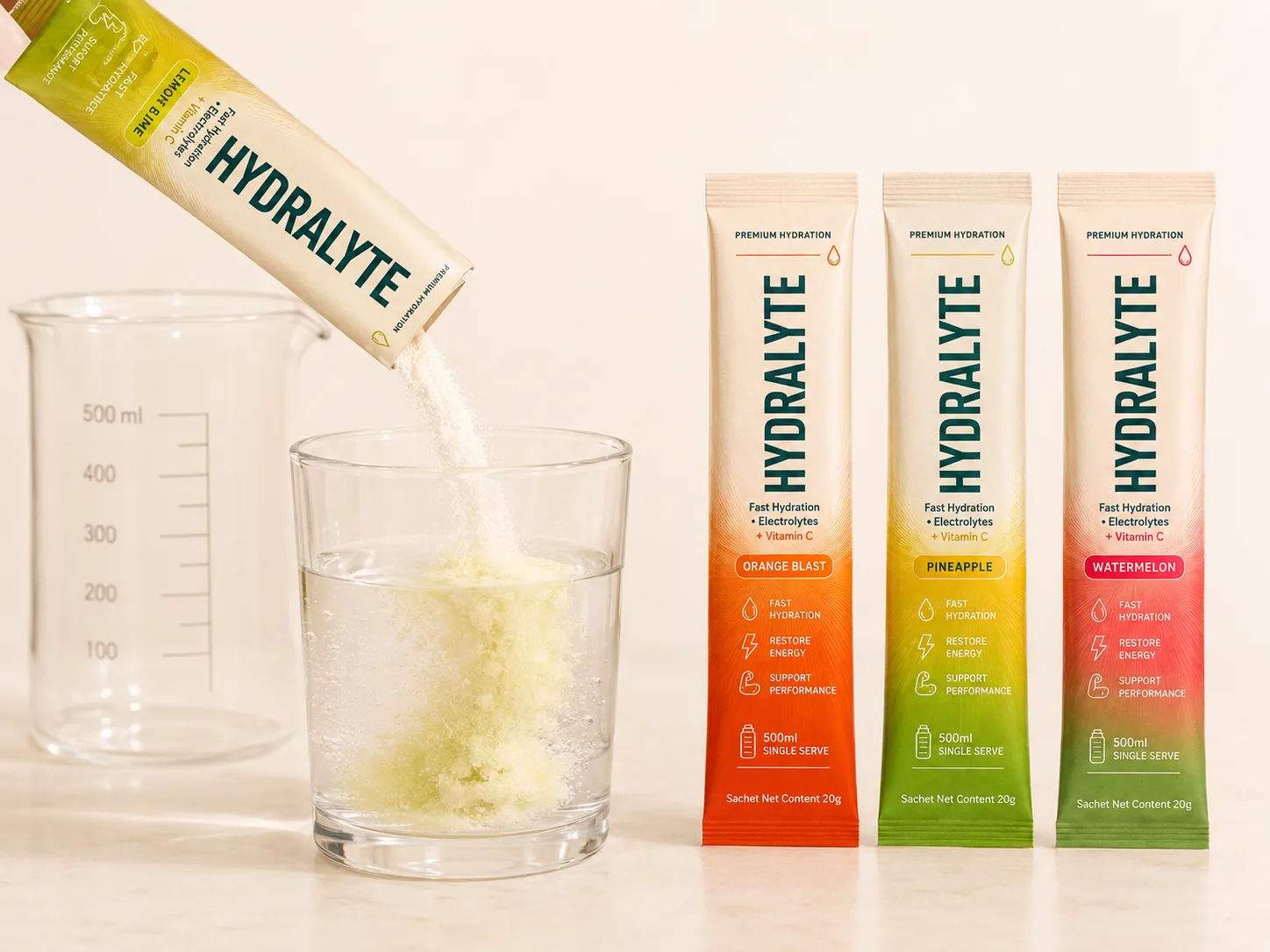
Hydralyte Lemon Lime 20 g stick dissolving into a clear 500 ml glass of water on a lab-clean cream bench

The essentials

Five minerals, one balanced serve.

K0mg potassium / 500 ml
Na0mg sodium / 500 ml
C0mg vitamin C / 500 ml

Alongside potassium and sodium, every serve carries chloride, calcium and magnesium — the five minerals sweat takes — with 500 mg of vitamin C for immune support and low sugar.

Sodium

The absorption driver. Sodium-glucose co-transport is what pulls water across the intestinal wall — without it, most of what you drink passes through.

Potassium

Balances the fluid inside your cells and supports muscle and nerve signalling. Sweat removes it constantly — cramps follow when it runs low.

Chloride

Sodium’s partner ion. Keeps blood volume and acid-base balance stable through long sweat sessions.

Calcium & Magnesium

Muscle contraction, nerve firing and recovery. Both are lost in sweat — and both are implicated in heat cramps when depleted.

The comparison

Water, sports drink, Hydralyte.

Following oral-rehydration principles, the potassium-to-sodium ratio supports fluid absorption without the sodium overload of classic rehydration formulas. Safe for every single day.

Per 500 ml — illustrative comparison
NutrientWaterSports drinkHydralyte
Sodium0 mg~250 mg105 mg
Potassium0 mg~25 mg180 mg
Vitamin C0 mg0 mg500 mg

Reading the label

What a 20 g stick actually says.

Four things on the front of every Hydralyte stick tell you what is in the glass. Here they are, decoded — with the numbers from the comparison table above.

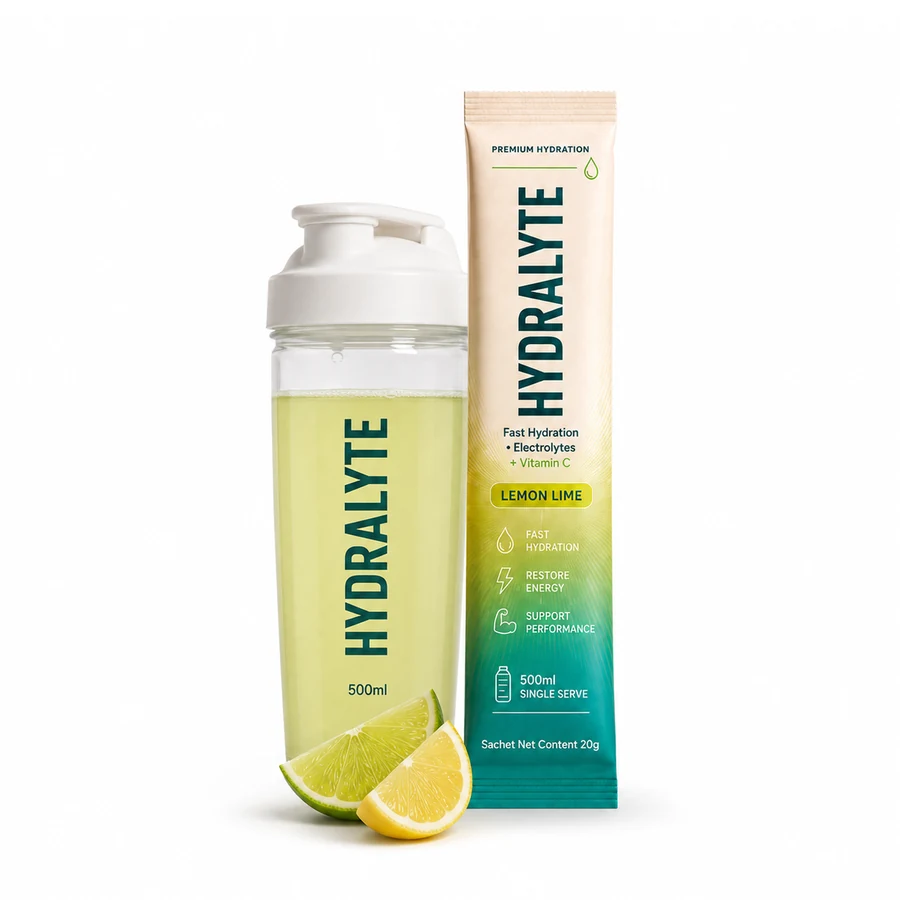
Hydralyte Lemon Lime 20 g single-serve stick sachet, front of pack, 500 ml single serve
Lemon Lime shown — the same panel appears on Orange Blast, Pineapple and Watermelon.
  1. The electrolyte panel

    “Electrolytes” on the front means the five minerals inside: 105 mg sodium and 180 mg potassium per 500 ml serve, with chloride, calcium and magnesium alongside. Potassium-heavy on purpose — a daily-prevention ratio, not a hospital-strength one.

  2. + Vitamin C

    500 mg per serve — the immune-support line on the pack. It is the same 500 mg you see in the table above, and it is what a sports drink does not carry at all.

  3. Serve size: 20 g into 500 ml

    The whole stick, one 500 ml serve. The ratio matters more than the volume: it sets the sodium-to-glucose balance that switches the SGLT1 pump on. Dilute it further and it still hydrates; concentrate it and you slow it down.

  4. Low sugar, by design

    “Restore energy” is not a sugar hit. There is just enough glucose to run sodium-glucose co-transport, not the 20–35 g of sugar a sports drink carries in the same 500 ml.

Gut lumen the drink you just swallowed Enterocyte gut-wall cell Bloodstream fluid where the body needs it SGLT1 cotransporter Na⁺/K⁺ pump GLUT2 carrier water follows by osmosis hundreds of H₂O per cycle Na⁺ Glc Na⁺ Glc Na⁺ Glc Na⁺ Glc
Sodium (Na⁺) Glucose (Glc) Water (H₂O)

The mechanism

SGLT1: the pump water rides on.

A balanced ratio of sodium and glucose activates the SGLT1 cotransporter on intestinal cells. Every transport cycle pulls hundreds of water molecules across by osmosis — an active absorption pathway that keeps working when passive diffusion stalls, even under extreme heat stress.

Read the diagram top to bottom: sodium and glucose enter the gut-wall cell together through SGLT1; the sodium-potassium pump and the GLUT2 carrier pass them on to the blood; water follows the gradient they create. Water on its own has no such escort.

The result: faster, more complete hydration than water alone — with a sodium level tuned for daily prevention, not clinical recovery.

Sweat loss in the heat window

Litres per hour of sustained effort at 40°C+ ambient

10:0012:0014:0016:00 2.5 L/h0.8 L/h

Heating load rises through the day — sweat rate roughly triples between the 10 AM hour and the 4 PM hour. Indicative planning curve, not a measurement.

Five use cases

Same physiology, five different days.

The pump above does not know whether you are in a gym, a car, a meeting room or on a site. What changes from day to day is how fast fluid leaves — and that is a wide band, not a single number. Sports-medicine bodies put exercise sweat rates anywhere from roughly 0.3 to 2.4 litres an hour depending on fitness, acclimatisation, clothing and how hard you are working. The chart places six ordinary days on that band; the cards below say what each one costs, what to drink, and — honestly — when plain water is all you need.

Typical fluid-loss band by scenario

Litres of fluid lost per hour, shown as a typical range for each day — placed on the sweat-rate span reported for exercise

Typical fluid-loss range per hour for six everyday scenarios Horizontal range bars on a 0 to 2.4 litres-per-hour axis. An air-conditioned office day sits below the exercise range, with insensible loss only. Summer errands over three hours typically sit around 0.3 to 0.5 litres an hour. A 45-minute indoor class typically 0.5 to 1.2. A 90-minute padel match typically 0.6 to 1.4. A 60-minute outdoor run at 35 degrees typically 1.0 to 2.0. An eight-hour site shift at 40 degrees or more typically 0.8 to 2.4 litres an hour. All bands are indicative placements, not measurements. exercise sweat-rate span · 0.3–2.4 L/h (ACSM) 0 0.5 1.0 1.5 2.0 2.4 L/h AC office day 8 h at a desk · dry air, coffee below the range · insensible loss only Summer errands 3 h in and out of AC · ≈ 1–1.5 L typically 0.3–0.5 Indoor class 45 min in an AC studio · ≈ 0.4–0.9 L typically 0.5–1.2 Padel match 90 min, evening court · ≈ 0.9–2.1 L typically 0.6–1.4 Outdoor run 60 min at 35 °C · ≈ 1–2 L typically 1.0–2.0 Site shift 8 h at 40 °C+ · litres per shift typically 0.8–2.4
  • AC office day, 8 hours at a desk: below the exercise range, insensible loss only.
  • Summer errands, 3 hours in and out of air-conditioning: typically 0.3 to 0.5 litres an hour, about 1 to 1.5 litres over the outing.
  • Indoor class, 45 minutes in an air-conditioned studio: typically 0.5 to 1.2 litres an hour, about 0.4 to 0.9 litres over the class.
  • Padel match, 90 minutes on an evening court: typically 0.6 to 1.4 litres an hour, about 0.9 to 2.1 litres over the match.
  • Outdoor run, 60 minutes at 35 degrees: typically 1.0 to 2.0 litres an hour.
  • Site shift, 8 hours at 40 degrees or more: typically 0.8 to 2.4 litres an hour, litres over the shift.

Sources: ACSM Position Stand, Exercise and Fluid Replacement (Sawka et al., 2007) — exercise sweat rates of roughly 0.3–2.4 L/h; EFSA Scientific Opinion on Dietary Reference Values for water (2010) — adequate total water intake of 2.0 L/day for women and 2.5 L/day for men, which covers an ordinary desk day. Scenario bands are indicative placements on that span, and the per-session figures are simply band × duration; individual sweat rates vary widely. Not measurements, not medical advice.

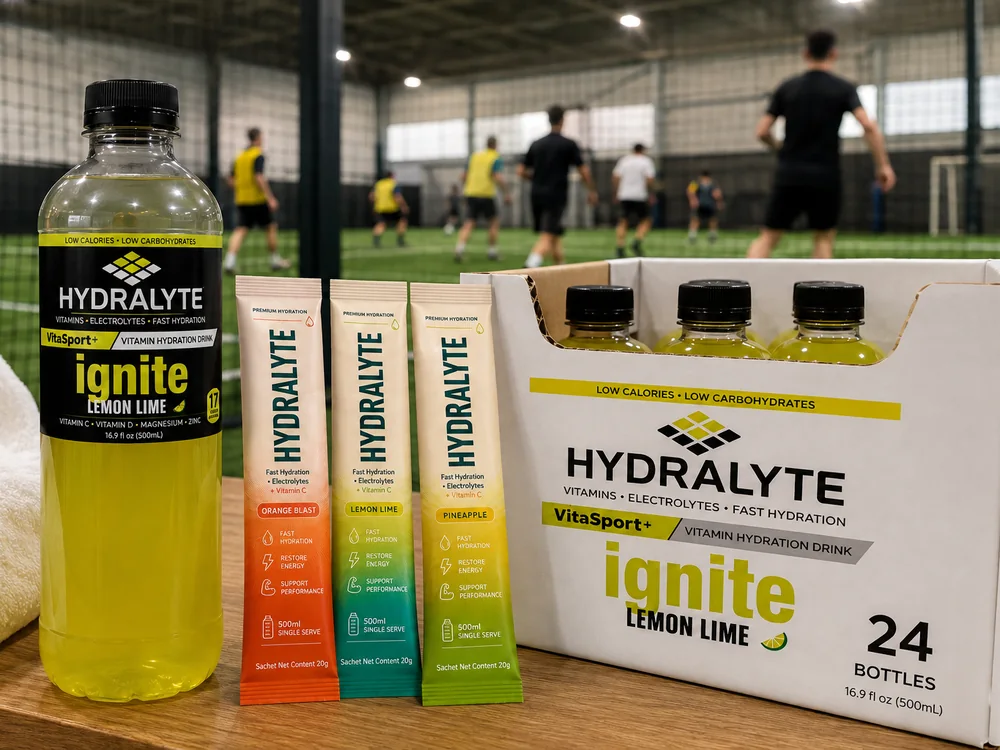
Indoor five-a-side pitch bench with an open VitaSport+ 24-pack case, Hydralyte 20 g sticks and towels, players on the pitch behind

Indoor sport

AC gym, class, padel, five-a-side, pool

What you lose
Sweat you rarely see. Chilled, moving air evaporates it as it forms, so a hard 45-minute class can sit in the middle of the band without a damp shirt to warn you.
What to drink
Water for a light session. A 20 g stick in 500 ml — or a cold VitaSport+ — after a hard class or a double session.
When a serve helps
Sessions past 45 minutes, back-to-back classes, heated rooms, or arriving already thirsty.
When water is enough
A 30-minute strength or mobility session in a cool room.
Sport recovery guide
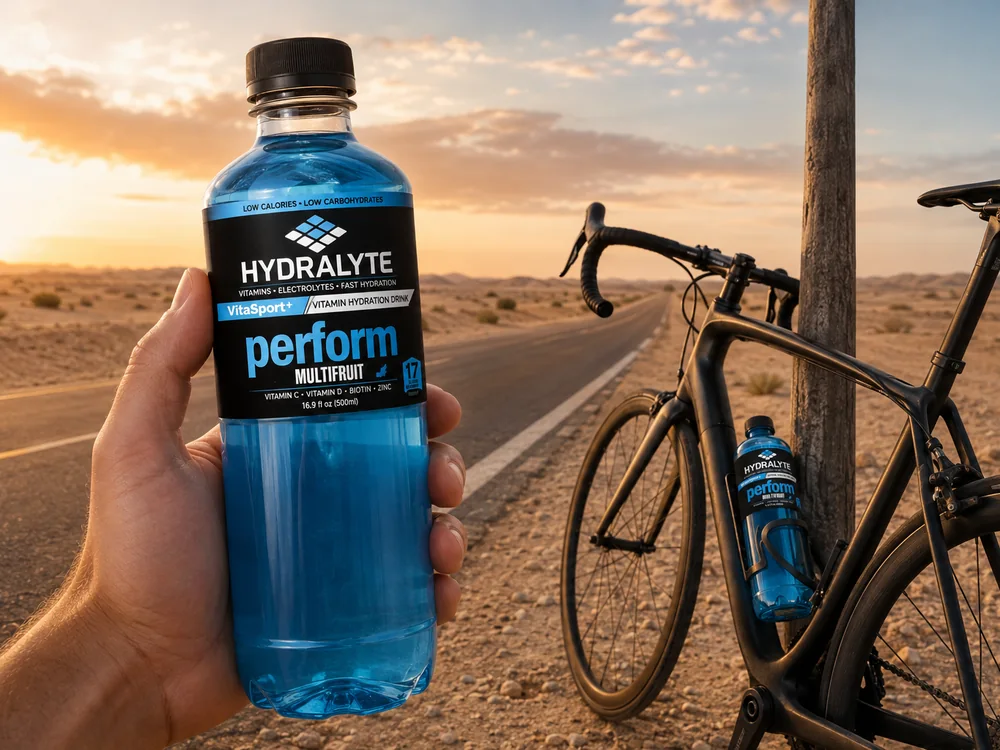
Road bike on an empty desert road at golden hour with a VitaSport+ Perform bottle in the cage and a second in hand

Outdoor sport

Dawn runs, cycling, golf, football, the beach

What you lose
The most. An hour outdoors at 35 °C typically sits toward the top of the band, and the sodium in that sweat goes with it — see the chart further down.
What to drink
A 10 g stick in 250 ml before you start, water or a serve during a long or hot session, a 20 g stick in 500 ml after.
When a serve helps
Any outdoor session over 45 minutes from May to October — dawn included — and two-a-day training.
When water is enough
A short, easy jog in the cool months.
Sport recovery guide
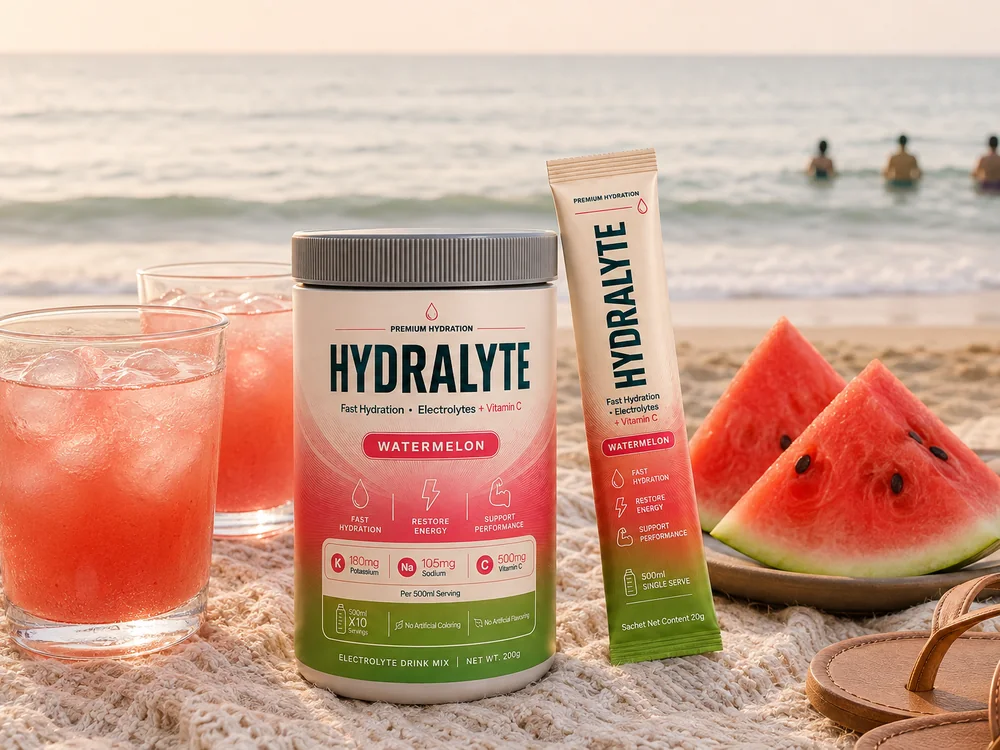
Beach picnic blanket with a Hydralyte Watermelon 200 g jar, two glasses of pink drink with ice, watermelon slices and a 20 g stick

Daily life

School run, errands, driving, weekends, fasting

What you lose
A little, all day. Three hours of car-to-shop-to-car in summer adds up quietly, and a fasting day squeezes the whole intake into a few hours.
What to drink
Water as the default. One serve on the hottest afternoons or a beach day; a 10 g stick in 250 ml at iftar or suhoor on fasting days.
When a serve helps
Long summer errands, a day at the beach or park, a fasting day in summer, a child home from sport.
When water is enough
An ordinary air-conditioned day at home.
Pick a flavour
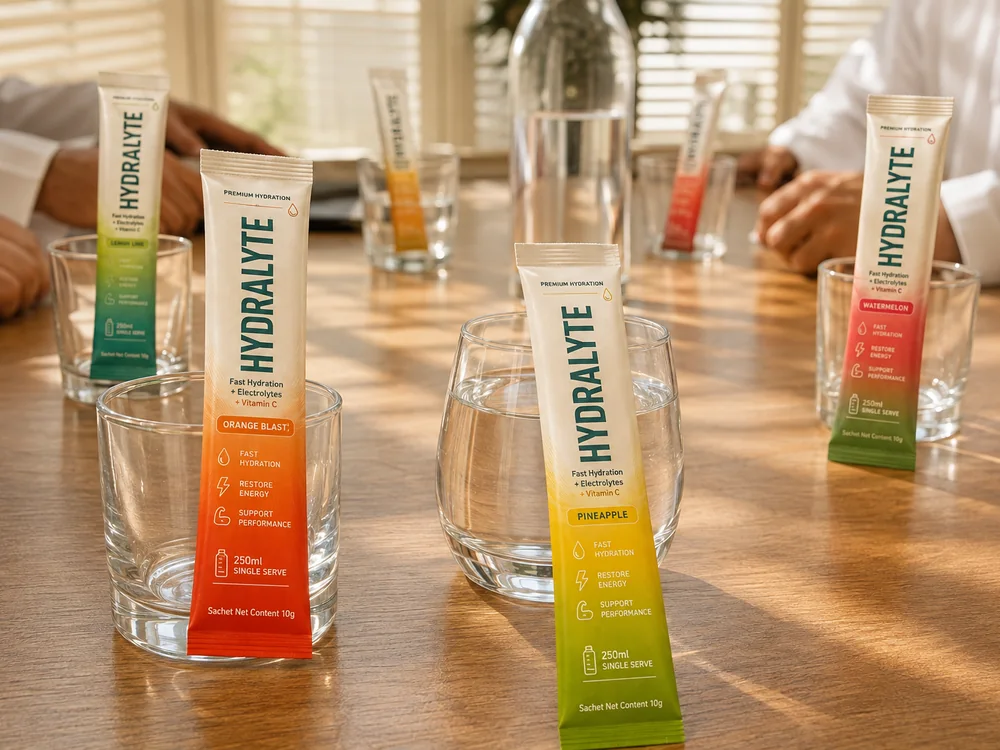
Meeting-room table with a water carafe, glasses and Hydralyte 10 g sticks laid at each place setting under sunlit blinds

Office & travel

AC desks, long meetings, coffee, flights, commutes

What you lose
Mostly the invisible kind — breath and skin in dry, chilled air. Coffee adds a little at high doses; a cup or two does not undo the day.
What to drink
Water toward the adequate-intake mark — about 2.0 L a day for women, 2.5 L for men, from all drinks and food. A 10 g stick in 250 ml when the day runs long or you are in the air.
When a serve helps
A long-haul flight, a 40 °C commute, meetings that push water to the afternoon, a headache creeping in.
When water is enough
Most desk days.
Your daily number
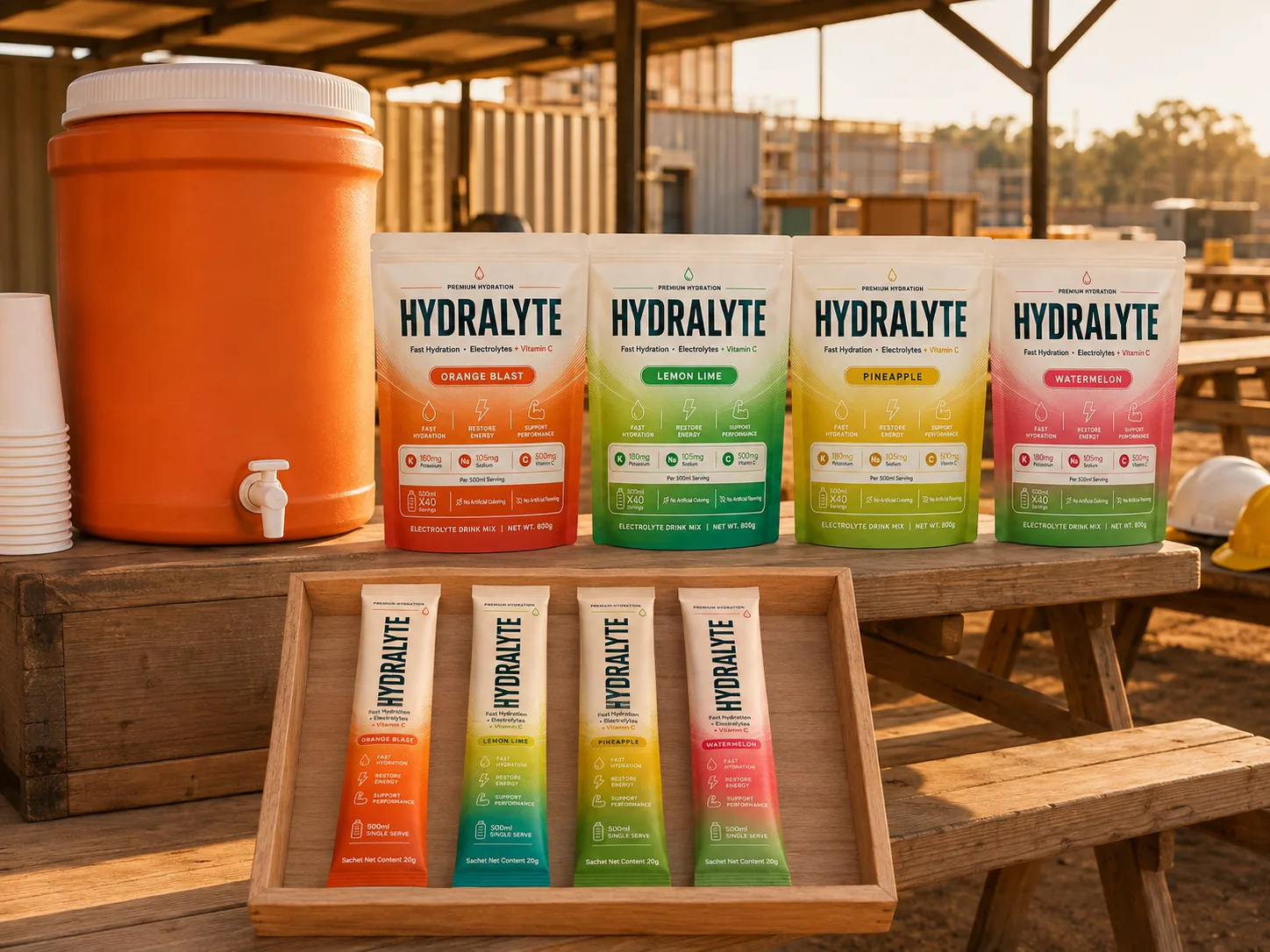
Welfare-station table under shade netting with a Hydralyte 800 g pouch, dispenser, cups and 20 g sticks, hi-vis crew in the background

Site & workforce

Outdoor shifts, yards, kitchens, delivery runs

What you lose
Litres per shift — the top of the band, hour after hour. Here the sodium loss is the story, not just the volume.
What to drink
A serve before the shift, then water plus a serve every few hours through the midday window — from a welfare-station dispenser, a tube or a stick.
When a serve helps
Every outdoor shift in the heat window, and longest for crews still acclimatising.
When water is enough
On its own, it is not — plain water refills volume and replaces none of the salt.
Plans for employers

General guidance for healthy adults, not medical advice. Industry-specific programmes, MoHRE midday-break compliance and welfare-station formats live on for business and industries.

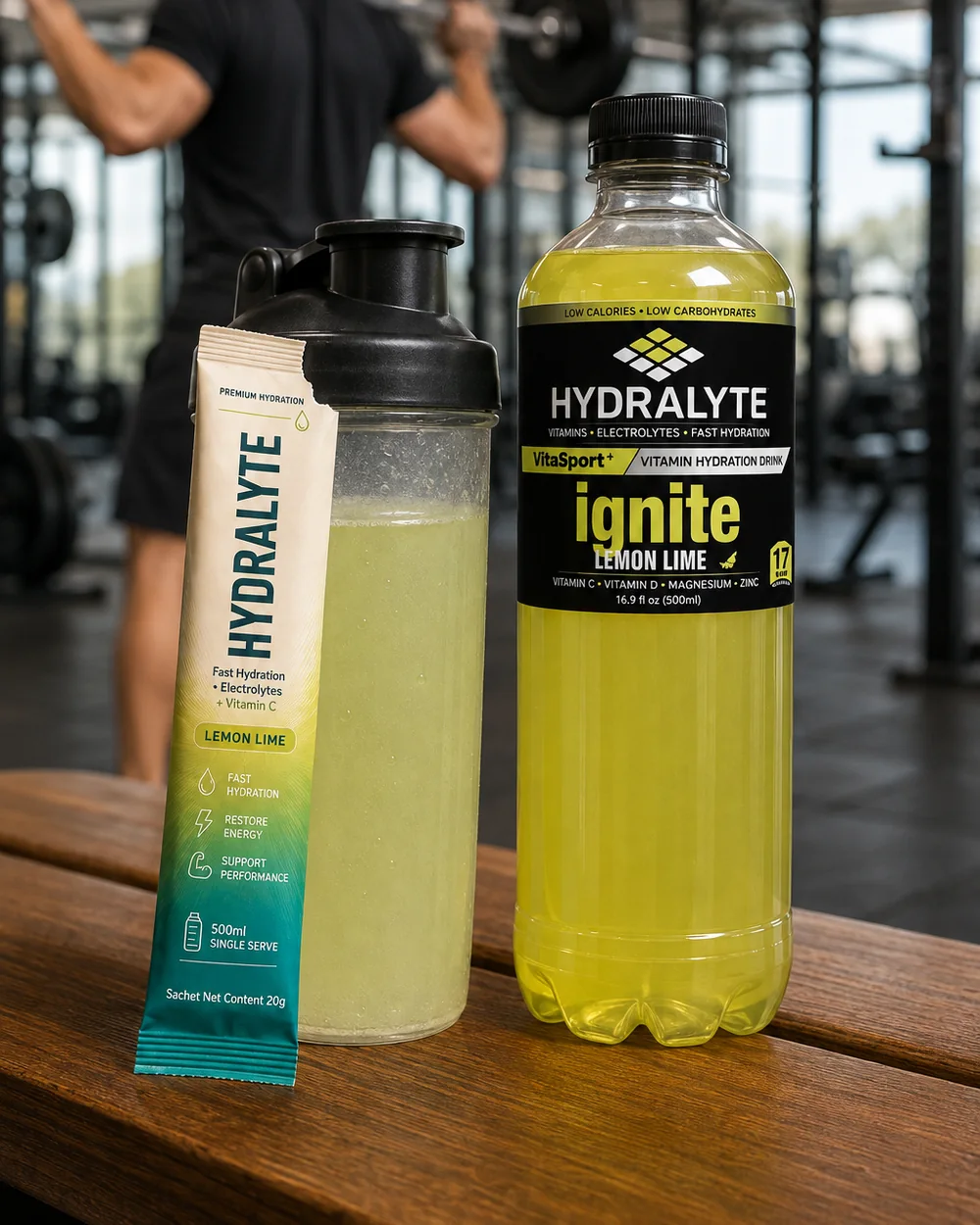
Air-conditioned gym bench with a torn-open Hydralyte Lemon Lime 20 g stick, a shaker of pale green drink and a VitaSport+ Ignite bottle

AC is not a shortcut

Indoor ≠ hydrated.

Air-conditioning cools the room, not the physiology. Three losses carry on indoors, and none of them announces itself.

  • Dry air. Chilled air holds less moisture, so every breath out gives up water vapour and skin loses moisture with no visible sweat — the “insensible” loss physiology textbooks describe.
  • Sweat you never see. In dry, moving air sweat evaporates about as fast as it forms. A hard 45-minute class costs fluid on the same scale as a warm walk; the wet-shirt cue just never arrives.
  • The coffee effect. At high doses caffeine has a mild diuretic effect. A cup or two does not undo hydration — but it is not water, either.
  1. Arrive with a glass

    250 ml of water — or a 10 g stick in 250 ml — about twenty minutes before the class or the first meeting.

  2. Sip through, not after

    A bottle on the bench or the desk, small sips every fifteen to twenty minutes, before thirst has a say.

  3. Match the serve to the session

    Under 45 minutes in a cool room: water is enough. A hard 45 minutes or more, a double session, or a long day in dry air: a 20 g stick in 500 ml afterwards.

General guidance, not medical advice. Adjust for body weight and the day’s heat with the personal hydration calculator.

Why not just water?

Water hydrates. Electrolytes retain.

Water alone cannot replace the minerals lost in sweat. In sustained heat, drinking only water can actually dilute remaining blood sodium — the opposite of what a working body needs. The chart below shows what a litre of sweat removes against what a 500 ml serve puts back.

What a litre of sweat takes vs what a 500 ml serve gives back

Milligrams — sweat loss shown as a range, Hydralyte serve as the value from the table above

0 500 1,000 1,500 2,000 mg Sodium (Na) per litre of sweat 460–1,840 per 500 ml serve 105 Potassium (K) per litre of sweat 160–390 per 500 ml serve 180

Sweat-loss values: typical ranges, sports-medicine literature (indicative). Serve values: Hydralyte per 500 ml, from the comparison table on this page.

A litre of sweat is not just water. Depending on fitness, acclimatisation and how salty a sweater you are, it carries somewhere between 460 and 1,840 mg of sodium and 160 to 390 mg of potassium out of the body — and on a hot afternoon a working adult can lose more than a litre an hour. Plain water refills the volume but replaces none of the minerals, so blood sodium drifts lower with every bottle. A 500 ml Hydralyte serve puts 105 mg of sodium and 180 mg of potassium back, in a potassium-heavy ratio built for daily prevention rather than clinical rehydration: enough sodium to keep the SGLT1 pump drawing water in, enough potassium to restore the fluid inside the cells that sweat quietly drains. The remaining sodium gap is deliberate — meals close it.

Hydralyte is formulated for proactive daily use — low in sodium, optimised for prevention rather than clinical recovery. That is what makes it safe for every single day, in a way hospital-strength ORS formulas are not.

How to use Hydralyte

Simple rules for hot-climate living.

01

Mix fresh, drink cold

Mix with cool water just before drinking — 250 ml for a 10 g stick, 500 ml for a 20 g stick or a scoop from the jar. Cold improves uptake behaviour, not just taste.

02

Front-load the heat window

A serve before peak exposure beats two after it. Between 10 AM and 4 PM outdoors, pre-hydration is the whole game.

03

One to three a day

Most people do well with one to three serves daily during heat, training or illness. Outside of that — water is all you need.

04

Office & travel: water first

A desk day in dry, chilled air is mostly invisible loss — keep water to hand and aim for the adequate-intake mark (about 2.0 L a day for women, 2.5 L for men, from all drinks and food). A 10 g stick in 250 ml earns its place on a long-haul flight, a 40 °C commute or a day of back-to-back meetings.

05

Indoor sport: judge by minutes, not sweat

AC evaporates sweat before you see it, so use the clock. Under 45 minutes in a cool room, water is enough. A hard 45 minutes or more, a double session or a heated class: a 20 g stick in 500 ml, or a cold VitaSport+ from the bag.

A day, dosed

Three serves. Zero maths.

07:00

Start ahead

One 10 g stick in 250 ml with breakfast front-loads fluid and potassium before the sun does its worst.

12:30

Midday top-up

A second serve with lunch replaces what the morning’s sweat took — sodium, mostly.

17:00

Train or commute

An ice-cold VitaSport+ or a tube in your bottle covers the evening session — or the drive home. Not sure which format? See all five formats.

Compare your drink

Put your usual bottle next to a serve.

Pick what you normally reach for and see the sodium, potassium, vitamin C and sugar side by side. The full version lives at /tools/electrolyte-comparison/.

Compare honestly

How does Hydralyte compare?

Pick what matters most to you and see which drink fits best. The match is calculated from the values in the table — nothing is hidden.

Per typical serving Electrolytes Potassium Sugar Vitamin C Calories Artificial colours / flavours
Hydralyte 5 mineralsHighLow500 mg36 (per 250 ml)None
Plain water NoneNone0 g0 mg0None
Typical sports drink 1–2 mineralsLow~30 g0 mg~80Often
Coconut water 4 mineralsHigh~9 g~3 mg~45None
Oral rehydration salts (ORS) 4 mineralsModerate~6 g0 mg~25None

Values are approximate and for general comparison per typical serving. Sports-drink and coconut-water figures vary widely by brand; check the label of any specific product.

Heat-stress assessment Working outdoors between 10 AM and 4 PM? Score your shift’s heat risk in two minutes and get a serve plan to match. Open the assessment

Questions, answered

The science FAQ.

How is Hydralyte different from a sports drink?

Sports drinks are built for taste and carry 20–35 g of sugar per 500 ml with modest electrolytes. Hydralyte flips the ratio: measured sodium, high potassium, 500 mg of vitamin C and low sugar. It’s hydration with a purpose — not a soft drink in gym clothing.

When should I choose Hydralyte over plain water?

Any time you’re losing more than you’re sipping: outdoor work between 10 AM and 4 PM, sessions over 45 minutes, long drives with the AC fighting 45°C outside, or days when cramps and headaches show up.

How many servings can I have in a day?

Most people do well with one to three a day: one before or during peak heat, one after sport or a heavy-sweat shift, and one whenever plain water isn’t cutting it. Outside of heat, exercise or illness, water is all you need.

I train in an air-conditioned gym. Do I still need electrolytes?

Sometimes. Chilled, dry air evaporates sweat as it forms, so an indoor session can cost as much fluid as a warm walk without a wet shirt to show for it. For a light session under 45 minutes, water is enough. After a hard class of 45 minutes or more, a double session or a heated room, a 20 g stick in 500 ml replaces the sodium and potassium that went with the sweat you never saw.

Is it suitable for children?

Yes — the formats mix to a gentle, low-sodium electrolyte serve that suits kids from around four years up (half a 250 ml stick serve). If your child has a medical condition, check with your paediatrician first.

Why low sodium?

Traditional rehydration formulas are sodium-heavy because they were built for clinical recovery. For daily prevention, a balanced potassium-to-sodium ratio supports absorption without pushing blood pressure the other way.

What do the five minerals actually do?

Sodium drives fluid uptake; potassium balances cellular fluid and supports muscle function; chloride pairs with sodium; calcium and magnesium support muscle and nerve signalling. Sweat removes all five — a good serve replaces all five.

I sit in an air-conditioned office all day. How much should I drink, and when does a serve help?

Most desk days are a water day. Aim for the adequate-intake mark — about 2.0 L a day for women and 2.5 L for men from all drinks and food — and keep a glass in reach, because dry office air takes water through breath and skin without any sweat. A 10 g stick in 250 ml helps on the days that run long: a flight, a hot commute, meetings that push water to the afternoon, or a headache creeping in.

More on the formats, flavours and the ready-to-drink line: formats · flavours · VitaSport+ · for business.

Do the maths

Your personal hydration number.

Body weight, activity and the day’s heat all change the target. The calculator does the sums — you do the drinking. Full version: /tools/personal-hydration-calculator/.

Know your numbers

Personal Hydration Calculator

Get a daily fluid and electrolyte target tuned to your body weight, activity and the climate you live and train in.

Fasting today? (e.g. Ramadan)
2.6 L target fluid intake / day
1–2 Hydralyte servings / day

A general wellness estimate, not medical advice. Fluid needs change with health conditions, medication and pregnancy — speak to a clinician if in doubt.

Feel the difference in a day.

Pick your format, mix your first serve, and see why water alone isn’t enough out here.