For Business
Keep your workforce
hydrated. Keep your
site compliant.
UAE law mandates approved rehydration materials on every work site. Hydralyte’s balanced isotonic electrolyte formula supports your workers — and your business — through the Gulf’s extreme summer months, with the documentation your HSE file requires.
The compliance context
The numbers every HSE manager plans around.
During the MoHRE midday break season (June 15 – September 15, 12:30–15:00), outdoor work stops at peak sun — but the 40°C+ hours on either side carry the real load, and approved rehydration materials must be in place throughout. Inadequate provision means fines, project-suspension orders and main-contractor audits. The calendar below is how a programme is sequenced around that window.
The summer programme calendar
Twelve-month rail: the mandated midday-break window sits inside a wider band of 40 °C+ afternoons — a programme is stocked before it, staffed through it and reviewed after it.
Pre-season · March to mid-June
Headcount and shift windows confirmed, welfare-station points mapped, first pallet drop scheduled so stock and signage are on site before 15 June — not chasing it in the first hot week.
In-season · 15 June to 15 September
Stations stocked daily around the midday break, scheduled replenishment of pouches and sticks, distribution logs kept per station and usage reports filed to your HSE records every month.
Post-season · mid-September to November
Consumption versus plan reviewed per site, surplus rotated to depots and camps that run year-round, the HSE pack closed out and next season’s baseline agreed.
Break window and hours are the MoHRE Midday Break rule as applied in the UAE; the 40 °C+ band is indicative of typical coastal-emirate afternoons and varies by site and year.
Check your site
Seven questions before the inspector asks them.
Run the self-assessment against the hydration and welfare side of the Midday Break rules. It scores the gaps, and the workforce planner further down turns the headcount into a supply schedule. The full version of each tool lives on its own page.
MoHRE Compliance Self-Check
Answer the questions below to see how your summer worksite measures up against the UAE Midday Break and heat-stress welfare requirements (15 June – 15 September, 12:30 – 15:00).
This self-check covers the hydration and welfare side of the programme only. Full MoHRE compliance also requires shaded rest, cooling provision, training and first-aid. It is guidance, not legal advice.
The reality
Heat stress costs more than you think.
Dehydration doesn’t just cause thirst — it triggers a cascade of physiological failures: impaired cognition, muscle cramps, heat exhaustion, and in severe cases, kidney damage and hospitalisation. For employers, the cost is doubled: medical bills plus lost productivity. The research is clear — proper electrolyte hydration is the most cost-effective intervention available.
The measured cost of heat stress
Share of affected workers / output loss — occupational heat-exposure research, GCC conditions
Indicative shares for planning, drawn from occupational heat-exposure research — not medical guidance.
The formula
Why employers switch from basic ORS.
Companies across the UAE are switching from basic ORS sachets and hypotonic electrolyte solutions to Hydralyte’s isotonic, balanced daily electrolyte formula — safer for daily use, more effective in sustained heat, and a formulation workforces actually finish. Clinical ORS is built for reactive rehydration after illness; a worker taking several serves a day for ninety summer days needs a low-sodium, potassium-forward profile designed for prevention. The documentation is the other half of the decision: a programme arrives with the paperwork an audit asks for, not just the product.
| Criteria | Hydralyte programme | Basic ORS sachets | No programme |
|---|---|---|---|
| Compliance documentation | Logs, spec sheets, usage reports included | Product only — paperwork is yours | Exposure to fines and suspension |
| Daily-use safety | Low sodium — safe every day | Clinical sodium load, not for daily use | — |
| Worker uptake | Four flavours, formats for every site | Medicinal taste, low uptake | Water alone, high risk |
| Audit readiness | HSE pack maintained monthly | Ad-hoc receipts | Findings per inspection |
| Supply predictability | Fixed scheduled supply | Per-purchase, variable | Incident and penalty exposure |
Industries we supply
Hydration programmes, tailored to the workforce.
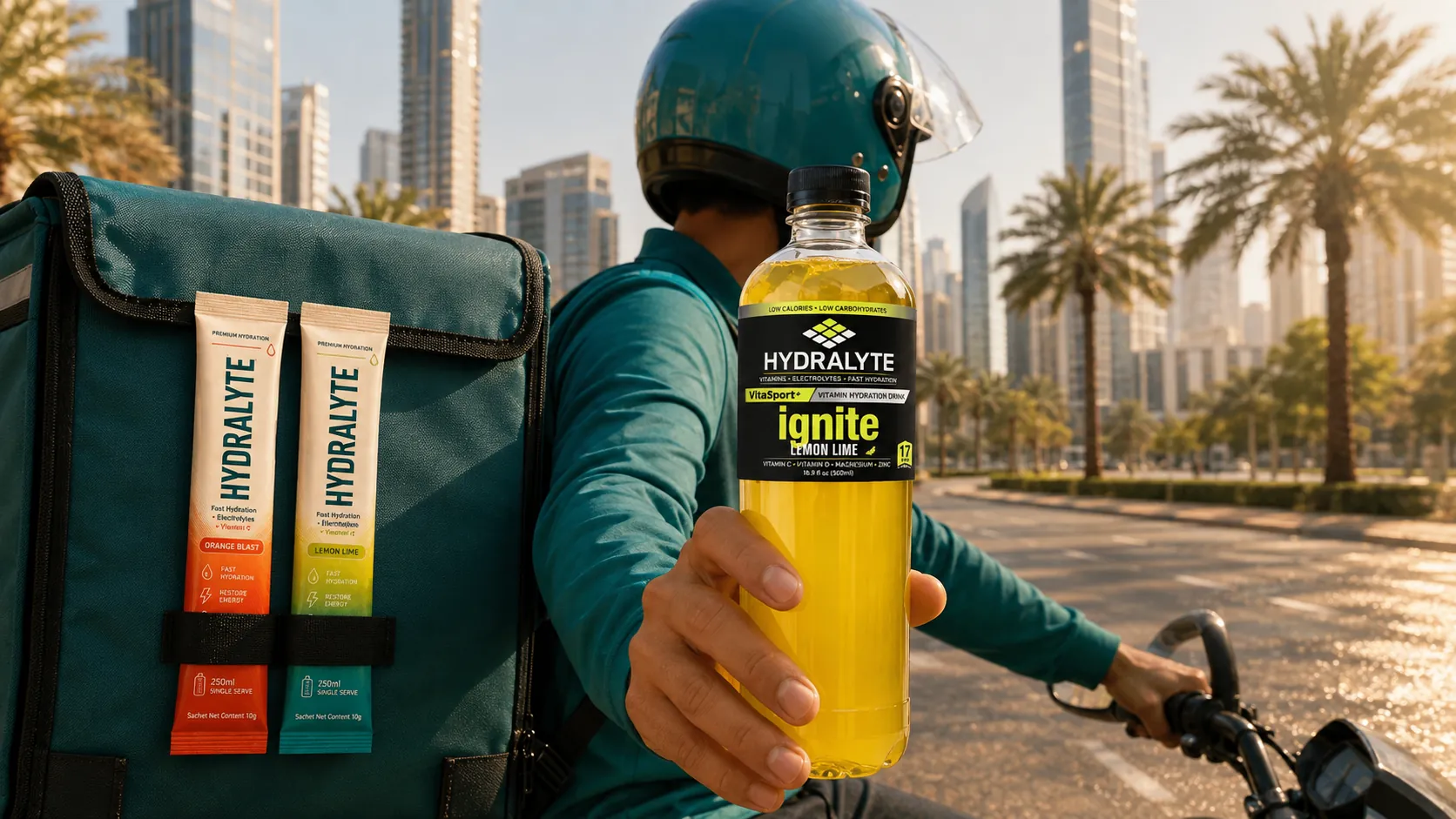
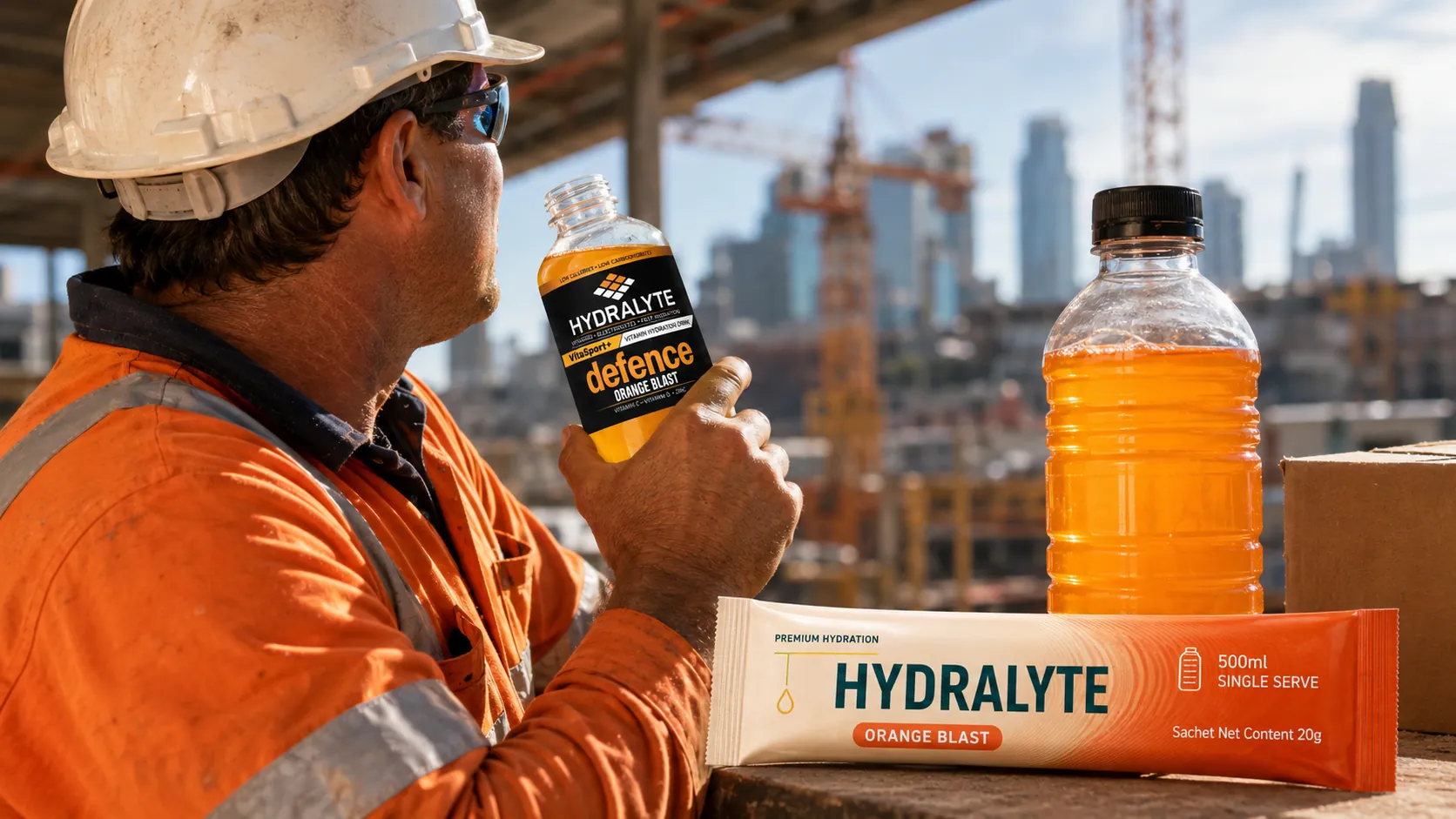
Site formats, supply schedules and documentation built for each industry — from construction welfare stations to fleet glove-box kits to oil & gas camps. Each industry page carries its own programme outline, formats and station layout.
How a programme runs
From walk-through to standing supply.
Assess
Site walk-through maps heat exposure, headcount and shift windows — the baseline for the whole programme.
Install
Welfare stations placed where workers actually are: shade points, gates, break areas. Signage included.
Supply
Scheduled replenishment in bulk formats — pouches for jugs, sticks for kits, VitaSport+ RTD for coolers.
Report
Usage reporting and compliance documentation filed to your HSE records — audit-ready, every month.
The planner
Size your programme right now.
Adjust the inputs to estimate the electrolyte servings your team needs per day and per month during the UAE summer, then read the worked example below to see how the same arithmetic becomes cartons on a pallet.
Workforce Hydration Planner
Size a hydration programme for your crew. Adjust the inputs to estimate the electrolyte servings your team needs per day and per month during the UAE summer.
Estimates assume 1–3 servings per worker per shift scaled by heat exposure and hours. Actual needs vary with acclimatisation, workload and individual health. Use as a planning starting point.
Worked example: a 500-worker site over a 26-day month
Four hydration tiers, one site, pure serve arithmetic. Every 20 g stick mixes 500 ml; every 800 g pouch holds 40 of those serves. Pick the tier that matches the shift and the table gives you the units to schedule — the quote adds the calendar and the paperwork.
| Tier | Per worker / day | Serves / day (site) | Serves / month | Litres / month | 20 g sticks | 800 g pouches |
|---|---|---|---|---|---|---|
| Essential | 500 ml · 1 serve | 500 | 13,000 | 6,500 L | 13,000 | 325 |
| Active | 1 L · 2 serves | 1,000 | 26,000 | 13,000 L | 26,000 | 650 |
| Performance | 1.5 L · 3 serves | 1,500 | 39,000 | 19,500 L | 39,000 | 975 |
| Peak | 2 L · 4 serves | 2,000 | 52,000 | 26,000 L | 52,000 | 1,300 |
Sticks and pouches are alternatives, not additions — a site usually runs pouches at welfare stations and a smaller stick allocation for kits and gate handouts. Tiers follow the planner’s heat-exposure logic; individual needs vary with acclimatisation and workload.
The planner turns headcount, heat exposure, shift hours and working days into a serves-per-month figure; the schedule follows from it. Divide that figure between the formats each station uses — pouches for jug-and-cup points, sticks for vehicles, kits and gate handouts — and it becomes cartons: standard cases hold 200 sticks or ten pouches, so the Active tier above is 130 cases of sticks or 65 cases of pouches. Split the month into two or four drops sized to the station’s storage, hold a buffer for the hottest fortnight, and log each drop against the distribution sheet. That log is what the monthly usage report is built from — and what the quote is scheduled around.
Deployment
What a station looks like when it works.
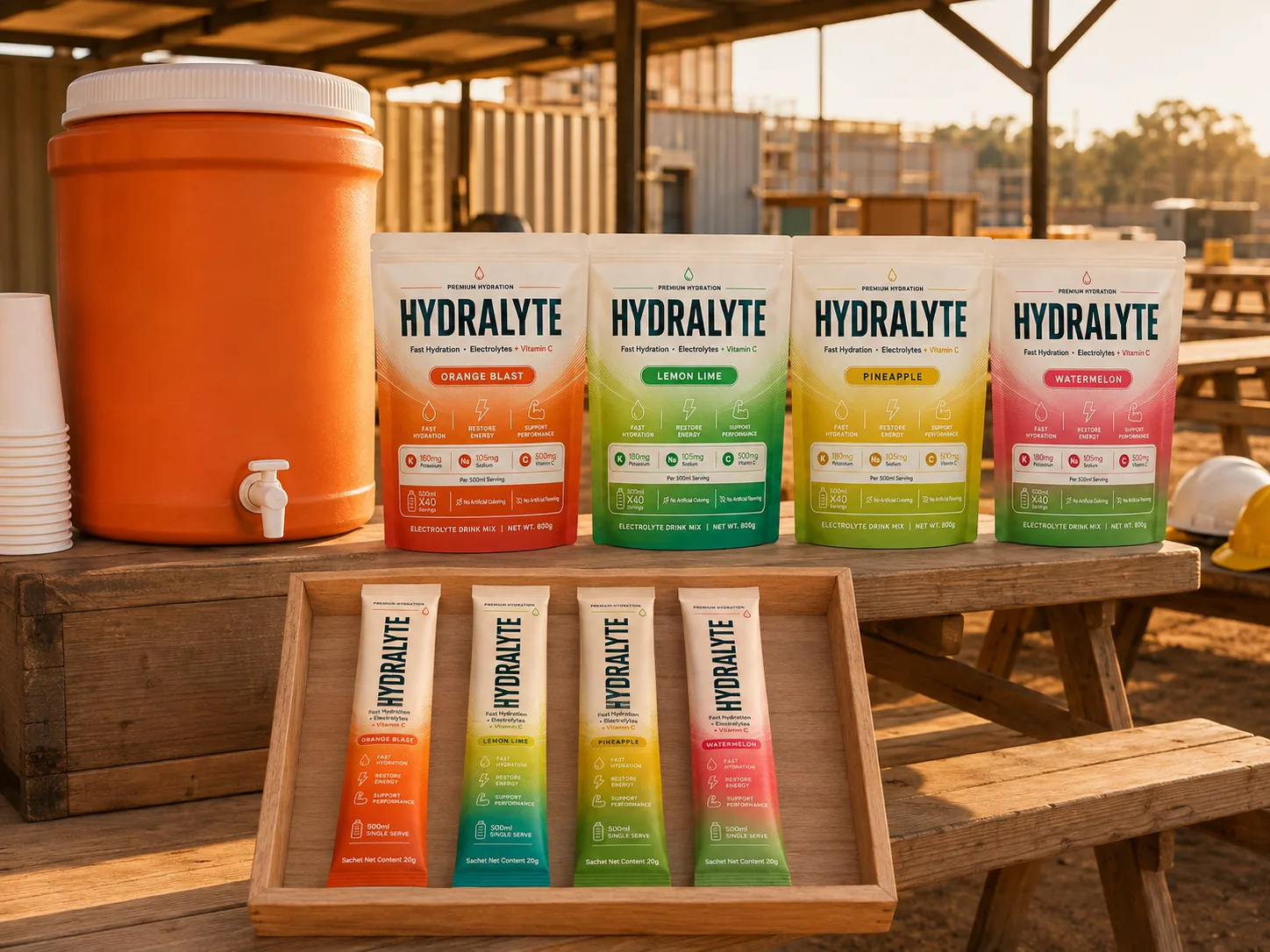
Jug-and-cup points at gates and shade areas, stocked and signed for the season — bulk pouch refills from a scheduled drop, no running dry at 2 PM in July. We build the layout, supply the formats, and keep the distribution logs.
Supply & logistics
Pallets timed to the season, not to purchase orders.
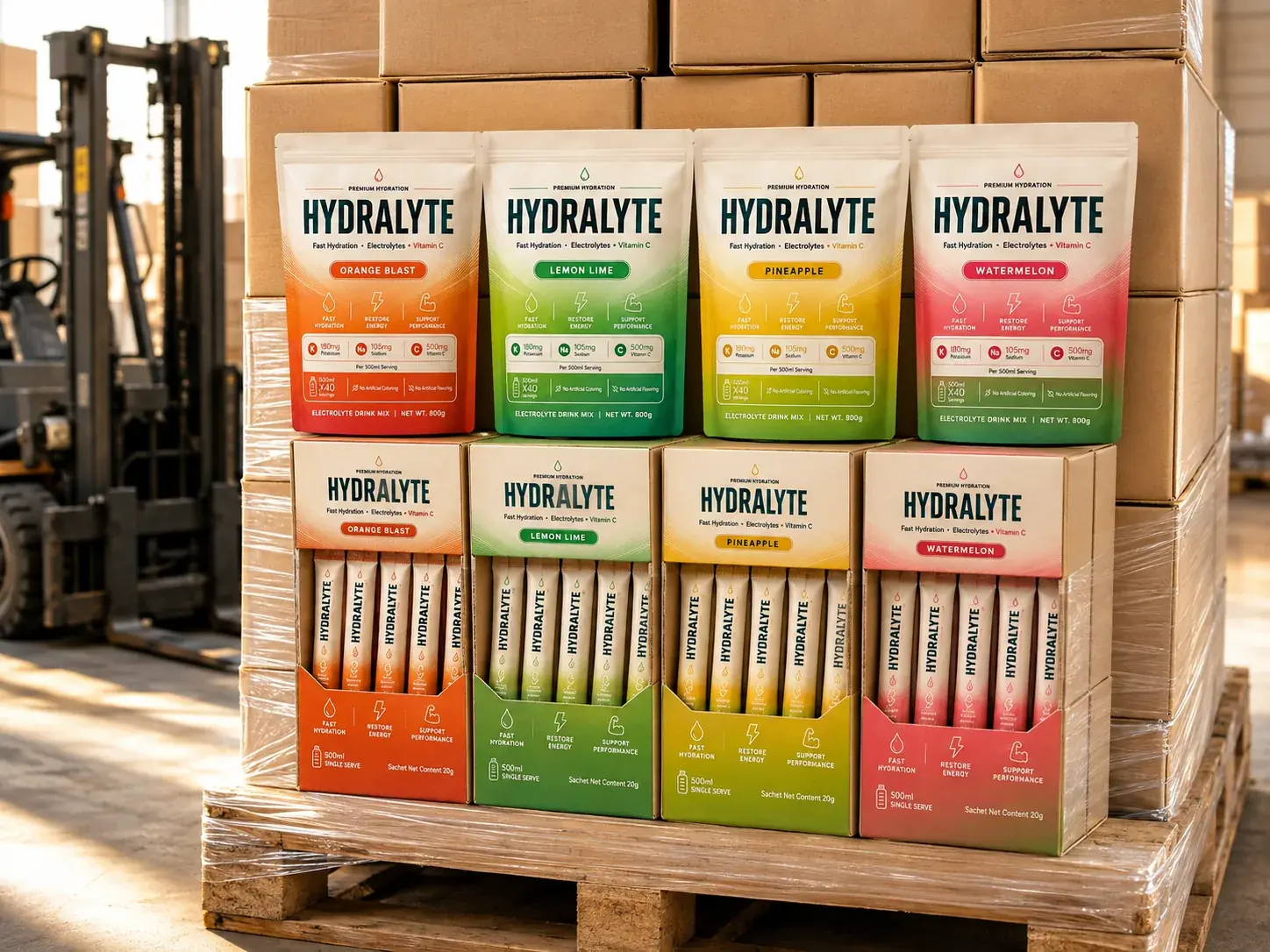
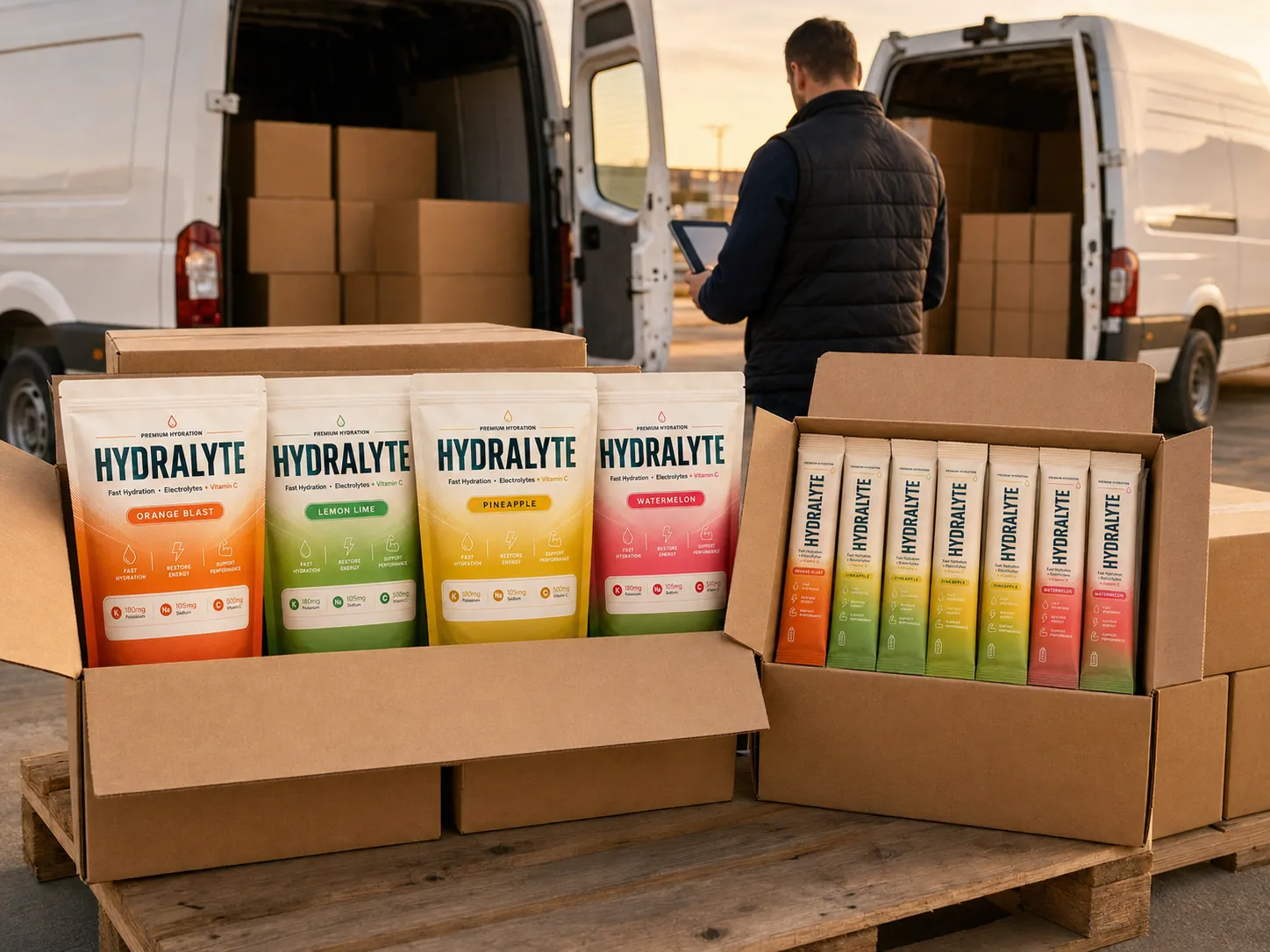
Bulk formats ship as plain cartons on shrink-wrapped pallets — 800 g pouches for stations, 20 g stick boxes for kits — from local stock, on a drop schedule agreed at quote. Multi-site accounts run one calendar across sites, camps and depots; the delivery note doubles as the first line of the distribution log.
Ready to drink
Coolers, cabs and camps run on VitaSport+.
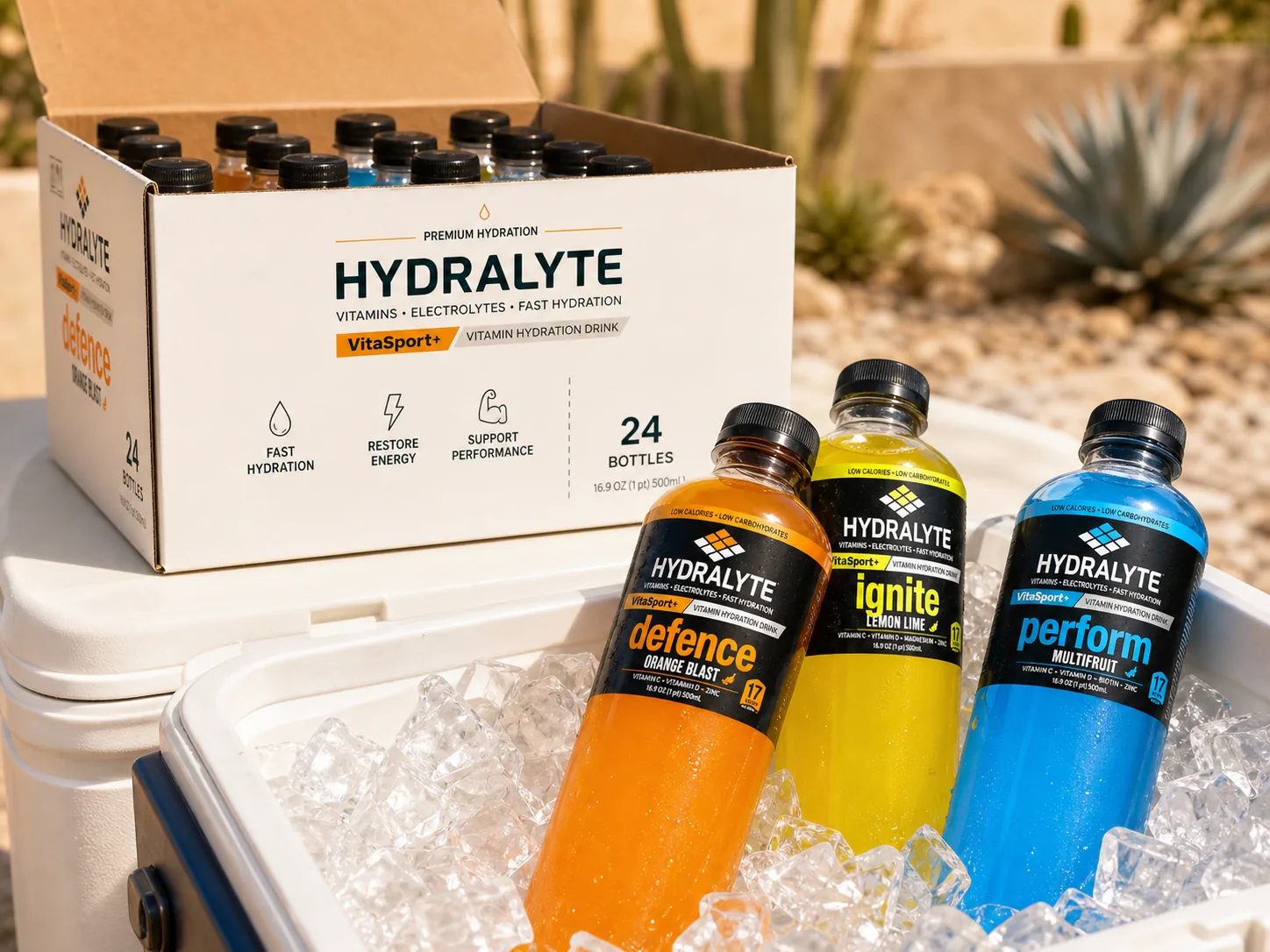
Where there is no jug and no time to mix — vehicle cabs, gate coolers, night shifts — the 500 ml VitaSport+ bottle is the format. Ignite, Defence and Perform ship in 24-bottle cases that stack on the same pallet as the pouches, so one drop covers the station and the fleet.
Paperwork
Audits love paper trails.
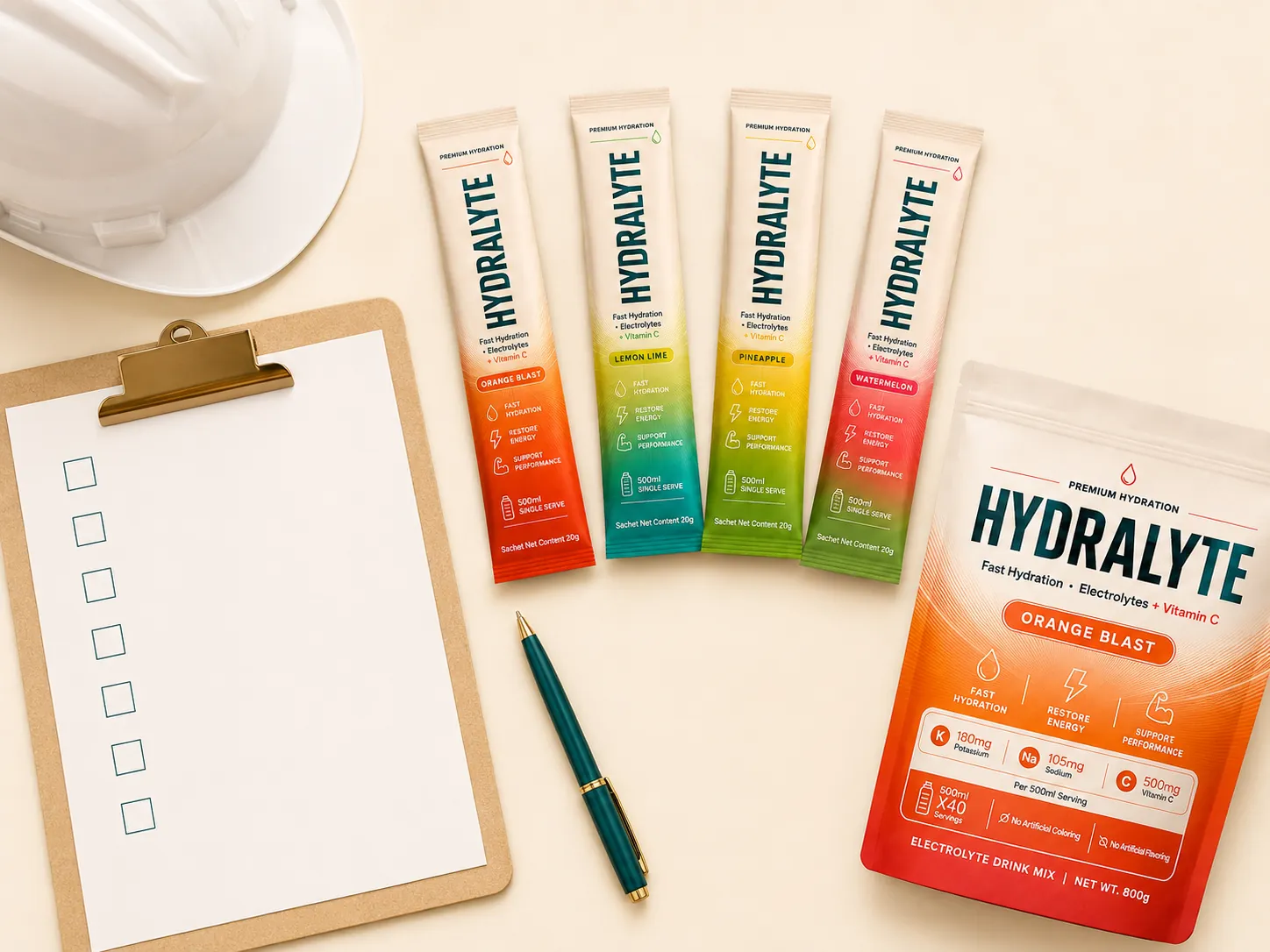
Distribution logs, product spec sheets and monthly usage reports — filed to your HSE records, ready before the inspector visits. Compliance is the floor; the paper trail is the ceiling. Everything in the pack below is maintained monthly for the life of the programme.
What the HSE pack contains
- Product spec sheetsPer-format specification and ingredient sheets for the audit file.
- Distribution-log templatesPer-station sheets to record each drop and daily issue.
- Monthly usage reportsConsumption against plan, per site, filed every month.
- Welfare-station signageMixing ratio and station signs, supplied at install.
- Replenishment & rotation calendarThe drop schedule by station, aligned to the season calendar.
- Heat-stress awareness one-pagerA toolbox-talk sheet on hydration and the midday-break rules.
Supplied at scale
The supply record behind every quote.
Hydralyte’s balanced isotonic formula keeps teams safe, hydrated and productive — from construction sites in Dubai to platforms off Abu Dhabi, logistics hubs in Jebel Ali and camps across the region — with delivery coverage across the GCC.
Procurement questions
What procurement asks before the first drop.
How long does it take to get a site supplied?
Standard formats are held in local stock and dispatched on a scheduled drop rather than order by order. Timing depends on quantities, formats and where the site is, so the quote confirms a delivery date for the first drop and a calendar for the rest of the season. Tell us the headcount and the start date on the bulk-inquiry form and we come back with both.
Which formats work best on a worksite?
800 g pouches for welfare stations — 40 serves of 500 ml per pouch, mixed into a 10-litre dispenser. 20 g sticks for glove-box kits, gate handouts and workers who mix their own bottle. VitaSport+ 500 ml RTD for coolers, cabs and camps where there is no jug. Most sites run pouches at the station and a smaller stick or RTD allocation for the people who move.
What documentation comes with a programme?
Product spec sheets, distribution-log templates, monthly usage reports, welfare-station signage, the replenishment calendar and a heat-stress one-pager for toolbox talks — the HSE pack listed above, maintained monthly and formatted to sit in your HSE records for main-contractor and MoHRE audits.
Can we trial it before committing a whole site?
Yes — start with a pilot station on one site. The station is installed, stocked and logged like a full programme, so at the end of the pilot you have real consumption data to size the rest of the season. Most corporate accounts scale to scheduled supply within the first month.
Do you deliver to sites and camps across the emirates?
Yes. Pallets go direct to sites, camps and depots across the UAE on the agreed schedule, and multi-site accounts run one calendar with a drop per location. For sites elsewhere in the GCC, tell us the location on the inquiry form and we confirm the route and lead time with the quote.
How does invoicing work for corporate accounts?
Corporate supply is quoted against your headcount and drop schedule and invoiced per delivery or per month, with quantities, formats and delivery dates itemised for your records. Account terms are set up with the trade desk during onboarding — mention your requirements on the bulk-inquiry form or email hydralyte@bagason.com and we take it from there.
Something specific to your site? Send it with the bulk inquiry or write to hydralyte@bagason.com.
Start with a pilot station on one site.
Most corporate accounts scale to scheduled supply within the first month. Quote back within one business day — with quantities, lead times and the documentation for your HSE file.