On a UAE worksite in July, a colleague stops sweating, becomes confused and then slumps to the ground. The next few minutes will shape the outcome. Knowing heat stress first aid is not optional knowledge for supervisors and workmates in this climate. It is a core safety skill, because severe heat illness can progress from looking unwell to a life-threatening emergency faster than most people expect, and the right early response can prevent lasting harm or save a life.
This guide explains how to recognise the warning signs, how to tell the difference between heat exhaustion and the far more dangerous heat stroke, and exactly what to do when someone collapses in the heat. It is written for real sites where help may be minutes away, where the temperature regularly exceeds 45°C and coastal humidity makes the air feel even hotter, and where a calm, practised response matters far more than perfect medical knowledge.
Heat illness is one of the most predictable workplace hazards in the Gulf, and one of the most preventable. Yet preparation alone is never quite enough, because conditions, workloads and individual fitness all vary. Every person on a hot site should therefore understand not only how to stop heat illness happening, but how to act decisively in the moment when prevention has failed and a workmate is in trouble.
Understanding how the body overheats
To respond well to heat illness, it helps to understand what is actually going wrong inside the body. Humans cool themselves chiefly by sweating: as sweat evaporates from the skin, it carries heat away. In the dry interior of the UAE this works reasonably well, but on the humid coast the air is already so saturated with moisture that sweat evaporates poorly, and the body's main cooling mechanism becomes far less effective even though the person is losing fluid and salts at a rapid rate.
When heat gain outpaces heat loss for long enough, the core temperature begins to climb. At first the body compensates, diverting blood to the skin and sweating harder. This is the stage of heat exhaustion. If the strain continues, the cooling system can fail outright, the core temperature soars, and the brain and other vital organs begin to suffer. This is heat stroke, and it is a true medical emergency. The progression from one to the other can be alarmingly quick, especially in workers wearing heavy protective gear or labouring through the hottest part of the afternoon.
Several factors make a worker more vulnerable: dehydration, lack of acclimatisation in someone newly arrived from a cooler climate, certain medications, alcohol the night before, existing illness, and simple exhaustion from consecutive long shifts. Recognising who is at higher risk on any given day is part of preventing collapses before they happen.
Recognising the warning signs early
Heat illness rarely arrives without warning. Before a collapse, there is usually a window in which a worker shows clear signs that the body is struggling to cope. Catching it here is far easier and safer than dealing with a full emergency, and it is in this window that a watchful colleague makes the biggest difference.
Heat exhaustion: the body sounding the alarm
Heat exhaustion is the stage where the body is overheating but still managing to defend itself. The person typically sweats heavily, feels weak, dizzy or nauseous, and may have a headache, muscle cramps, clammy skin and a fast, weak pulse. They may look pale and complain of feeling faint. They are usually still conscious and able to talk, even if their speech is sluggish. This is a serious signal, but it is also the moment when prompt action — rest, shade, cooling and fluids — can stop things getting worse.
Heat stroke: a medical emergency
Heat stroke is when the body's cooling system has failed and the core temperature climbs dangerously. The classic and most frightening signs are confusion, slurred speech, strange or aggressive behaviour, agitation, seizures or loss of consciousness. The skin may become hot and, in some cases of so-called classic heat stroke, sweating stops altogether and the skin feels dry. In exertional heat stroke, which is more common among working people, the person may still be sweating. The defining feature is altered mental state, not the skin. Heat stroke is a medical emergency, and every minute the body stays overheated increases the risk of permanent damage, so it must be treated with urgency.
The reason heat stroke is so dangerous is that a sustained high core temperature begins to damage cells throughout the body. The brain is especially sensitive, which is why confusion and unconsciousness appear, but the heart, kidneys, liver and the blood's clotting system can all be affected. Some of this damage can become permanent if the overheating is not reversed quickly, and in the worst cases heat stroke is fatal. This is precisely why on-site responders are taught to act on suspicion rather than wait for certainty: the cost of treating a bad case of heat exhaustion as heat stroke is a little extra caution, whereas the cost of treating heat stroke as mere exhaustion can be a life.
The grey area in between
In practice, the line between severe heat exhaustion and early heat stroke can be blurred, and you will not have a thermometer in the body's core to settle the question. The safe rule is this: if there is any change in how the person thinks, speaks or behaves — any confusion, drowsiness, disorientation or loss of consciousness — treat it as heat stroke and act accordingly. It is far better to over-react to heat exhaustion than to under-react to heat stroke.
What to do when a worker collapses
If a worker collapses in the heat, treat it as heat stroke until proven otherwise. Speed and cooling are everything. The aim is to call for help, get the person out of the heat and cool them as fast as safely possible while you wait for professional medical care to arrive.
- Call emergency services immediately and send someone to guide them to the exact location, which on a large site can otherwise cost vital minutes
- Move the worker into shade or an air-conditioned space straight away
- Remove heavy clothing and any protective equipment that traps heat
- Cool them aggressively with water, wet cloths, fanning or ice packs to the neck, armpits and groin, where large blood vessels run close to the surface
- If they are conscious and fully alert, give small sips of an electrolyte drink, but never force fluids on someone who is confused or unconscious
- If unconscious and breathing, place them in the recovery position and monitor their breathing closely until help arrives
Do not wait to see whether the person improves before calling for help. With heat stroke, time lost is the single biggest risk. Cooling should begin the moment you suspect it, not once professionals arrive. The most effective on-site cooling is whole-body water immersion or continuous dousing with cool water combined with fanning, because evaporation and conduction together pull heat away fastest.
It helps to think about why these methods work so you can improvise effectively with whatever is to hand. Conduction moves heat directly into a cooler surface, which is why cold water poured over the skin and ice packs against the major blood vessels are so useful. Evaporation carries heat away as moisture turns to vapour, which is why wetting the skin and then fanning hard is more effective than either on its own. Convection, the movement of air across the body, adds to this, so positioning the worker where air can move freely, or creating a draught with a fan or even a sheet of cardboard, all contribute. On a typical site you may not have an ice bath, but you almost always have water, something to fan with, and shade, and used together these are powerful.
Throughout the response, keep talking to the worker if they are conscious. Reassurance keeps them calm, and their replies tell you a great deal about their condition: clear, sensible answers are a good sign, while rambling, confusion or a failure to respond signals deterioration that should raise your urgency. Note the time symptoms began and the time you started cooling, as this information is genuinely useful to the medical team who take over.
Keeping yourself organised in the moment
In an emergency, clear roles prevent chaos. One person should take charge, one should make the emergency call, and one should fetch water and cooling supplies. If bystanders are milling about, give them specific jobs. A collapse is frightening, and a calm voice directing the response keeps everyone effective rather than frozen.
Common mistakes that make things worse
In the rush of an emergency, well-meaning responders sometimes do things that delay recovery. Knowing what to avoid is almost as valuable as knowing what to do, because a single wrong instinct can cost precious minutes.
One frequent error is waiting too long to escalate, hoping the worker will simply recover after a sit-down and a drink. With clear-cut heat exhaustion that may be reasonable, but if there is any confusion or loss of consciousness, treating it as heat stroke and calling for help immediately is the only safe choice. Another mistake is moving a collapsed worker more than necessary or trying to walk them somewhere, which can be dangerous if they are unsteady or unconscious; instead, bring shade and cooling to them where possible. Forcing fluids on someone who is not fully alert is a third common and serious error, as it risks choking and aspiration.
A further pitfall is using only one cooling method when several together would work far better. A single wet cloth on the forehead does little for a body that is dangerously overheated. Pour water over the torso and limbs, fan continuously, and apply cold packs to the major pulse points all at once. Equally, do not give up too early: cooling should continue until the person is clearly recovering or until medical professionals take over.
Cool first, transport second
A particularly important principle in severe cases is that aggressive cooling should not be delayed in order to move the person. The damage from heat stroke is driven by how long the body stays overheated, so cooling that begins on site, while help is on the way, is more valuable than waiting until the worker reaches a vehicle or clinic. Pour water over them, fan them, and apply cold to the neck, armpits and groin straight away rather than holding off until later. The phrase to remember is cool first, transport second.
Handling an unconscious or non-breathing worker
Most heat illness casualties remain conscious, but a small number lose consciousness, and the response in that situation must be confident and correct. The moment someone is unresponsive, the priorities shift to the basics of life support alongside cooling.
If the worker is unconscious but breathing normally, place them on their side in the recovery position. This keeps the airway open and allows any vomit to drain rather than be inhaled, which is a real risk given that nausea and vomiting often accompany severe heat illness. Continue aggressive cooling while they are in this position, and monitor their breathing constantly until help arrives, because their condition can change quickly.
If the worker is not breathing, or not breathing normally, this is a cardiac emergency on top of the heat illness. Begin cardiopulmonary resuscitation immediately if you are trained, send someone for the nearest defibrillator if one is available, and ensure emergency services are already on their way. Cooling can continue alongside chest compressions if there are enough people present, but restoring breathing and circulation takes precedence. This is exactly why sites in remote or high-risk settings should ensure that trained responders and basic equipment are genuinely within reach, not nominally available somewhere on a distant part of the site.
Caring for someone after they recover
If a worker improves with rest, shade and cooling, the response is not over. Someone who has suffered heat exhaustion remains vulnerable for the rest of the day and often beyond, and sending them straight back to heavy work in the sun risks a rapid relapse that can be worse than the first episode. The sensible course is to keep them resting in a cool place, encourage steady sips of an electrolyte drink if they are fully alert, and watch for any return of symptoms.
Anyone who showed signs of heat stroke, even briefly, should be assessed by a medical professional regardless of how quickly they seemed to bounce back. The body can look recovered while internal effects persist, and a proper check protects against complications that are not visible on site. It is also worth investigating why the episode happened at all. If one worker went down, others on the same task in the same conditions may be close behind, and adjusting the workload, breaks or hydration for the whole team can prevent a second casualty.
Documenting the incident
Every heat illness incident is a lesson. Recording what happened, the conditions at the time, how the person was working and how quickly they recovered builds a picture that helps prevent the next one. Patterns often emerge: a particular task, time of day, or crew that is repeatedly affected. Treating each event as data rather than a one-off keeps a site improving rather than repeating the same mistakes summer after summer.
It is worth being clear that documentation is not about assigning blame to the worker who fell ill. Heat illness is overwhelmingly a function of conditions, workload and provision, not personal failing, and a culture that treats a casualty as someone who simply could not cope will only push others to hide their symptoms until they too collapse. The purpose of recording is to understand the system: was water available and cold, was shade close, was the task scheduled into the hottest hours, had the worker recently arrived from a cooler climate. Honest answers to those questions are what prevent the next incident.
The spectrum of heat illness beyond exhaustion and stroke
While heat exhaustion and heat stroke are the two stages that matter most in an emergency, they are not the only forms heat illness takes. Recognising the milder conditions is valuable because they are early warnings that the body is under strain, and addressing them promptly often prevents progression to something dangerous.
Heat cramps are painful muscle spasms, usually in the legs, arms or abdomen, caused by the loss of salts through heavy sweating. They are a clear sign that a worker needs rest, shade and electrolyte replacement, not just plain water. Heat syncope is a brief fainting or dizziness that can occur when someone stands for long periods in the heat or rises suddenly; while often not serious in itself, a faint near machinery or at height can be catastrophic, so it must be taken seriously. Heat rash, the prickly irritation that develops where sweat is trapped against the skin, is uncomfortable rather than dangerous, but it too signals that a worker is sweating heavily and may be heading towards greater trouble.
The practical lesson is that these milder conditions are the body's early alarms. A worker with cramps or repeated dizziness should not simply be told to push on. Treating these signs as the start of a chain that can end in collapse, and acting on them with rest, cooling and electrolytes, is one of the most effective ways to keep small problems from becoming emergencies.
Who is most at risk, and why it matters
Heat illness does not strike everyone equally. Understanding which workers are more vulnerable on a given day allows supervisors to watch them more closely and adjust their workload before trouble develops. Risk is rarely about weakness; it is about a combination of physiology, circumstance and conditions.
Acclimatisation and new arrivals
Workers newly arrived from cooler climates, or those returning after a long leave, have not yet adapted to the heat. Acclimatisation is a real physiological process that takes days to a couple of weeks, during which the body becomes more efficient at sweating and conserving salts. Until that adaptation occurs, new arrivals are markedly more likely to suffer heat illness, even if they are young and fit. Phasing in their workload gradually rather than throwing them into full duties on day one is a simple, effective protection.
Health, lifestyle and the day before
A worker's condition on any given day shifts their risk. Dehydration carried over from the previous shift, alcohol consumed the night before, certain medications, an existing infection, poor sleep and simple fatigue from consecutive long days all reduce the body's ability to cope. None of these are visible at a glance, which is why encouraging workers to flag when they feel unwell, and creating a culture where doing so is welcomed rather than penalised, is so important. A worker who hides feeling rough to avoid seeming weak is a worker at risk of collapse.
The difference between recovery and tragedy is preparation
Most heat emergencies are not bolts from the blue. They build over a shift, often on a day when the conditions were predictable. Knowing in advance how hot and demanding a day is likely to be lets supervisors plan rest, shade and fluids before anyone gets into trouble. A simple way to do this is to %assess the heat stress risk on your site% so that high-risk days are flagged and staffing, breaks and hydration are adjusted accordingly.
Certain environments carry higher stakes than others. Confined spaces, heavy protective gear and remote locations all make heat illness more likely and harder to treat, which is why %people working in oil and gas% need especially robust first aid arrangements and trained responders close at hand. The further help is from the worker, the more the on-site response has to carry the load, and the more important it becomes to have practised the drill.
Heat illness response and UAE compliance
Heat safety in the UAE is not only a matter of good practice; it is a legal obligation. During the hottest months, the summer <a href="/industries">Midday Break</a> Rule prohibits work in the sun and in open areas during the hottest part of the day, typically from around half past noon until mid-afternoon, each year from mid-June to mid-September. The rule is enforced by the Ministry of Human Resources and Emiratisation, and it exists precisely because that window is when heat stroke is most likely.
Employers should therefore align their first aid readiness with their wider compliance duties. Scheduling the most demanding tasks outside the prohibited hours, providing shade and rest facilities, and ensuring rehydration supplies are stocked are all part of meeting the standard expected of a responsible employer. If you are unsure where your site stands, it is worth taking a moment to %check your obligations under the Midday Break Rule% before the peak of summer, so that gaps are closed before they become incidents.
Compliance and care reinforce each other. A site that follows the rules on working hours and rest is also a site where workers are less likely to reach the point of collapse in the first place, which means fewer emergencies for first-aiders to manage.
Preventing the collapse in the first place
The best heat emergency is the one that never happens. While this guide is about responding when a worker goes down, the wider goal of any hot-weather safety programme is to make collapses rare. Prevention rests on a handful of well-understood measures that, applied together, dramatically reduce the number of emergencies a first-aider ever has to manage.
Hydration before, during and after the shift
Proper hydration is the foundation. Workers should arrive already hydrated rather than trying to catch up once they are sweating hard, drink steadily throughout the shift rather than waiting for thirst, and continue replacing fluids and salts after work as the body recovers. Because heavy sweating strips away electrolytes as well as water, plain water alone is not enough for sustained heavy work; salts must be replaced too, or a worker can drink plenty and still slide towards trouble.
Work scheduling and rest
Scheduling the hardest physical tasks for the cooler parts of the day, building in regular rest in shade, and rotating workers through demanding duties all reduce the cumulative heat load on any one person. The UAE summer working-hours restrictions exist precisely to take people out of the worst of the heat, and building site routines around them, rather than treating them as an interruption, is the mark of a well-run operation.
Shade, monitoring and the buddy system
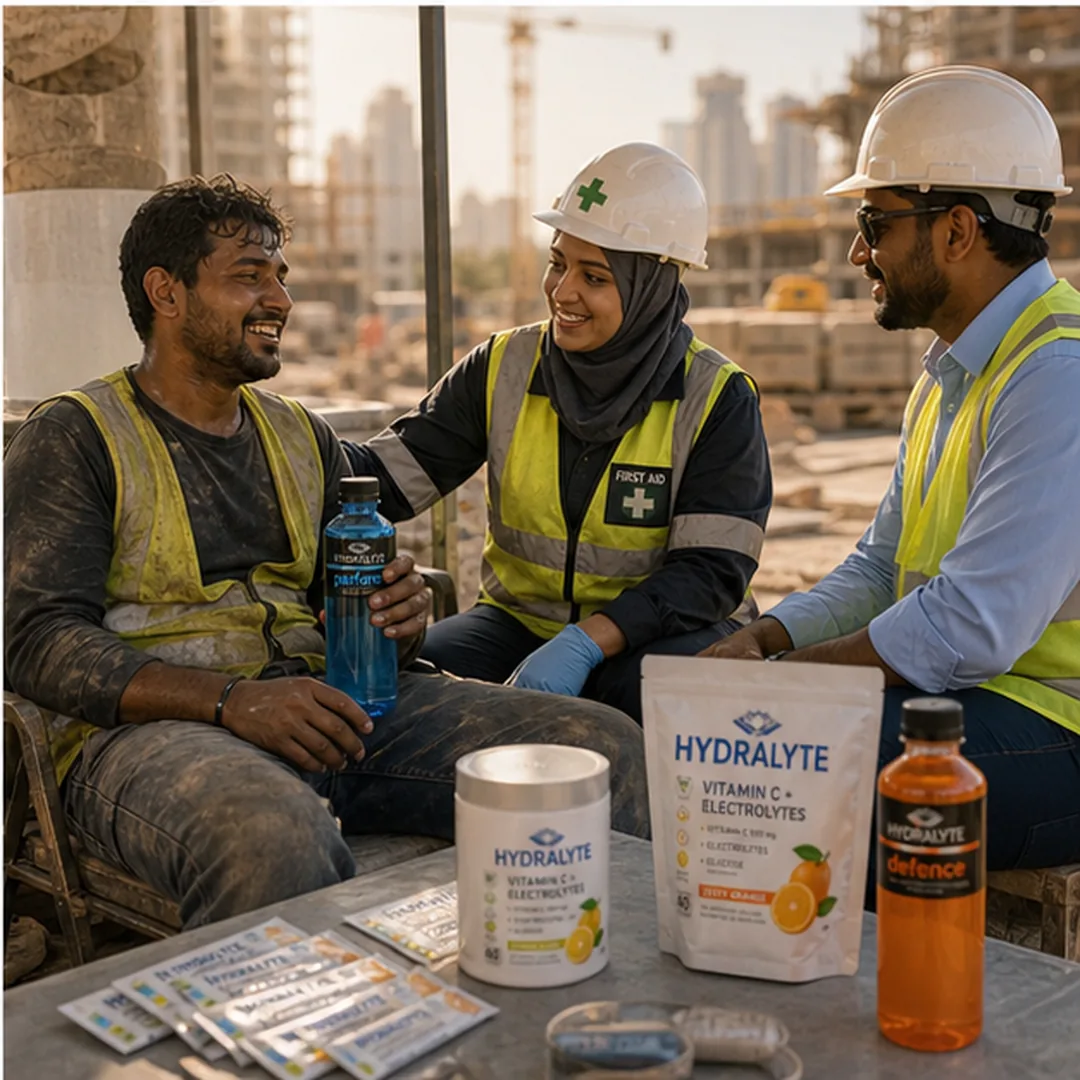
Accessible shade lets the body shed heat during breaks. A simple buddy system, where workmates keep an eye on one another and know the early signs of heat illness, catches problems while they are still minor. Many collapses are preceded by a colleague noticing that someone is unusually quiet, stumbling or confused; empowering workers to act on that observation, rather than wait for a supervisor, saves lives.
Equipping responders and training the team
Knowing the theory of heat first aid is not the same as being able to deliver it under pressure. The sites that respond best to heat emergencies are those that have turned knowledge into a practised, well-equipped routine, so that when a worker collapses nobody has to stop and think about where the water is or who should call for help.
What trained responders should be able to do
At a minimum, designated first-aiders on a hot site should be confident recognising the difference between heat exhaustion and heat stroke, initiating aggressive cooling with whatever is to hand, managing an unconscious but breathing casualty in the recovery position, and performing basic life support if breathing stops. They should also know the local emergency numbers, the exact site address and access points to give to dispatchers, and the quickest route to guide an ambulance in. Training that is refreshed before each summer keeps these skills sharp rather than half-remembered from a course taken long ago.
Running heat illness drills
A drill turns a poster into a reflex. Periodically walking a crew through a simulated collapse — who takes charge, who calls, who fetches water, where the casualty is moved, how cooling begins — reveals the gaps that only show up in practice, such as a cooling supply that is locked away or a part of the site where it is unclear who would respond. Fixing those gaps in a drill is far cheaper than discovering them during a real emergency. Drills also build the calm familiarity that keeps people effective when the real thing is frightening and chaotic.
Keeping the right supplies within reach
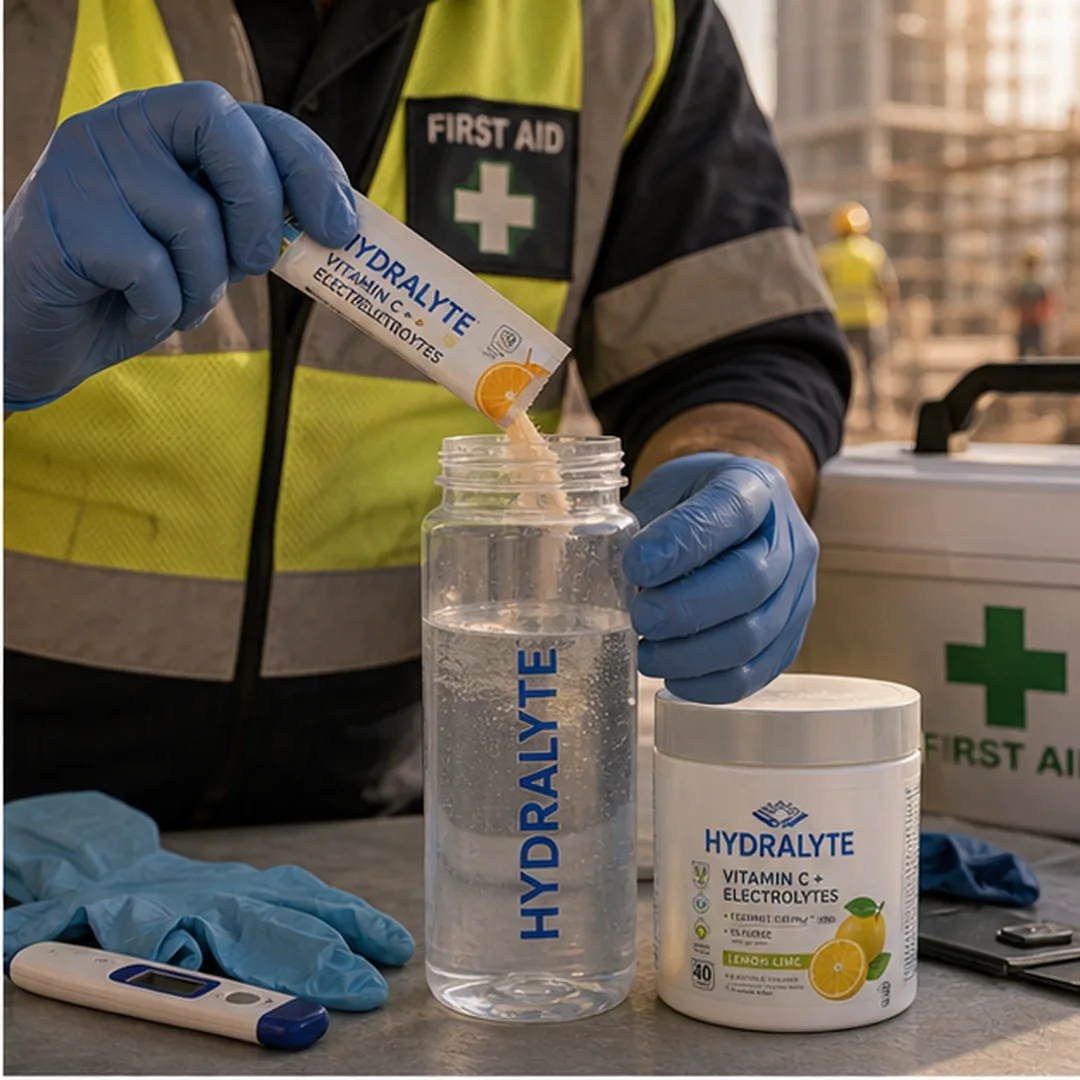
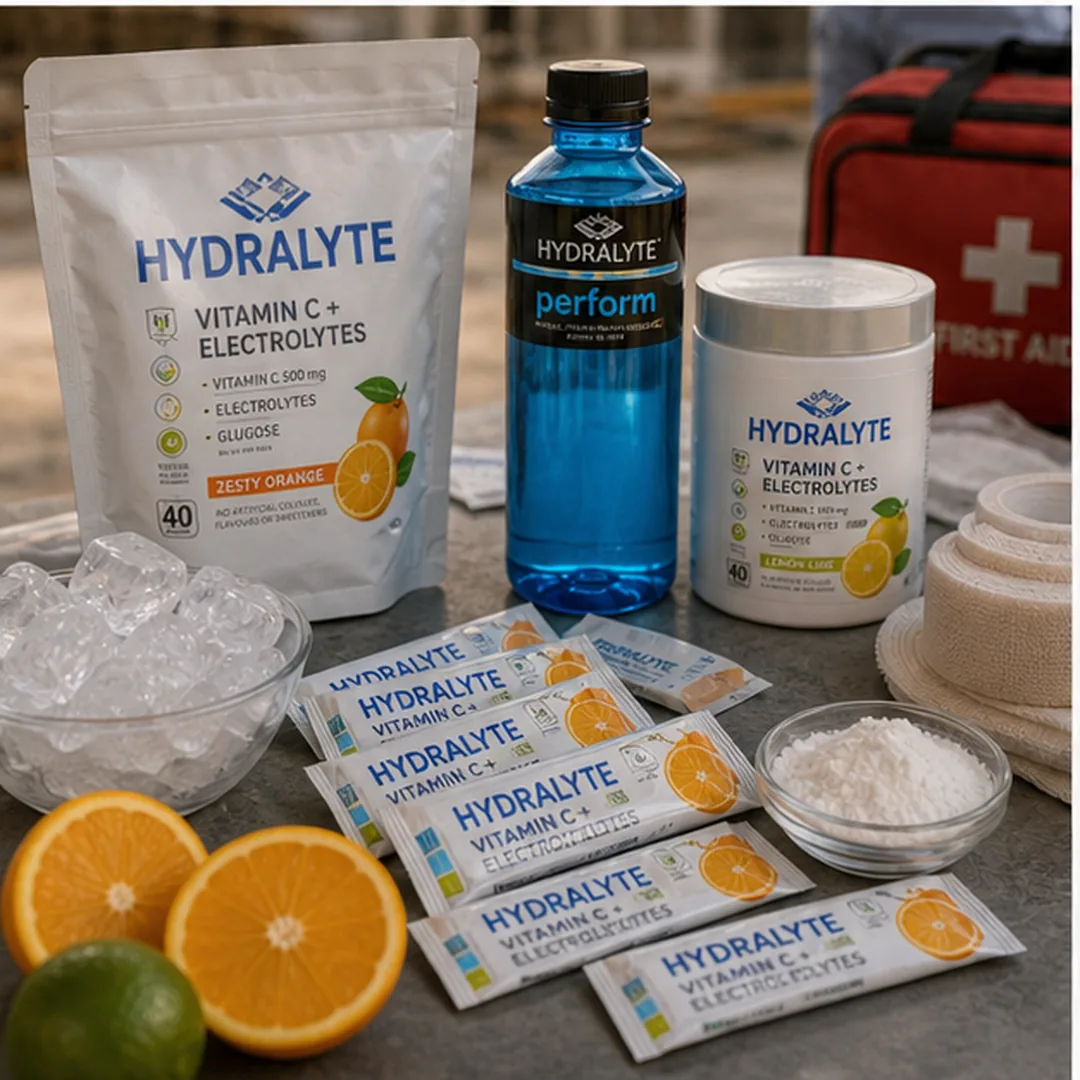
Even the best-trained responder is limited by what is available. Cool drinking water, electrolyte drinks, ice or cold packs, clean cloths, fans where power allows, and clearly marked shaded rest areas should all be in place and checked before the peak of summer, not scrambled together when someone is already down. On large or dispersed sites, supplies need to be distributed so that there is always cooling close to where people work, because help that is a long way off forces the first response to rely entirely on what is to hand.
Building heat illness response into your safety culture
First aid knowledge fades if it is never practised. The most resilient sites treat heat illness response as a regular drill rather than a poster on a wall. Supervisors should know the signs, every team should know who to call and where shade and cooling supplies are kept, and electrolyte drinks should be stocked and within easy reach before the worst of the summer arrives.
The same principles apply well beyond construction. Drivers, warehouse staff and %logistics and transport crews% face their own heat risks, often working alone or in vehicles where a developing problem may go unnoticed until it is severe. Tailoring the response to the working pattern — lone-worker check-ins, in-cab water supplies, scheduled stops — matters as much as having a first-aider on a fixed site.
Prevention and response are two halves of the same effort. A <a href="/industries">workforce</a> that is well hydrated, well rested and acclimatised is far less likely to suffer heat illness, which is why it pays to %plan rehydration for the whole workforce% rather than leaving hydration to individual habit. Good planning reduces the number of emergencies; good first aid handles the ones that still occur.
Heat stress first aid comes down to a simple sequence: recognise the signs early, escalate fast when someone collapses, and cool aggressively while help is on its way. None of it requires advanced training, only awareness and preparation. The same sequence works whether you are a supervisor, a first-aider or simply the nearest workmate, which is exactly why everyone on a hot site should know it rather than leaving it to a single trained person who may not be present when it counts.
If there is one idea to carry away from all of this, it is that heat illness is a continuum, not a switch. A worker does not leap from healthy to collapsed in an instant; they pass through warning stages that an attentive colleague can see. The whole art of heat safety lies in acting early — at the cramp, the dizziness, the unusual quietness — rather than waiting for the dramatic moment of collapse. When prevention has nonetheless failed and someone goes down, the response is not complicated, but it must be fast, decisive and well-rehearsed. Recognise, escalate, cool. Practise it before the summer, make sure everyone knows it, and keep the supplies that make it possible within reach.
If you want help building a heat safety plan or stocking the right rehydration supplies for your team, %speak to our team% and we will point you in the right direction.
Frequently Asked Questions
How can I tell heat exhaustion from heat stroke?
The key difference is mental state and the body's ability to cool itself. With heat exhaustion the person is usually still alert, sweating and able to talk, even if they feel weak or dizzy. With heat stroke there is confusion, slurred speech, strange behaviour or loss of consciousness, which makes it a medical emergency. If you are ever unsure, treat it as heat stroke and call for help, because under-reacting is far more dangerous than over-reacting.
Should I give a collapsed worker something to drink?
Only if they are fully conscious and alert. In that case small sips of an electrolyte drink can help replace lost fluid and salts. Never try to give fluids to someone who is confused, drowsy or unconscious, because they may choke or inhale the liquid. Focus instead on calling for help and cooling them down aggressively.
What is the most important first step when someone collapses in the heat?
Call emergency services immediately and begin cooling at once. Do not wait to see if the person recovers on their own. With suspected heat stroke, every minute the body stays overheated raises the risk of permanent harm, so rapid cooling and professional help cannot be delayed. Send someone to guide the ambulance in while cooling continues.
How do I cool an overheated worker quickly?
Move them out of the heat into shade or air conditioning, remove heavy clothing and trapped-heat gear, and cool the body aggressively using water, wet cloths, continuous fanning and ice packs placed at the neck, armpits and groin. Use several methods together rather than one alone, and keep cooling until help arrives or their condition clearly improves.
Why does sweating sometimes stop during heat stroke?
In classic heat stroke the body's cooling system has been so overwhelmed that it can no longer produce sweat, leaving the skin hot and dry. However, in the exertional heat stroke more common among working people, the person may still be sweating. For this reason you should never rely on the presence or absence of sweat to judge severity; the decisive sign is a change in mental state such as confusion or unconsciousness.
Can someone seem fine after heat stroke and still need a doctor?
Yes, and this is a dangerous trap. A person can appear to recover on the surface while internal organs are still affected, and complications may develop hours later. Anyone who showed signs of heat stroke, even briefly, should be assessed by a medical professional regardless of how quickly they seemed to bounce back. Do not let an apparent recovery talk you out of seeking proper care.
Is it safe to send a recovered worker back to work the same day?
No. Someone who has suffered heat exhaustion or heat stroke remains far more vulnerable for the rest of the day and beyond. Returning them to heavy work in the sun risks a relapse that can be more severe than the first episode. Keep them resting in a cool place, encourage steady rehydration if they are alert, and reassign or stand them down rather than risk a second collapse.
Who on a worksite should know heat stress first aid?
Everyone. While dedicated first-aiders are essential, a collapse can happen anywhere on a large site, and the nearest workmate is often the first responder. Because the core sequence — recognise, escalate, cool — is simple, every worker and supervisor should know it. Relying on a single trained person who may be elsewhere when an emergency strikes leaves dangerous gaps.
How does the UAE Midday Break Rule relate to heat first aid?
The Midday Break Rule prohibits work in the sun and open areas during the hottest part of the day in summer, enforced by the Ministry of Human Resources and Emiratisation. It exists because that window carries the highest risk of heat stroke. Following it reduces the number of emergencies, but it does not remove the need for first aid readiness, since heat illness can still occur during permitted hours or in hot indoor environments.
What supplies should a hot site keep ready for heat emergencies?
At minimum, keep a supply of cool drinking water, electrolyte drinks, ice or cold packs, clean cloths, fans where power allows, and shaded rest areas close to where people work. A clear emergency contact procedure and trained responders complete the picture. Stocking and checking these before the peak of summer ensures they are available the moment they are needed rather than missing in a crisis.