When people picture heat-exposed work in the UAE, they tend to think of construction sites and outdoor labour. Delivery and logistics drivers rarely come to mind — yet driver hydration in the UAE is one of the most underestimated heat-safety challenges of the Gulf summer. Drivers spend their days moving between the relative comfort of an air-conditioned cab and the searing heat of loading bays, doorsteps and unshaded streets, often dozens of times in a single shift.
This stop-start exposure creates a deceptive hydration pattern. Because drivers are not continuously in the sun, they and their employers may assume the risk is low. But each delivery brings a burst of exertion in extreme heat, and the cumulative fluid loss across a long route can be substantial. Add the dehydrating effect of running the air conditioning, the temptation to limit drinking to avoid toilet stops, and the rise of last-mile e-commerce volumes that pack more drops into every shift, and drivers can finish a day seriously depleted without ever feeling they were "in the heat" for long.
The UAE summer makes this far more than a comfort issue. With daytime temperatures regularly climbing past 45°C and coastal humidity pushing the heat-stress index higher still, a driver who falls behind on fluids is at real risk of heat exhaustion, impaired judgement and, in the worst cases, heat stroke. This guide looks at why drivers under-hydrate, how the risk differs from a fixed worksite, and the practical steps fleets can take to keep their people safe on the move through the hottest months of the year.
The hidden hydration risk for drivers
The core problem is that a driver's heat exposure is intermittent but intense. Stepping out of a cooled cab into the afternoon heat to carry parcels up a flight of stairs is a sharp physical demand, repeated again and again across a shift. The body never gets a long, settled period to adapt; instead it lurches between cool and hot environments, which is tiring in its own right and blunts the natural cues that would otherwise prompt a worker to drink.
Crucially, this pattern makes it easy to misjudge fluid needs. A worker on a static outdoor site is constantly reminded that it is hot, so drinking tends to stay front of mind. A driver in a cool cab may simply forget. For anyone managing %logistics and delivery operations%, recognising this hidden risk is the first step to addressing it, because the solution looks quite different from hydration on a fixed site. The intermittent exposure means the danger is spread thinly across the day rather than concentrated, which is exactly what makes it so easy to overlook until a driver is already in trouble.
Consider a typical last-mile driver working an August route through Dubai or Sharjah. They might leave a cool depot at first light, then over the next ten hours make sixty or seventy individual drops. Each one means opening the cab door, stepping into 45-degree heat, lifting and carrying parcels, perhaps climbing stairs or waiting at a gate, then returning to the cab to cool down for a few minutes before the next address. Across a full shift those short bursts add up to hours of cumulative heat exposure and heavy sweating — yet at no single moment does the driver feel they have been baking in the sun, because the cab keeps resetting their sense of comfort. By the time the route is finished, a driver who has not drunk deliberately and consistently can be carrying a fluid deficit equivalent to a hard day of outdoor labour, without ever having registered it as such.
Why the risk is rising
The growth of online shopping and on-demand delivery has reshaped logistics across the UAE. Where a route might once have meant a handful of bulk drops to businesses, last-mile drivers now make dozens of individual deliveries to homes and apartment blocks, each requiring them to leave the cab. More stops mean more heat exposure, more exertion and more cumulative sweat loss, all compressed into tight delivery windows. The hydration challenge has grown alongside the parcel volumes, but operational planning has not always kept pace.
The structure of the delivery sector adds another layer. Many drivers are employed through contractors or work to demanding service-level agreements with narrow delivery windows. Vehicles are often shared across shifts, so a driver may not have a consistent, personally stocked cab. Routes can change daily based on demand, meaning a driver rarely settles into a familiar rhythm of known rest points. All of this works against the steady, habitual drinking that good hydration depends on, and it means fleets cannot assume drivers will solve the problem on their own. The operating model itself has to make hydration easy.
How dehydration affects driving performance and safety
Hydration is not only a health concern; it is a road-safety concern. Even mild dehydration measurably degrades the cognitive functions a driver relies on most: concentration, reaction time, alertness and short-term memory. A driver who is a few per cent down on fluids may take fractionally longer to register a hazard, judge a gap or react to a sudden stop — and in dense UAE traffic, fractions of a second matter. Studies into driving and dehydration have consistently found that the impairment is comparable to the kind of lapse that comes with fatigue, which is itself a leading factor in road incidents.
The risk compounds because dehydration and heat both push in the same direction. As a driver overheats and dries out, they become more tired, more irritable and slower to think, exactly when the demands of the road require them to be sharp. A frustrated, foggy driver is more likely to make an aggressive manoeuvre, miss a turning or misjudge a reversing space at a delivery point. Framing hydration as part of safe driving — not merely personal comfort — helps both drivers and managers take it as seriously as seatbelts, speed and rest.
Why drivers under-hydrate
Several practical pressures push drivers towards drinking too little. Tight delivery schedules discourage stops of any kind, including for water or the toilet. A cool cab masks the body's signals that it is overheating. And the simple logistics of carrying and accessing cold drinks while driving can be a barrier in themselves. The result is a <a href="/industries">workforce</a> that is quietly at risk despite spending much of the day indoors.
There is also a cultural and psychological dimension. Many drivers see stopping to drink as time lost, or worry that frequent pauses will be read as poor performance. Where pay is linked to the number of drops completed, the incentive to keep moving and skip breaks is even stronger. Until fleets actively signal that hydration stops are expected and protected, these pressures will continue to win out over good intentions.
It is worth naming the toilet problem directly, because it is one of the biggest hidden drivers of under-hydration and one that managers are often reluctant to discuss. On long routes through areas with few accessible facilities, drinking enough water inevitably means needing to stop, and a driver under time pressure quickly learns that the simplest way to avoid that interruption is to drink less. This is a false economy that trades a minor inconvenience for a genuine health risk. Fleets that map clean, accessible facilities along routes, allow realistic time for stops, and make clear that nobody will be penalised for using them remove one of the most powerful reasons drivers give for going short on fluids.
Common barriers to staying hydrated on the road
- Schedule pressure that discourages stopping to drink or use facilities
- The cooled cab hiding the body's heat-strain signals
- Deliberately drinking less to avoid needing the toilet between stops
- Warm water in the cab becoming unappealing as the day wears on
- No designated place to keep cold fluids within easy reach
- Performance pressure or piece-rate pay that makes any pause feel costly
Recognising the warning signs on the road
Because drivers work without direct supervision, knowing the early symptoms of dehydration and heat strain is a frontline defence. The first signs are often subtle: a dry mouth, a nagging headache, darker urine and a general feeling of fatigue. As fluid loss deepens, drivers may notice dizziness, muscle cramps, poor concentration and irritability — all of which are particularly dangerous behind the wheel.
More serious heat illness announces itself through nausea, confusion, a rapid pulse and, in the case of heat stroke, a worrying change such as the skin becoming hot and dry, or behaviour turning erratic. A driver who reaches this stage needs to stop immediately, move to a cool place and seek help. Training drivers to treat the earliest signs as a signal to pull over and rehydrate — rather than something to push through to finish the route — prevents minor depletion from escalating into an emergency far from any help.
One practical self-check that drivers can use anywhere is the colour of their urine. Pale straw colour generally indicates good hydration, while dark yellow is a clear sign that fluid intake needs to increase. Because drivers control their own breaks, simple, memorable cues like this are more useful than abstract litre targets they cannot easily track on the move. Pairing a self-check habit with a fixed rule — for example, a full drink at every refuelling stop and at every scheduled break whether thirsty or not — gives drivers a reliable system that does not depend on noticing symptoms that the cool cab may be hiding.
Building hydration into the route
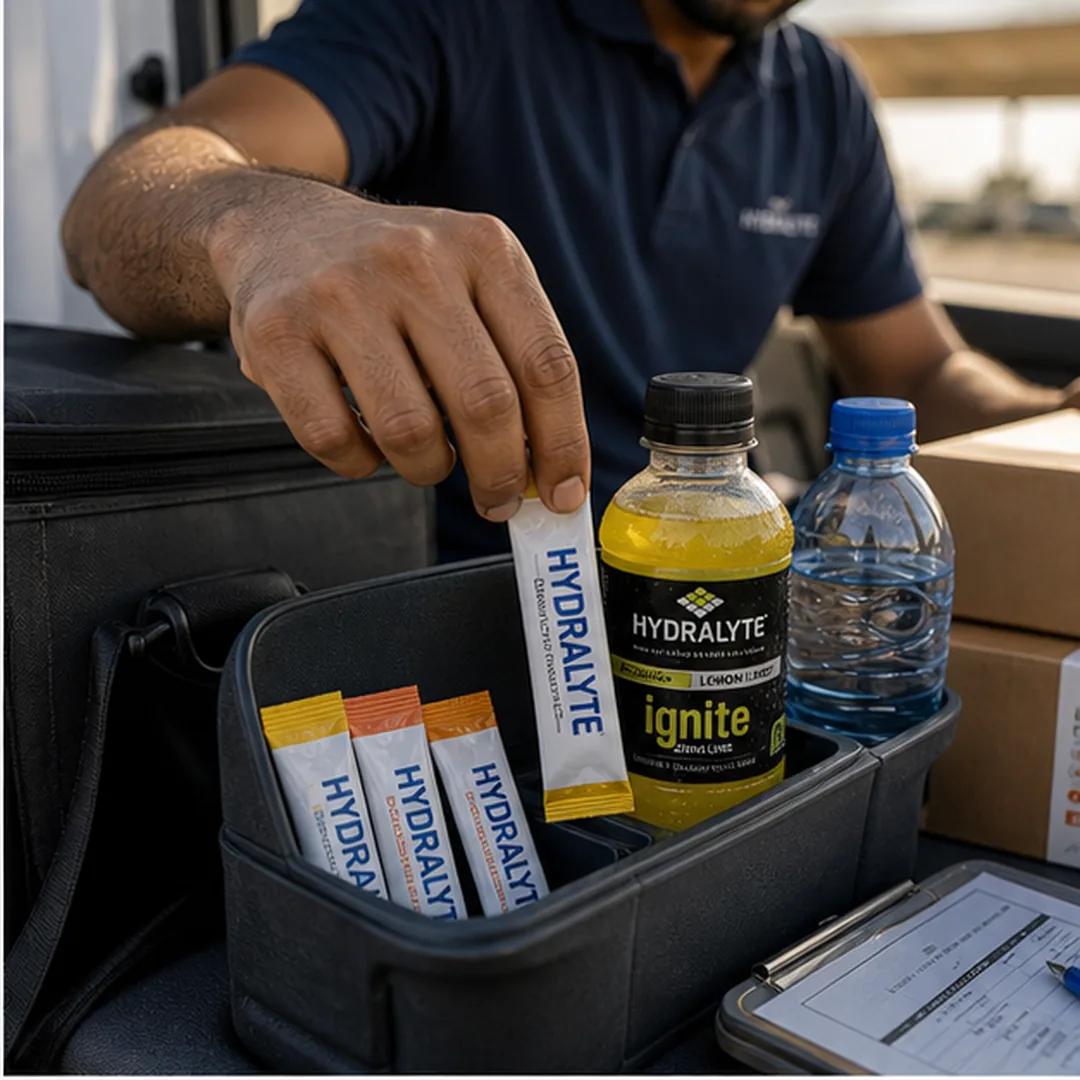
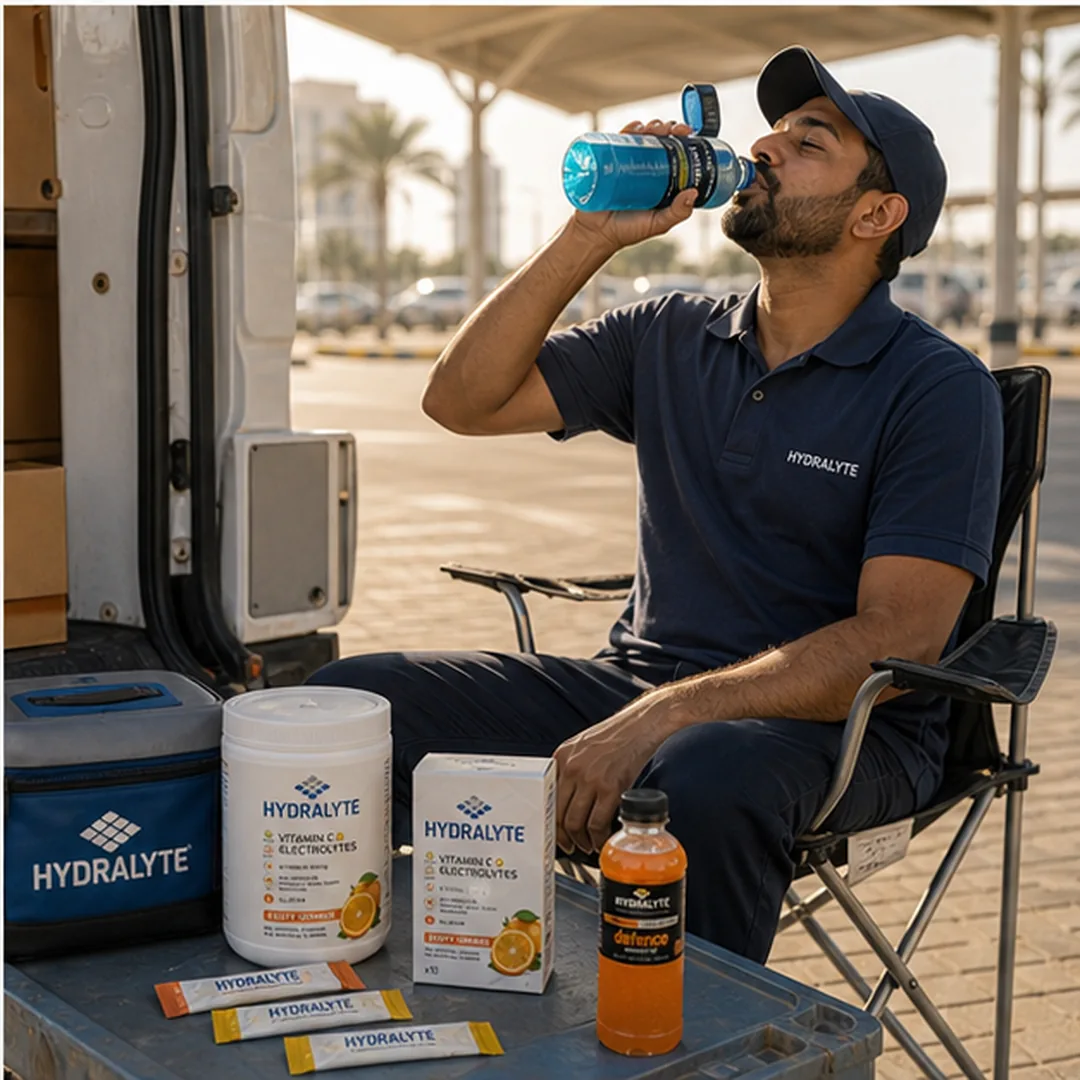
The remedy is to treat hydration as part of the route, not an afterthought. Fleets can equip vehicles with insulated bottles or coolers so that cold water and electrolyte drinks stay accessible and palatable throughout the shift. Building short, planned hydration pauses into routing — and reassuring drivers that these are expected, not a sign of slacking — removes the pressure that leads people to skip drinking.
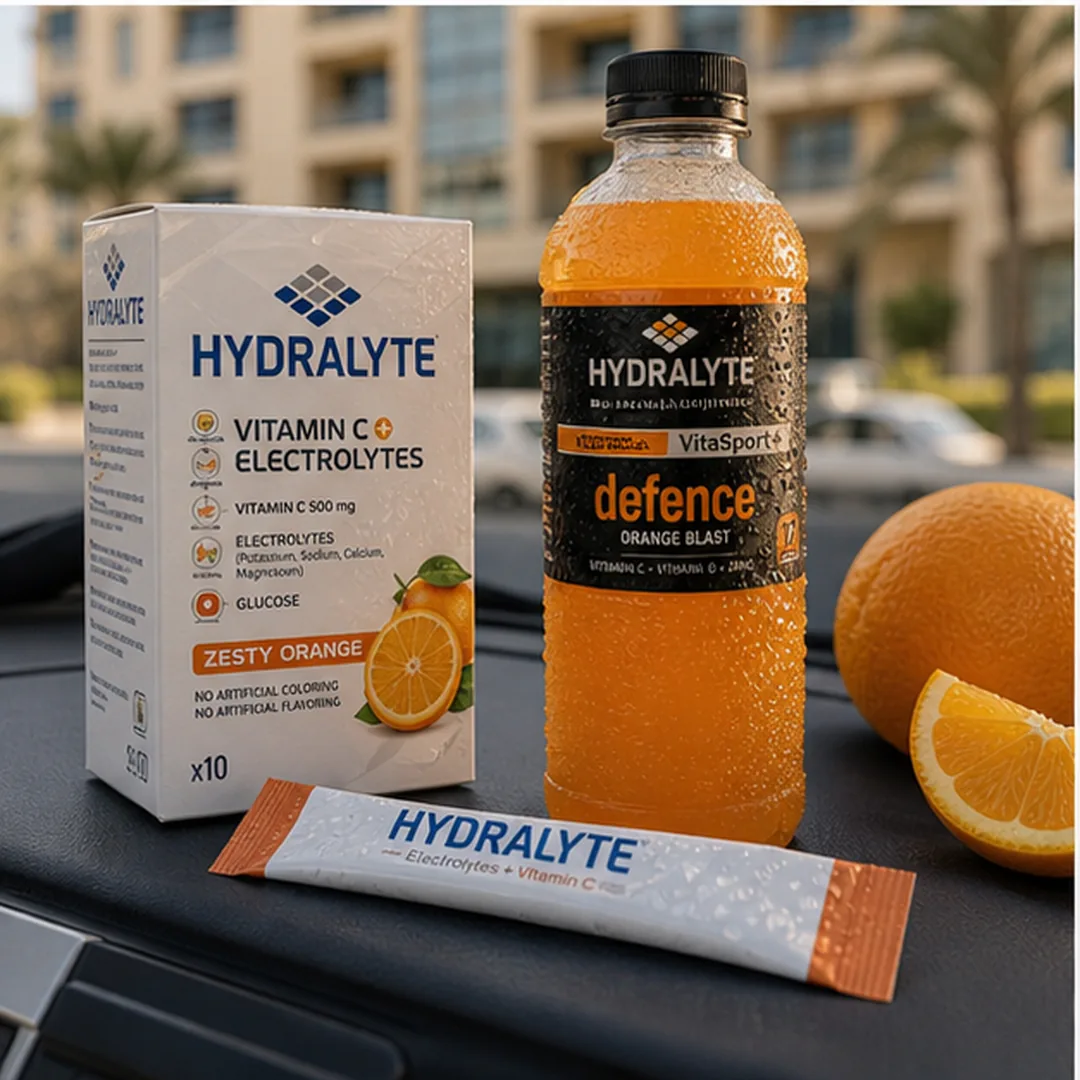
Because drivers face repeated bursts of heavy exertion in heat, plain water is not always sufficient, particularly on the longest summer routes. Electrolyte solutions help replace the salts lost during those repeated exertions and encourage the body to retain fluid between stops. Fleet managers can %compare electrolyte options for your team% to choose options that suit on-the-road use, balancing convenience, taste and effectiveness for drivers who cannot stop frequently.
Route design itself can support hydration. Scheduling the densest, most physically demanding clusters of drops for the cooler morning hours, and lighter work for the punishing early afternoon, reduces peak heat exposure. Where routes pass known rest points — fuel stations, depots, shaded laybys — these can be flagged as natural hydration checkpoints, giving drivers a structured rhythm of topping up rather than leaving it to chance.
Equipping the vehicle
The vehicle itself is the driver's worksite, and a small amount of thoughtful kit makes a large difference. An insulated cooler box or bottle holder within arm's reach keeps drinks cold and accessible without the driver having to reach into the back or onto the floor while moving. A daily routine of loading enough chilled water and electrolyte sachets or bottles at the depot, sized to the route, means the driver never starts a shift under-supplied. Some fleets provide marked bottles so a driver can see at a glance whether they are on track for the day. None of this is expensive, but it removes the friction that otherwise turns good intentions into a warm, half-empty bottle rolling around the cab.
Personalising hydration for each driver
No two drivers are identical. Body size, route intensity, the number of stops and individual sweat rates all affect how much fluid a particular driver needs across a shift. A blanket recommendation tends to leave the heaviest-working drivers short. It helps to %work out the right intake for each driver%, giving each person a realistic personal target rather than a generic guideline that ignores the demands of their specific route.
Pairing these individual targets with simple habits — drinking before the shift, topping up at every stop, and continuing to rehydrate after the last delivery — keeps drivers consistently ahead of their fluid losses rather than constantly catching up. A driver who starts the day already well hydrated has a buffer to draw on; one who starts in deficit is fighting a losing battle from the first drop.
A simple daily rhythm for drivers
- Pre-load before the shift: a measured drink with electrolytes before leaving the depot
- Top up at every stop: a few mouthfuls each time the driver returns to the cab
- Set scheduled checkpoints: a fuller drink at set points on the route, regardless of thirst
- Recover after the last drop: continue drinking through the evening to clear the day's deficit
The air conditioning paradox
The very feature that makes driving bearable in the summer — the cab's air conditioning — can quietly work against good hydration. Cool, dry, recirculated air feels comfortable and masks the heat strain a driver picks up at each stop, so the body's usual prompts to drink are dulled. Drivers step back into a cool environment, feel fine, and assume they have recovered, when in reality they are carrying forward a fluid deficit from the last delivery into the next.
There is also a subtler effect. Spending long stretches in cool air can reduce the sensation of thirst even as fluid losses mount during the hot bursts outside. The practical lesson is that drivers cannot rely on how they feel in the cab to judge their hydration. Drinking to a plan, regardless of comfort level, is far more reliable than waiting for a thirst signal that the air conditioning has effectively switched off.
How driver hydration differs from fixed-site hydration
It is worth being explicit about why a hydration approach designed for a building site or warehouse does not simply transfer to a fleet. On a fixed site, water points, shaded rest shelters and supervisors are all in one place, and the workforce shares a common environment that can be monitored centrally. A driver, by contrast, carries their entire working environment with them and is rarely seen by a manager during the day.
This means fleet hydration policy has to be built around self-sufficiency and trust rather than direct oversight. The water has to travel with the driver, the breaks have to be self-initiated within a supportive culture, and the monitoring has to come largely from the driver's own awareness. Recognising this difference stops fleets from copying a site-based programme that was never designed for people who spend the day alone and on the move.
It also changes what good monitoring looks like. On a site, a supervisor can do a visual round and spot a struggling worker; with a fleet, monitoring has to be designed in. That might mean a brief check-in call to drivers on the hottest afternoons, a simple end-of-shift question about how they coped with the heat, or telematics that flag unusually long gaps between deliveries that could indicate a driver in difficulty. The point is not surveillance but reach: finding ways for the operation to stay connected to a worker it cannot physically see, so that a developing problem does not go unnoticed until it is severe.
Heat acclimatisation for new and returning drivers
One factor that is easy to overlook is acclimatisation. The body adapts to working in heat over a period of days to a couple of weeks, becoming more efficient at sweating and at conserving salt. A driver who is new to the job, returning from leave in a cooler country, or moving onto a much busier route is not yet adapted and is therefore at higher risk during their first exposures to full summer conditions. Treating every driver as equally heat-ready from day one is a mistake.
Sensible fleets phase new and returning drivers into demanding summer routes, starting with lighter loads or cooler shift patterns and building up as the body adjusts. They also pay closer attention to hydration and symptoms during this window, when the margin for error is smallest. This is particularly relevant in the UAE, where a large, internationally mobile workforce means drivers are frequently arriving from very different climates and need time to adapt before they can safely sustain a full peak-season workload.
Recovery between shifts matters too
Because driver hydration is so easy to neglect during the day, the recovery period after a shift takes on extra importance. A driver who finishes a long summer route in deficit and does not properly rehydrate that evening starts the next day already behind, compounding the problem across the working week. Encouraging drivers to continue drinking after their last delivery, to rehydrate well before sleep and to begin the next shift fully topped up breaks that cycle.
Fleets that brief drivers on end-of-shift recovery, not just on-the-road drinking, tend to see fewer fatigue-related problems as the season wears on. Chronic, low-level dehydration that builds over days is harder to spot than a single bad afternoon, but it steadily erodes alertness, mood and physical resilience — exactly the qualities a driver needs to stay safe on UAE roads in peak summer.
What a driver eats and drinks off duty matters here too. Heavy reliance on sugary energy drinks or large amounts of strong coffee can work against good hydration, and skipping proper meals deprives the body of the salts it needs to hold onto fluid. Encouraging drivers to rehydrate steadily through the evening with water and electrolytes, to eat balanced meals, and to get genuine rest gives them the best chance of starting the next shift fully restored. Recovery is not a separate activity from on-the-road hydration; it is the other half of the same cycle, and neglecting it quietly undermines everything done during the working day.
Compliance, duty of care and the <a href="/industries">Midday Break</a> Rule
Hydration sits within a wider legal and ethical framework. Under UAE labour rules, the Midday Break Rule prohibits work in the sun and in open areas during the hottest part of the afternoon — broadly the middle of the day — through the peak summer months, and the Ministry of Human Resources and Emiratisation enforces it. While drivers spend part of their time in vehicles, any work that places them outdoors during these hours falls squarely within the spirit of the rule, and a responsible operator plans around it.
Beyond the specific break requirement, employers carry a broad duty of care to protect workers from foreseeable harm — and heat illness in a UAE summer is entirely foreseeable. Fleets can %plan hydration across the whole fleet% so that supplies, breaks and scheduling are consistent across every route, and use a structured way to %check how your operation sits against MoHRE rules% to confirm their summer arrangements line up with their obligations. Treating compliance as a baseline rather than a ceiling tends to produce both a safer workforce and a more defensible operation.
A safety culture that travels with the driver
Perhaps the greatest challenge with driver hydration is that drivers work alone. There is no supervisor watching for the early signs of heat strain, no colleague to notice a slurred word or a stumble. That makes self-awareness and a strong safety culture essential. Drivers should be trained to recognise the symptoms of dehydration and heat illness in themselves, to take them seriously, and to know that pulling over to cool down and rehydrate is always the right call.
Building that culture takes more than a single toolbox talk. It means leaders consistently reinforcing that no delivery is worth a driver's health, supervisors checking in by phone on the hottest days, and the operation visibly investing in coolers, supplies and sensible scheduling. When drivers see that hydration is genuinely valued rather than merely mentioned, they are far more likely to look after themselves on the road.
Communication style matters as much as content. Many UAE drivers speak a range of first languages, so heat-safety briefings and reminders land best when they are visual, simple and available in the languages drivers actually use. A short pictorial guide in the cab, a quick refresher at the start of a heatwave, and team leaders who model good habits themselves will do more than a dense policy document few will read. The aim is for safe hydration to feel like a shared norm among drivers, reinforced by peers and visibly backed by the company, rather than a top-down instruction that competes with the pressure to keep moving.
Common mistakes fleets make with driver hydration
Even well-meaning operations fall into predictable traps. The most common is assuming that because drivers have a cab and air conditioning, hydration is a non-issue — the very assumption this article exists to correct. A second is providing water but not protecting the time to drink it, leaving bottles unopened because the schedule never allows a pause. A third is treating hydration as a single annual briefing rather than a habit that needs reinforcing throughout the summer, so that early enthusiasm fades just as the worst heat arrives.
Other mistakes are quieter but just as damaging. Relying on plain water for the heaviest routes ignores the salt lost through repeated heavy sweating. Issuing a blanket litre target ignores how different routes and body sizes really are. And measuring drivers purely on drops completed, with no allowance for safe pacing in extreme heat, actively rewards the behaviour that puts them at risk. Recognising these patterns is the first step to designing them out, replacing good intentions with a system that makes the safe choice the easy one.
Putting it into practice across the fleet
Turning these principles into routine does not require a major overhaul. It starts with a clear, simple hydration standard for the summer, the right kit in every vehicle, realistic scheduling that protects break time, and a short, repeated programme of driver education in the languages the team speaks. Layering on personalised intake targets and light-touch monitoring on the hottest days rounds out a programme that is genuinely fit for people who work alone and on the move. Reviewing what worked at the end of each season — which routes proved hardest, where drivers struggled, what kit helped most — lets the approach improve year on year rather than resetting each summer.
The business case for driver hydration
For operators, there is a clear business case alongside the safety one. A well-hydrated driver is sharper, makes fewer errors, drives more safely and is less likely to be sidelined by heat illness at the busiest time of year. Investing in coolers, sensible routing and driver education costs little against the disruption of a single serious incident, a road accident caused by a fatigued driver, or the steady drag of fatigue-related mistakes across a fleet.
Treating driver hydration as a core part of summer operations — rather than an afterthought once someone falls ill — is simply good management. It protects service levels during the peak e-commerce season, reduces absence, and sends a clear message to drivers that their wellbeing is taken seriously even when no one is there to see it. Operators who want help designing a programme that fits their routes and vehicles can %talk to our team about a fleet hydration programme%, turning a hidden risk into a managed and well-understood part of the working day.
There is a retention and reputation dimension too. Drivers talk to one another, and an operation known for working its people into the ground through the summer will struggle to attract and keep good staff, while one visibly committed to their welfare earns loyalty that is hard to buy. In a competitive labour market, being a fleet that genuinely looks after its drivers is a real advantage, not a soft extra. The cost of a few coolers and some thoughtful scheduling is trivial set against the cost of constant turnover, training new drivers and the service disruption that churn brings during the busiest season of the year.
The hidden nature of the threat is precisely what makes a deliberate approach so valuable. When fleets equip vehicles properly, plan hydration into routes, personalise intake, build in recovery and educate drivers to look after themselves, hydration on the move stops being a quiet danger and becomes a controlled, everyday part of operating safely through the UAE summer.
Frequently Asked Questions
Why are delivery drivers at risk of dehydration if they sit in an air-conditioned cab?
Drivers face intermittent but intense heat exposure, stepping out into extreme heat to make each delivery before returning to the cool cab. This stop-start pattern, combined with the cooled cab masking heat-strain signals, makes it easy to under-hydrate. Cumulative fluid losses across a long route can be significant even though the driver never spends a long unbroken stretch in the sun.
Why do drivers often drink too little during a shift?
Tight schedules discourage stops, a cool cab hides the body's signals, and many drivers deliberately limit fluids to avoid needing the toilet. Warm water in the cab also becomes unappealing as the day goes on, and piece-rate pay can make any pause feel like lost income. These pressures combine to push drivers towards drinking less than they need.
Should drivers use water or electrolyte drinks?
For short routes water may be enough, but on long summer routes with repeated bursts of heavy exertion, electrolyte solutions help replace the salts lost in sweat and encourage the body to retain fluid between stops. Matching the drink to route intensity is the most effective approach. Heavy-sweating drivers on the most demanding routes benefit most from electrolytes.
How can a fleet help drivers stay hydrated?
Fleets can fit vehicles with insulated bottles or coolers to keep cold drinks accessible, build short planned hydration pauses into routes, and reassure drivers that these stops are expected. Personalising intake targets and training drivers to recognise heat-illness symptoms in themselves completes the picture. A supportive culture that protects breaks is just as important as the equipment.
What are the early warning signs of dehydration a driver should watch for?
Early signs include a dry mouth, headache, darker urine, tiredness and difficulty concentrating. As dehydration deepens, drivers may feel dizzy, develop cramps or become irritable, all of which are dangerous behind the wheel. Confusion, nausea or a rapid pulse signal more serious heat illness that requires stopping immediately and seeking help.
How much should a delivery driver drink during a UAE summer shift?
There is no single figure because needs depend on body size, route intensity, number of stops and individual sweat rate. As a rule of thumb, drivers should drink steadily throughout the shift rather than in large infrequent gulps, topping up at every stop. Using a personal hydration calculator gives each driver a realistic target tailored to their own route rather than a generic guideline.
Does the UAE Midday Break Rule apply to delivery drivers?
The Midday Break Rule prohibits work in the sun and open areas during the hottest part of the afternoon through the peak summer months. While drivers spend part of their time in vehicles, any outdoor work during those hours falls within the spirit of the rule. Responsible fleets plan routes to avoid heavy outdoor exertion in the prohibited window and treat the rule as a minimum standard.
What should a driver do if they start feeling unwell from the heat?
A driver who notices dizziness, cramps, nausea or confusion should pull over safely as soon as possible, move into the shade or air conditioning, and rehydrate with water and electrolytes. They should rest until symptoms ease and contact their supervisor. If symptoms are severe or include confusion or hot dry skin, this may be heat stroke, which is a medical emergency requiring immediate help.
Why does recovery between shifts matter for drivers?
A driver who ends a shift dehydrated and does not rehydrate that evening starts the next day already behind, and the deficit compounds across the week. Continuing to drink after the last delivery and starting each shift fully hydrated breaks this cycle. Good recovery protects alertness, mood and physical resilience over the course of a long, hot summer.
What is the business benefit of a fleet hydration programme?
Well-hydrated drivers are sharper, drive more safely, make fewer errors and are less likely to be lost to heat illness during peak season. The cost of coolers, sensible routing and driver education is small against the disruption of a serious incident or accident. A clear hydration programme protects service levels, reduces absence and demonstrates genuine care for the workforce.