Every summer, the MoHRE <a href="/industries">midday break</a> becomes one of the most important compliance obligations for any business that employs people outdoors in the UAE. The rule is simple in principle: during the peak summer months, work under direct sunlight and in open areas is prohibited during the hottest hours of the day. Yet behind that straightforward statement sits a set of practical responsibilities that employers must plan for carefully, because the penalties for getting it wrong are real and, more importantly, so are the health risks to workers.
The UAE summer work ban is not a new measure. It has been refined and reinforced over many years as the country has grown into one of the largest construction and logistics hubs in the region, and as the understanding of occupational heat illness has deepened. What began as a seasonal pause has matured into a comprehensive expectation that employers actively protect their people from a climate that, for several months each year, is genuinely hostile to physical labour. Treating the rule as a mere formality misses the point entirely.
This guide explains what the midday break rule means in practice for 2026, who it applies to, what employers are expected to do, the consequences of non-compliance, and how to treat the requirement not as a box-ticking exercise but as the foundation of a genuine heat-safety programme. If you manage outdoor teams, the first sensible step is to %run a quick MoHRE compliance check% so you know exactly where your organisation stands before the season begins.
What the MoHRE midday break rule actually requires
The Ministry of Human Resources and Emiratisation enforces an annual prohibition on outdoor work during the middle of the day across the summer period. The ban typically runs from the middle of June to the middle of September each year, and it applies to work carried out in open spaces and under direct sunlight during a defined window in the early afternoon, generally from around 12:30 to 15:00, when ambient temperatures and solar radiation are at their most dangerous. During this window, employers must stop outdoor activity and provide workers with adequate shaded rest areas.
The break is not simply a pause in productivity. It is a recognition that the human body cannot safely regulate its core temperature when it is asked to perform physical labour in extreme heat. By removing workers from direct sun during the most hazardous hours, the rule prevents the cumulative heat load that leads to heat exhaustion, heat stroke and, in the worst cases, fatalities. The midday break rule in the UAE therefore sits at the heart of the country's wider worker-welfare framework.
It is important to note that the exact dates and hours are announced officially each year ahead of the season. Employers should always confirm the current year's timing through MoHRE's official channels rather than relying on memory from a previous summer, because small adjustments to the window can and do occur. Building your 2026 break schedule on the confirmed official figures is the only safe approach.
Who the rule applies to
The midday break covers workers performing tasks outdoors and in open areas exposed to the sun. This naturally includes the construction sector, but it reaches far wider. Logistics and yard operations, landscaping, road works, facilities maintenance, agriculture, port handling, and many oil and gas field activities all fall within scope when the work is carried out in the open during the prohibited hours.
There are limited exemptions for work that cannot be interrupted for technical reasons or that must continue to protect public safety or the public interest, such as certain emergency repairs or works that would cause greater harm if halted partway. These exemptions are narrow and come with strict additional protective conditions, including extra rest, cooling and rehydration. Employers should never assume an exemption applies; if you operate across multiple sites and trades, it is worth taking time to %assess the heat stress risk on your sites% and confirm which teams are genuinely affected.
The default position for the vast majority of outdoor labour is that the break is mandatory. When in doubt, assume the rule applies and stop work. The cost of an unnecessary pause is trivial; the cost of an unlawful continuation is not.
Indoor and mixed environments
A common misconception is that the rule only matters for those standing in open desert sun. In reality, many workers operate in mixed environments: a logistics team may load trucks in a shaded bay but spend long stretches in an exposed yard, while a maintenance crew may move between an air-conditioned plant room and a rooftop. Where any meaningful portion of the work falls in open areas under the sun during the prohibited window, the safe and compliant course is to schedule that portion outside the banned hours. Heat does not respect job titles, and neither should your planning.
Employer obligations beyond stopping work
Compliance is about more than switching off the tools at the right time. MoHRE expects employers to put a supportive framework around the break so that workers can actually recover during it. In practice this means several things working together.
- Providing shaded, ventilated rest areas where workers can sit out of direct sun, ideally with cooling, fans or air conditioning, and somewhere to sit comfortably rather than on bare hot ground.
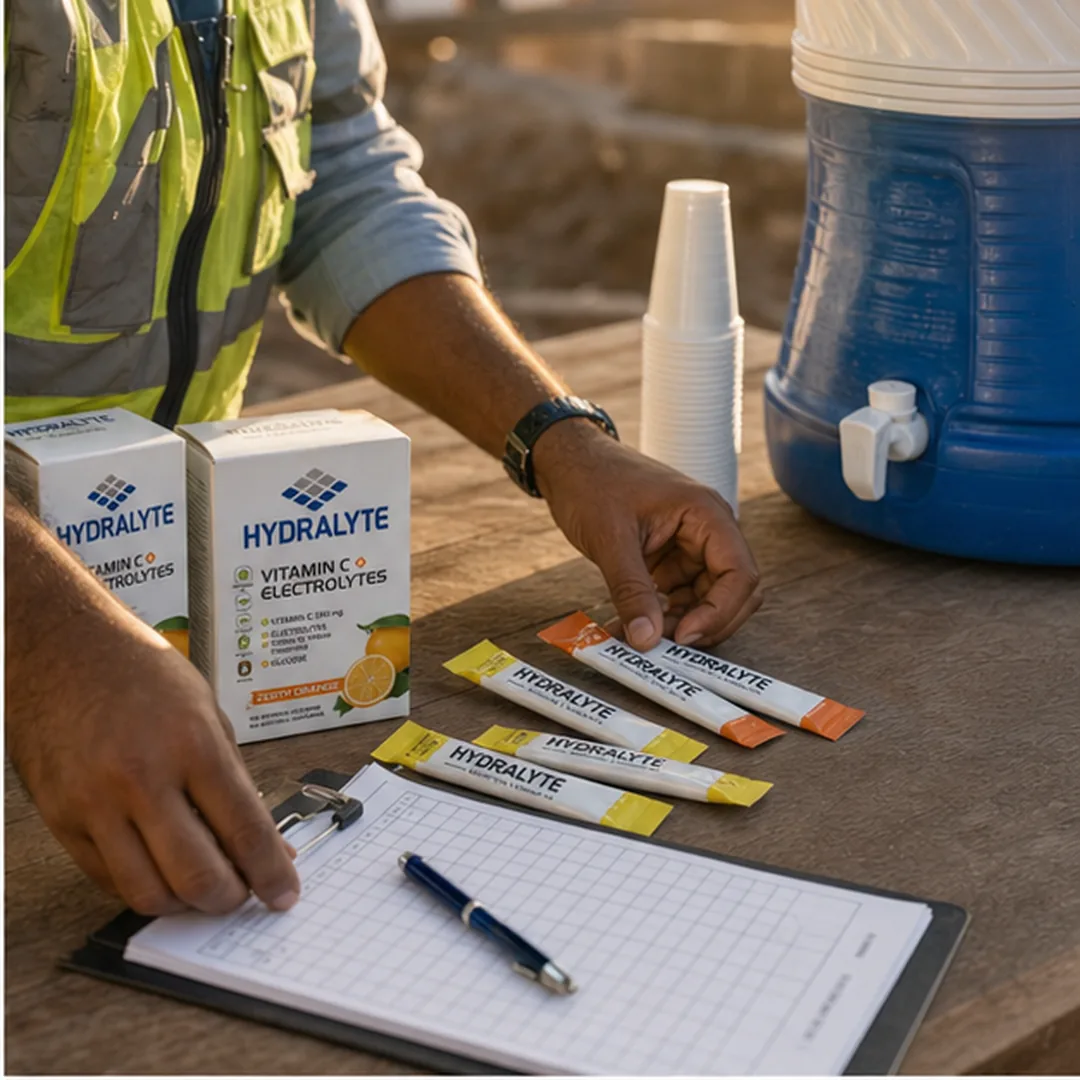
- Ensuring a continuous supply of cool drinking water, along with appropriate rehydration support, so that fluids and electrolytes lost through sweat are replaced rather than simply diluted.
- Displaying clear information, in languages workers understand, about the break times, the signs of heat illness and what to do in an emergency.
- Adjusting shift patterns so that demanding physical tasks are scheduled for the cooler parts of the day rather than crammed in around the break.
- Keeping records of break observance, water provision and any heat-related incidents so that good practice can be demonstrated and improved upon.
These measures matter because the break alone does not undo the strain of a morning of heavy work in high humidity. Recovery depends on shade, rest and proper rehydration acting together. A worker who sits in a hot, airless container for the break, with only warm water and no salts, has not truly recovered when work resumes, and the afternoon may be more dangerous than the morning that preceded it.
Rest areas that actually work
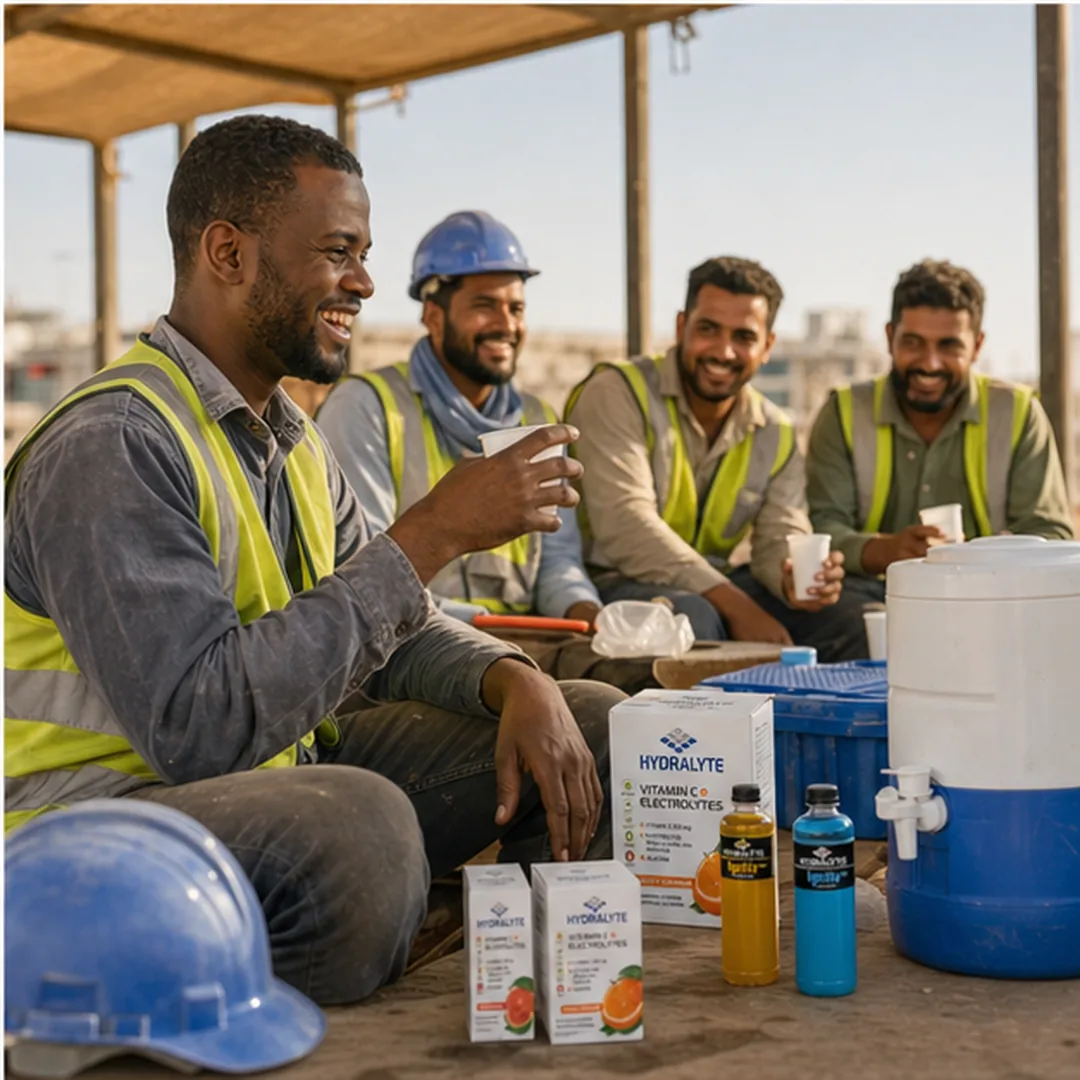
The quality of the rest area is as important as its existence. A genuinely effective rest space is shaded from above and from the low afternoon sun, ventilated so that body heat and humidity do not build up, and large enough that the whole crew can rest without crowding. It should be close enough to the work area that workers are not deterred from using it by a long walk in the sun. Seating, clean water points and basic cooling transform a nominal rest area into one that allows real physiological recovery. Employers who invest here see fewer afternoon incidents and steadier productivity once work resumes.
How the rule fits into the wider UAE labour framework
The midday break does not exist in isolation. It is one element of a broader UAE labour and occupational-health framework that has steadily raised the bar for worker welfare over the years. Understanding that context helps employers see the break as part of a coherent system rather than an isolated seasonal inconvenience, and it makes compliance easier to plan because the same underlying principles run through the whole framework.
That wider framework expects employers to provide safe systems of work, adequate welfare facilities, proper accommodation and transport standards for many workers, and clear channels for raising concerns. Heat is simply one of the most acute and predictable hazards within that picture, and the summer work ban is the headline measure addressing it. Employers who already take their general welfare obligations seriously find the midday break slots naturally into their existing systems; those who treat welfare as an afterthought tend to struggle with the break too, because the gaps are the same.
Seen this way, getting the summer right is also a useful test of an organisation's overall maturity. A business that can plan, communicate, provision and document its heat-safety response well is usually a business that runs its other obligations well too. The discipline transfers, and the reputational benefits compound across everything the employer does.
Why the midday hours are uniquely dangerous
It is worth understanding why the rule targets the early afternoon specifically, because that understanding helps employers apply it with the right seriousness. The danger of heat is not only about the air temperature shown on a thermometer. It is the combination of that temperature with humidity, with direct solar radiation, and with the heat already stored in the body from a morning of exertion. By the early afternoon, all of these factors peak together.
The morning's work means workers arrive at midday already carrying a heat load and already partly dehydrated, even if they have been drinking. The sun is at or near its highest point, beating directly onto exposed skin and onto the surfaces around them, which radiate stored heat back at the body. Humidity along the coast suppresses the evaporation of sweat, which is the body's main cooling mechanism, so the body works harder and harder for less and less cooling effect. This is precisely the moment when heat exhaustion tips into heat stroke.
UAE summer temperatures regularly exceed 45°C, and on the coast this is compounded by very high humidity that makes the effective heat felt by the body considerably worse. The midday break exists because this window is when the human body is least able to protect itself, regardless of how fit or experienced the worker is. No amount of toughness or acclimatisation makes the early afternoon safe for sustained physical labour in the open.
Acclimatisation and the early days of summer
One factor employers frequently overlook is acclimatisation. The body adapts to working in heat over a period of days, becoming more efficient at sweating and at conserving salts. Workers who are new to the UAE, who have just returned from leave in a cooler climate, or who are facing the first real heatwave of the season have not yet made that adaptation. They are at heightened risk even within the rules, which is why the opening weeks of summer deserve particular vigilance.
The midday break protects everyone, but supervisors should watch un-acclimatised workers especially closely during the rest of the working day too. A sensible practice is to ease new or returning workers in gradually over their first week, increasing their workload step by step so that their bodies have time to adjust. This single measure prevents a disproportionate share of early-season incidents and costs almost nothing to implement.
An illustrative day on a compliant site
It can help to picture how all of this comes together over the course of a single hot August day. Consider a 150-worker construction site in Abu Dhabi during the peak of summer. The day begins before sunrise; crews start early to take advantage of the coolest hours, and the most strenuous tasks, the heavy lifting and the concrete work, are deliberately scheduled for the first part of the morning while the heat is still climbing.
Throughout the morning, water points stocked with cool water and electrolytes are positioned close to where people are working, and supervisors prompt scheduled drink breaks rather than waiting for anyone to ask. As the prohibited window approaches in the early afternoon, work winds down in good time, with no last-minute rush to finish a task that would push the crew past the cut-off. Workers move into shaded, ventilated rest areas with seating and cooling, where they sit out the hottest hours, rest properly and continue to rehydrate.
When the break ends, work resumes with lighter tasks first to let bodies ease back in, and supervisors keep a closer eye on anyone who looked tired or who is newer to the climate. Records are kept of the break, the water provision and any concerns raised. None of this is dramatic or expensive; it is simply a day designed around the climate rather than against it. The result is a site that meets its legal obligations comfortably, loses little real productivity and, most importantly, sends every worker home safely.
The cost of non-compliance
MoHRE conducts inspections throughout the summer, and employers found working outdoors during the prohibited hours face financial penalties that increase with the number of workers involved and with repeat offences. Beyond the fines, there is reputational damage, the risk of work stoppages and project delays, and the far heavier human cost of a worker collapsing on site. A single serious heat illness incident can halt a project, trigger investigations and, tragically, change lives permanently.
The reputational dimension should not be underestimated. Major clients, main contractors and international partners increasingly expect demonstrable worker-welfare standards from everyone in their supply chain. A publicised breach of the summer work ban can cost an employer far more in lost contracts and damaged relationships than any direct fine. Conversely, a clean record and visible commitment to worker safety has become a genuine commercial asset when bidding for work.
Viewed in that light, the midday break is one of the most cost-effective protections an employer can implement. The lost production during the break is small compared with the disruption of an incident or an enforcement action, and that lost production can largely be recovered by sensible scheduling of work into the cooler hours.
Turning compliance into a real safety culture
The employers who handle the summer best are those who treat the midday break as the starting point rather than the finish line. They plan the working day around the heat, build hydration into the routine, train supervisors to spot early warning signs, and check in on vulnerable workers more frequently. This is especially true in physically demanding %construction and outdoor sectors%, where the combination of heavy exertion and exposure makes the margin for error very small.
The same discipline pays off in %logistics and yard operations%, where exposed yards, hot vehicle cabs and the pressure of delivery schedules can quietly push teams beyond safe limits well outside the formal break hours. A culture that takes heat seriously applies the same care to a driver waiting on a loading bay as it does to a labourer on scaffolding.
A strong programme also keeps records. Documenting break times, water provision, toolbox talks and any heat-related incidents demonstrates good faith during inspections and gives you the data to improve year on year. Compliance becomes a by-product of genuinely looking after your people, rather than an obligation bolted on at the last minute. When senior leadership visibly backs the programme, that message reaches every level of the site.
Hydration: the other half of compliance
Stopping work and providing shade addresses exposure, but it does not by itself replace what the body has lost. Over a hot morning, a labouring worker can sweat out several litres of fluid along with significant quantities of sodium and other electrolytes. Plain water replaces the fluid but not the salts, and in heavy sweating conditions, drinking large volumes of water alone can even dilute the body's remaining electrolytes and create its own problems.
This is why proper rehydration is an integral part of meeting the spirit of the rule, not an optional extra. Cool water should always be freely available, but it works far better when paired with electrolyte replacement so that workers actually retain the fluid and maintain the salt balance their muscles and nervous systems depend on. Employers managing large or dispersed teams find it useful to %plan hydration across your whole workforce% so that water and electrolyte provision is matched to headcount, work intensity and the specific conditions on each site rather than left to chance.
Embedding hydration into the daily routine, with scheduled drink breaks rather than relying on thirst, keeps workers functioning safely through both the morning and the afternoon shift. Thirst is a lagging indicator: by the time it is felt, the worker is already behind. A short, regular drinking schedule, reinforced by supervisors, is one of the simplest and most effective heat controls available.
Scheduling work around the heat without losing productivity
One of the most common objections employers raise to the midday break is the fear of lost output. In reality, a well-planned summer schedule loses very little, and what it does lose it more than recovers in reduced errors, illness and downtime. The key is to stop treating the break as a hole punched out of an otherwise normal day and instead to redesign the day around the climate.
The most demanding physical tasks, such as concrete pours, heavy lifting, excavation and anything requiring sustained exertion in the open, should be pulled forward into the cooler early morning hours and pushed back into the late afternoon and evening where operationally possible. Lighter tasks, planning, indoor preparation, equipment maintenance and administrative work naturally fill the hours around the break. Many sites adopt a split-shift or early-start pattern through the peak weeks, beginning at first light to make full use of the coolest part of the day before the sun becomes punishing.
Productivity per hour worked in cooler conditions is also higher than in the brutal midday heat, when fatigue, slower movement and frequent rest needs all drag output down. In other words, an hour of work at seven in the morning is worth considerably more than an hour attempted at one in the afternoon, even before the legal prohibition is considered. Employers who internalise this often find that respecting the break costs them far less than they feared, and sometimes nothing at all.
Planning for the supply chain
Effective scheduling extends beyond your own crews. Deliveries, subcontractor visits, inspections and crane movements all need to be planned so that nobody is left standing in the sun during the prohibited hours waiting for access or materials. Coordinating with suppliers and partners to avoid midday bottlenecks keeps both your own and their workers out of harm's way and prevents the frustration that tempts people to cut corners. A summer schedule shared clearly with everyone who sets foot on site is itself a safety control.
The role of supervisors and the safety chain
Rules are only as strong as the people who apply them on the ground, and on a busy site that means the supervisors and foremen. They are the link between management's intentions and the reality experienced by each worker, and they make countless small decisions every day that determine whether the heat-safety programme actually functions. A supervisor who quietly lets a crew finish a task five minutes into the prohibited window, or who waves away a worker's complaint of dizziness, can undo the best policy ever written.
For this reason, supervisors need clear authority, clear training and clear backing. They must know the exact break times, understand the early signs of heat illness, feel empowered to stop work without fear of being blamed for lost time, and trust that management will support them when they put safety first. Where supervisors are measured purely on output, heat safety suffers; where they are measured partly on the wellbeing and incident record of their crews, it flourishes. Aligning incentives with safety is one of the most powerful levers an employer has.
Communicating the rule to a diverse <a href="/industries">workforce</a>
Many UAE worksites employ people from a wide range of countries who speak many different languages. A rule that workers do not understand cannot protect them, so communication is a genuine compliance issue rather than an afterthought. Information about break times, the reasons behind them, the signs of heat illness and the steps to take in an emergency should be presented in the languages your workforce actually speaks, using clear visuals wherever possible so that the message does not depend on literacy alone.
It also helps to explain the why, not just the what. Workers who understand that the break exists to keep them alive, rather than as an arbitrary instruction, are far more likely to take it seriously, to rest properly during it and to keep drinking. Toolbox talks at the start of shifts, posters at water points and rest areas, and supervisors who reinforce the message in person all combine to make the rule part of the site culture.
When workers themselves understand the danger, they begin to look out for one another, which is one of the most effective safeguards of all. A buddy system, in which colleagues are encouraged to notice and report early signs of heat strain in each other, catches problems that an individual may not recognise in themselves, since confusion and poor judgement are themselves symptoms of serious heat illness.
Common mistakes employers make
Even well-intentioned employers fall into predictable traps, and recognising them in advance is the easiest way to avoid them. The first and most common is treating the break as the entire obligation, stopping work on time but providing only a patch of shade and a few jerry cans of warm water. The break without genuine rest, cooling and rehydration is a legal box ticked but a real protection missed, and it leaves workers little better off in the dangerous afternoon hours.
A second frequent mistake is poor timekeeping at the margins. Crews under pressure to finish a task often run a few minutes into the prohibited window or restart a few minutes early, and supervisors anxious about deadlines may allow it. These small breaches are exactly when inspections find violations, and more importantly they expose workers to the very peak of the day's danger. Strict, visible discipline at the start and end of the break protects both the workforce and the employer.
Other recurring errors include ignoring un-acclimatised and returning workers, assuming an exemption applies without verifying it, failing to communicate the rule in languages workers understand, and neglecting record-keeping so that there is nothing to show during an inspection. None of these is difficult to fix, but each one quietly undermines an otherwise sound programme.
- Providing the break but neglecting shade quality, cooling and electrolyte rehydration.
- Allowing crews to run over or restart early at the edges of the prohibited window.
- Overlooking new, returning and un-acclimatised workers who carry higher risk.
- Assuming an exemption applies rather than confirming the specific conditions.
- Communicating only in one language and relying on workers to interpret for one another.
- Keeping no records of breaks, water provision, training or incidents.
The wider business case for worker welfare
It is tempting to view the midday break purely through the lens of legal risk, but the most successful employers see it as part of a broader, commercially sensible commitment to worker welfare. The UAE's economy depends heavily on its largely expatriate workforce, much of it concentrated in physically demanding sectors, and the businesses that look after that workforce well enjoy tangible advantages.
Workers who are protected from heat illness are healthier, more productive and less likely to be absent. They make fewer mistakes, suffer fewer accidents and stay with employers who treat them decently, reducing the considerable costs of turnover and retraining. A strong welfare record opens doors with major clients and main contractors who increasingly demand demonstrable standards throughout their supply chains, and it protects the brand from the serious reputational damage that follows a publicised incident.
Set against these benefits, the cost of doing the summer properly, with good shade, reliable water and electrolyte provision, sensible scheduling and trained supervisors, is modest. Worker welfare is not a drag on the business; handled well, it is a competitive advantage and a mark of a serious, well-run operation.
Preparing for the 2026 season
Ahead of the summer, review your sites against the rule now rather than waiting for the first heatwave. Confirm the official break schedule for 2026, audit your shade and water provision, refresh worker training, and make sure supervisors know exactly what is expected of them. A practical pre-season checklist might include the following.
- Verify the confirmed start and end dates and the daily prohibited hours through MoHRE's official announcement for 2026.
- Map every outdoor task across all sites and reschedule work that would otherwise fall in the banned window.
- Inspect and upgrade rest areas so that each provides real shade, ventilation, seating and cooling.
- Confirm water and electrolyte supply is sufficient for peak headcount on the hottest days, with no single point of failure.
- Run refreshed toolbox talks and post multilingual signage at rest and water points.
- Brief supervisors on recognition, first response and the emergency escalation plan.
The earlier the planning happens, the smoother the season runs and the safer your workforce will be when temperatures climb. If you would like help building a programme that goes beyond the minimum, you can %speak to our team about a tailored programme% suited to your sites and trades. The midday break is a legal requirement, but at its heart it is simply a sensible response to a hostile climate, and meeting it well protects both your business and the people who keep it running.
Frequently Asked Questions
What hours does the MoHRE midday break cover?
The rule prohibits outdoor work in open areas and under direct sunlight during a defined window in the early afternoon, generally from around 12:30 to 15:00, throughout the summer months. The period typically runs from the middle of June to the middle of September. Employers should always confirm the exact official timing each year, as MoHRE announces the precise dates and hours ahead of the season.
When does the midday break rule start and end in 2026?
The ban runs across the peak summer period, usually from mid-June to mid-September, with the exact start and end dates announced officially by MoHRE before the season. Because small adjustments can occur from year to year, you should base your 2026 schedule on the confirmed official announcement rather than on a previous year's dates.
Does the midday break apply to all employees?
It applies to workers performing tasks outdoors and in open areas exposed to the sun. Indoor and office staff are generally not covered, but most construction, logistics, landscaping, agriculture and field operations fall within scope. Only narrow, strictly conditioned exemptions exist for work that cannot be interrupted for technical reasons or to protect public safety.
What happens if an employer ignores the rule?
MoHRE carries out inspections during the summer and imposes financial penalties that rise with the number of workers involved and with repeat violations. Employers also risk work stoppages, project delays, reputational harm with clients and partners, and, most seriously, worker heat illness or fatalities. The combined cost of a breach far outweighs the modest productivity lost to the break.
Are there any exemptions to the summer work ban?
Yes, but they are limited. Work that cannot be interrupted for technical reasons, or that must continue to protect public safety or avoid greater harm, may be permitted under strict additional conditions including extra rest, cooling and rehydration. These exemptions are narrow, and employers should never assume one applies without verifying the specific requirements.
Is providing water enough to comply?
Water is essential but not sufficient on its own. Employers must also provide shaded, ventilated rest areas, appropriate rehydration support to replace lost electrolytes, clear safety information in languages workers understand, and sensible scheduling of demanding tasks away from the hottest hours. Plain water alone does not replace the salts lost through heavy sweating.
What makes a compliant rest area?
An effective rest area is shaded from above and from the low afternoon sun, ventilated or cooled so heat does not build up, and large enough for the whole crew to rest comfortably with seating rather than bare hot ground. It should be close to the work area and stocked with cool drinking water. A nominal shelter that is hot, cramped and airless does not allow genuine recovery and does not meet the spirit of the rule.
How should employers prepare before the season begins?
Review every site well before the first heatwave: confirm the official 2026 break schedule, reschedule any outdoor work that falls in the banned hours, audit and upgrade rest areas, ensure adequate water and electrolyte supply for peak headcount, refresh multilingual training and signage, and brief supervisors on recognition and emergency response. Early planning makes the season smoother and far safer.
How can compliance become more than a legal box-tick?
By treating the break as the foundation of a wider heat-safety culture rather than the whole of it. The best employers plan the working day around the heat, build scheduled hydration into the routine, train supervisors to spot early warning signs, watch over vulnerable and un-acclimatised workers, and keep records to improve year on year. Compliance then becomes a natural by-product of genuinely looking after people.
Why is the early afternoon specifically targeted?
Because that is when danger peaks. The sun is at its most intense, surfaces radiate stored heat, humidity on the coast suppresses sweat evaporation, and workers arrive already carrying heat load and partial dehydration from the morning. All these factors combine in the early afternoon to make sustained outdoor labour unsafe for everyone, which is exactly why the break falls in that window.