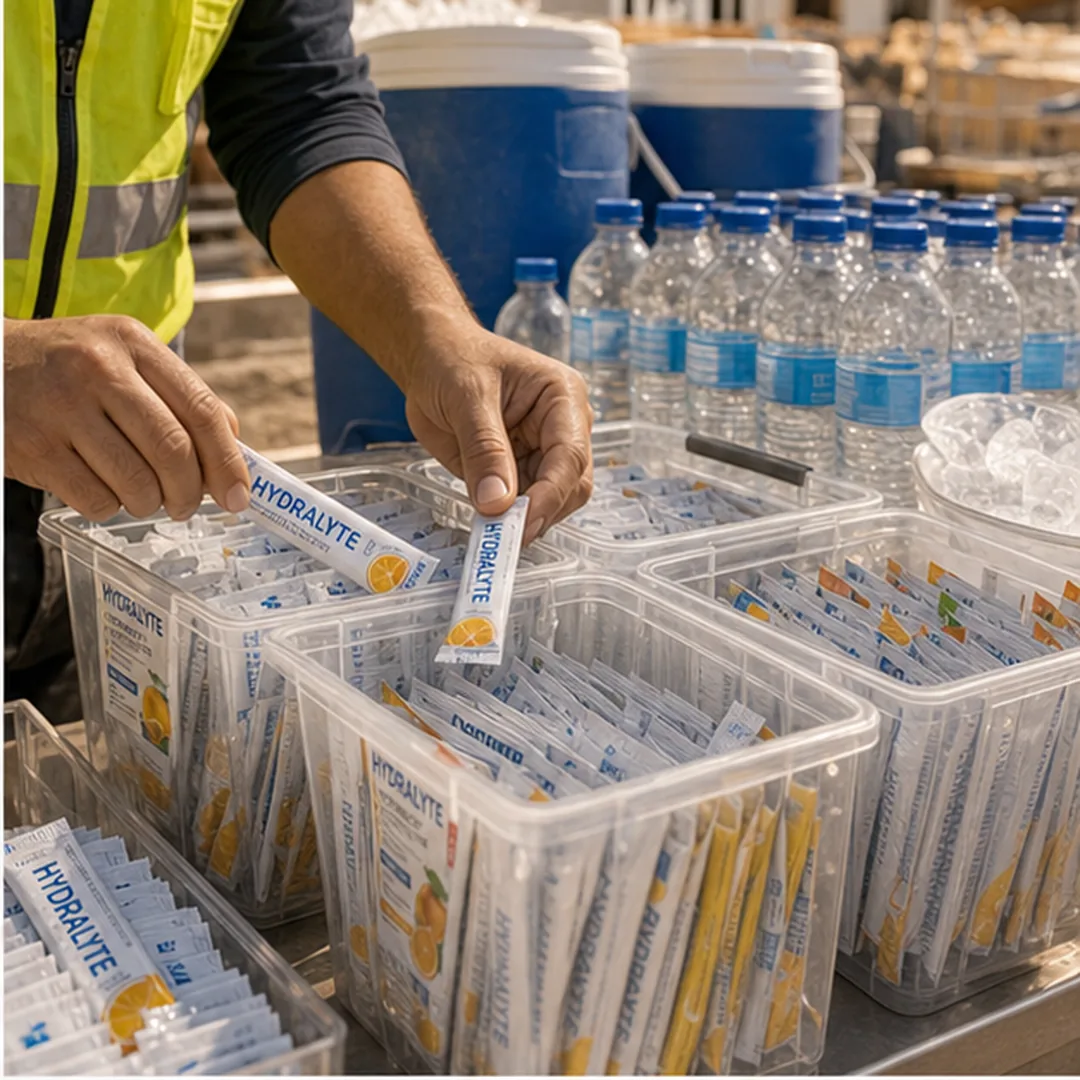
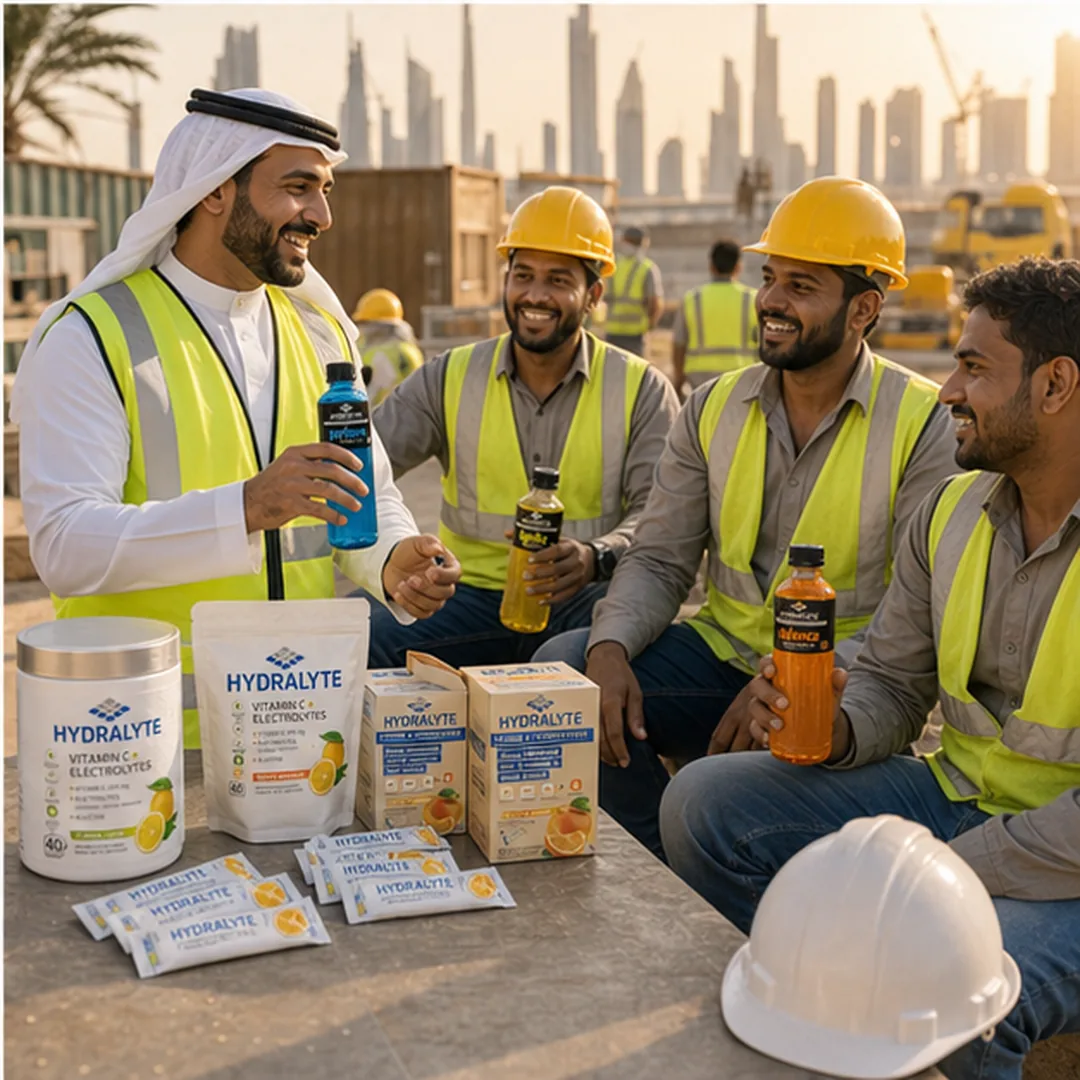
A water cooler tucked away in a site office does very little for a worker labouring two hundred metres away in direct sun. On UAE worksites, where summer heat is relentless and temperatures regularly climb past 45°C, the design and placement of hydration stations is one of the most overlooked factors in keeping a <a href="/industries">workforce</a> safe and productive. Well-designed hydration stations remove every small barrier between a thirsty worker and a proper drink, and that convenience is what turns good intentions into consistent hydration.
Designing hydration stations well is part logistics, part behavioural psychology and part compliance. It is not enough to provide water somewhere on site. The drink has to be close, cool, clean and appealing, and it has to include electrolytes for people sweating heavily for hours on end. A worker who loses litres of sweat across a shift cannot stay safe on plain water alone, and they certainly cannot stay safe if reaching that water means a long walk back across a baking site.
This article walks through the practical decisions that make the difference between a station people use and one they walk past: where to put it, what to stock it with, how to keep it running, and how to build the surrounding culture that makes drinking regularly feel normal. Get these right and a hydration station stops being a box-ticking exercise and becomes a quiet engine of a safer, more productive summer.
Why hydration stations matter so much in the UAE
The UAE climate is uniquely punishing for outdoor work. Inland, the dry heat soars; on the coast, high humidity means sweat evaporates poorly, so the body struggles to cool itself even as it loses fluid and salts rapidly. A worker can become dangerously dehydrated within a single shift without ever feeling that they have drunk too little, because thirst lags behind the body's actual needs in extreme heat.
Dehydration is not only a health risk; it is a performance and safety risk. Even mild fluid loss impairs concentration, slows reaction times and increases the chance of mistakes — a serious matter around heavy machinery, at height or behind the wheel. By the time a worker is visibly struggling, productivity has already fallen and the risk of heat illness has risen. Hydration stations exist to keep people topped up steadily, long before any of that happens.
It is also worth appreciating how quickly the margin disappears in this climate. A worker who starts a shift slightly under-hydrated, drinks too little because the nearest water is a long walk away, and is doing heavy physical work through the afternoon can move from comfortable to genuinely at risk within a couple of hours. The station network is the practical mechanism that closes that gap: it keeps fluid and salts flowing into the body at roughly the rate the heat is taking them out, so the worker never reaches the steep part of the curve where performance falls and danger rises sharply.
There is a compliance dimension too. Providing accessible drinking water and rest facilities is part of an employer's duty of care during the UAE summer, and a thoughtfully designed network of stations is the visible expression of that duty. Before the season peaks it is worth taking time to %assess the heat stress risk across your site% so that the number, placement and stocking of stations match the real conditions your crews face rather than a generic assumption.
Placement is everything
The most important design decision is location. Workers will not walk far in extreme heat for a drink, and every extra minute of travel discourages them from hydrating as often as they should. The guiding principle is simple: bring the water to the work, not the other way around.
Keep stations within easy reach
Hydration points should be positioned so that no worker has to travel far from their task to reach one. On large or spread-out sites this means multiple stations rather than a single central point, and it means moving them as the work moves. A station that was perfectly placed last month may be stranded once the active zone shifts to another part of the site. Planning this across a whole project is far easier with a structured approach, and a %workforce hydration planner% can help translate headcount and conditions into the number and location of stations a site actually needs.
Provide shade and seating
A hydration station in full sun is self-defeating. Pairing each station with shade, and ideally somewhere to sit, encourages workers to pause properly rather than gulp and rush back into the heat. These rest points double as natural cool-down spots and reinforce a culture where taking a hydration break is normal and expected rather than frowned upon. Shade also keeps the water and supplies themselves cooler, which matters a great deal when the alternative is water heated to an unpleasant temperature within minutes.
Catch people on natural routes
Placement is not only about distance to the task; it is about the paths workers already walk. Stations positioned at site entry points, near welfare facilities, at the foot of access ladders or along the routes between work zones catch people at moments when stopping for a drink is easy and natural. A station that sits slightly off the beaten track, even if technically close, will be used far less than one a worker passes anyway.
What a good station provides
Placement gets people to the station. What they find there determines whether they actually rehydrate. The contents need to reflect the reality of heavy sweating in heat, not just the legal minimum of available water.
- Cool, clean drinking water that is genuinely cold, since warm water is poorly tolerated in the heat
- Electrolyte solutions for workers sweating heavily across long shifts
- Clean, single-use cups or refillable bottles to keep hydration hygienic
- Shade over the station and a place to sit while drinking
- Clear signage reminding workers to drink regularly, not only when thirsty
Cold water matters more than many managers realise. People drink more when water is genuinely cool, so insulated coolers, ice or refrigeration are worth the investment. Pairing water with electrolytes is equally important, because workers who only drink plain water for hours can deplete their salts even while staying topped up with fluid — a condition that can itself cause cramps, weakness and, in severe cases, dangerous complications.
Signage is a small detail that punches above its weight. A worker in the heat is tired and focused on the task, and a clear visual prompt at the moment they pass a station nudges them to stop and drink when they might otherwise press on. Effective signs are simple and visual, work across the languages spoken on a typical UAE site, and reinforce the key message that people should drink at regular intervals rather than waiting for thirst. The same signage can remind workers when to choose an electrolyte drink over plain water, helping them self-manage without needing a supervisor at their shoulder.
Cups and bottles deserve thought too. Single-use cups are convenient and hygienic but generate waste and can run out; labelled personal refillable bottles cut waste and let a worker carry water back to the task, but require somewhere clean to refill. Many sites land on a hybrid: refillable bottles for regular staff at fixed points, with single-use cups held in reserve for visitors and peak demand. Whichever approach is chosen, running out of the means to drink is as much a failure as running out of water itself.
Balancing water and electrolytes
A common question is whether every drink should contain electrolytes. The sensible answer is to offer both: plenty of plain cool water for general thirst, and electrolyte solutions for the heavy, sustained sweating of demanding tasks. Workers doing light duties in shade have different needs from those pouring concrete in the afternoon sun, and a good station lets each person take what suits their situation. Signage explaining when to reach for electrolytes helps people make the right choice without supervision.
Types of hydration station and equipment choices
Not every site needs the same kind of station, and matching the equipment to the conditions is part of good design. The right choice depends on how mobile the work is, how much power and water access is available, and how many people each point must serve.
Fixed versus mobile stations
Fixed stations suit stable work areas such as welfare compounds, canteens and entry points, where they can be plumbed in or served by regular deliveries and kept reliably cold. Mobile stations — wheeled coolers, trailer-mounted tanks or simple insulated containers that can be carried — suit the active face of the work, which moves as a project progresses. Most large sites need a blend of both: dependable fixed points for rest and breaks, and mobile units that follow the crews into the zones where they are actually labouring.
Cooling and storage equipment
Keeping water genuinely cold in the UAE summer takes deliberate equipment rather than hope. Insulated coolers, ice packs, refrigerated dispensers and shaded storage all help. Where power is available, refrigerated water dispensers are ideal; where it is not, well-insulated containers topped up with ice can hold temperature for hours if kept out of the sun. Whatever the method, the test is simple: if the water is unpleasantly warm by mid-afternoon, the equipment is not up to the job and workers will drink less.
Dispensing and cups
How the drink is dispensed affects both hygiene and uptake. Touch-free taps or dispensers reduce contamination, while a steady supply of single-use cups or clearly labelled personal refillable bottles keeps things sanitary. Bottle-filling stations work well where each worker has their own bottle, cutting waste and giving people a drink they can carry back to the task. The aim throughout is to remove friction: anything that makes getting a drink slower or more awkward reduces how often people do it.
Encouraging workers to actually use the station
A perfectly stocked, well-placed station still fails if the surrounding culture treats hydration breaks as a sign of weakness or lost time. Design has to be matched by behaviour, and that comes from the top. When supervisors visibly take regular drinks and encourage their teams to do the same, hydration becomes routine rather than something workers feel they must justify.
The aim is to shift people away from drinking only when they feel thirsty, because by the time thirst sets in during heavy heat, dehydration is already under way. Clear signage, scheduled hydration breaks tied to the work rhythm, and gentle reminders from supervisors all help establish steady, proactive drinking. Stations placed along natural walking routes, near rest areas and at shift entry points catch people at moments when stopping for a drink is easy and natural.
Tying hydration breaks to the rhythm of the work, rather than leaving them to individual discretion, is one of the most effective behavioural levers available. When a crew breaks together at set intervals to drink in the shade, no individual has to decide to step away and risk looking as though they are slacking. The break becomes part of the job, like any other safety step, and consumption rises as a result. Supervisors who treat these breaks as productive time well spent, rather than an interruption to be minimised, send a powerful signal that hydration is genuinely valued.
Making electrolytes easy and appealing
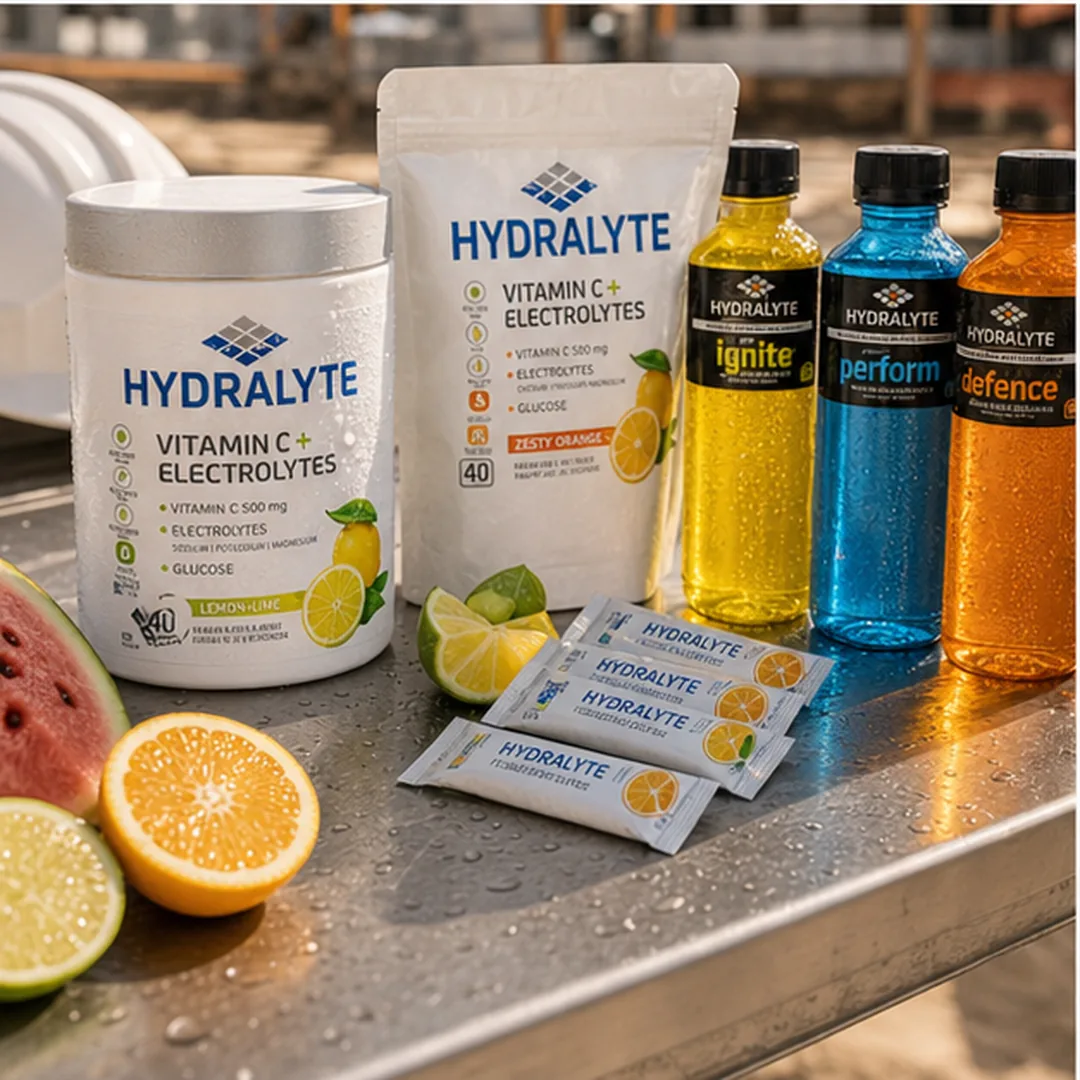
Workers are more likely to use electrolyte solutions if they are simple to prepare and pleasant to drink. Pre-mixed options or easy-to-use sachets remove friction, and offering a taste people tolerate across a long shift matters more than any specification on paper. A station that requires fiddly measuring or serves an unpalatable drink will quietly fall out of use, no matter how good the formula is in theory. Variety helps too: a flavour people enjoy in the morning may become tiresome by afternoon, so a small range keeps consumption up.
Keeping stations clean and stocked
A hydration station only works if it is maintained. A station that is empty, warm or dirty quickly loses the trust of the workforce, and once workers stop relying on it they fall back into drinking too little. Assigning clear responsibility for refilling water, replenishing electrolytes, restocking cups and cleaning surfaces is as important as the initial design. On a hot site this is a daily, sometimes hourly, task rather than a weekly one.
Hygiene in shared facilities
Shared water points carry hygiene risks if neglected. Touch-free dispensers, regularly cleaned surfaces and a steady supply of fresh cups all reduce the chance of illness spreading through a crew. Good hygiene also signals that management takes the facility seriously, which in turn encourages workers to use it. In the heat, an outbreak of stomach illness that spreads through a shared water point can sideline a significant part of a workforce, so cleanliness is a productivity matter as much as a health one.
Assigning ownership
The single most reliable way to keep stations working is to give a named person responsibility for each one, with a simple checklist and schedule. Vague collective responsibility tends to mean no one acts; a clear owner who checks water temperature, levels, cup supply and cleanliness on a set rhythm keeps the station dependable. On larger sites this responsibility can rotate, but it should never be left to chance.
Sizing capacity to the workforce and the heat
A station that runs dry by lunchtime is worse than no station at all, because it teaches workers not to rely on it. Sizing capacity correctly means thinking about how much fluid a hard-working crew actually consumes on a hot day, and planning supply to comfortably exceed it.
Fluid needs in extreme heat are substantial. As a rule of thumb, a worker doing heavy physical labour in the UAE summer can lose and need to replace well over a litre of fluid an hour during the hottest part of the day. Multiply that across a crew and across a long shift and the totals add up fast. Consider a crew of fifty working a demanding August afternoon: the volume of cool water and electrolyte solution required is far greater than a single small cooler can hold, which is why capacity, restocking frequency and the number of stations all have to be planned together rather than guessed.
Capacity also has to flex with the conditions. The same crew needs far more on a humid 48°C afternoon than on a milder, breezier morning. Planning for the worst conditions of the day, and having a clear method to bring in extra supply when a heatwave hits, prevents the demoralising and dangerous situation of stations emptying just when workers need them most.
Adapting stations as conditions change
A worksite in the UAE summer is not static, and neither are its hydration needs. The intensity of the heat shifts through the day, peaking in the early afternoon, and humidity can swing the perceived strain considerably even when the thermometer reads the same. A station design that copes well in the morning may be overwhelmed by the time the hardest hours arrive, so it pays to plan capacity around the worst conditions of the day rather than the average.
The work itself changes too. As a project moves through its phases, the number of workers, the type of tasks and the locations of activity all evolve. Heavy concrete pours, steel fixing or excavation create far greater fluid losses than lighter finishing work, and stations should be reinforced wherever the most demanding tasks are concentrated. Reviewing station placement and stocking regularly, rather than setting it once at the start, keeps hydration matched to what is actually happening on the ground. A periodic reassessment will flag the days and zones where extra capacity is most needed.
Listening to the workforce
The people using the stations are the best source of feedback on whether the setup works. If workers report that water is too warm, that a station is too far away, or that an electrolyte drink is unpleasant, those are practical signals worth acting on quickly. A short, regular check-in with crews often reveals simple fixes that make a disproportionate difference to how much people drink. Frontline workers notice problems long before they show up in an incident report.
Feedback works best when it is genuinely easy to give and visibly acted upon. A worker who mentions that the afternoon water is warm and then sees an extra cooler appear the next day learns that speaking up makes a difference, and will keep doing it. The opposite is also true: if reports vanish into silence, people stop bothering, and the most valuable early-warning system on the site goes quiet. Asking crews directly during toolbox talks, and closing the loop by telling them what changed as a result, keeps that channel open through the hardest months.
Hydration stations and UAE compliance
Designing hydration stations is closely tied to legal obligations during the UAE summer. The Ministry of Human Resources and Emiratisation enforces a <a href="/industries">Midday Break</a> Rule that prohibits work in the sun and open areas during the hottest part of the day, typically from around half past noon until mid-afternoon, from mid-June to mid-September. Providing accessible drinking water, shade and rest facilities is part of meeting the broader duty of care that sits alongside that rule.
A well-planned network of hydration stations supports compliance directly: the shaded rest points double as places for the midday break, and reliable cool water and electrolytes are exactly what workers need when they return to work afterwards. Employers unsure of their standing should take time to %meet your Midday Break Rule obligations% so that hydration provision is documented as part of an overall heat-safety regime rather than treated as an afterthought.
Beyond construction: stations for every work pattern
While much of this guidance is framed around construction, the same thinking applies wherever people work in the heat. Warehouses, ports, yards and the cabs and depots used by %logistics and transport operations% all present hydration challenges, often with workers who are mobile, lone or spread across a wide area. For these settings, fixed stations may be supplemented by in-vehicle water supplies, scheduled stops and check-in routines, but the underlying goal is identical: make cool water and electrolytes effortless to reach.
Tailoring the approach to the work pattern is what makes it effective. A driver cannot walk to a shaded station mid-route, so the station, in effect, has to travel with them. A picker moving constantly through a hot warehouse needs points along their path rather than one at the entrance. Thinking about how each role actually moves through the day reveals where hydration provision has to go.
Lone and mobile workers also need a way to be checked on. A driver who becomes unwell with heat illness while alone in a vehicle is in a far more precarious position than a worker on a busy site, because there is no colleague nearby to notice and respond. Pairing in-vehicle hydration with scheduled check-ins, clear guidance on rest stops, and a culture that expects drivers to pull over and cool down rather than push through, extends the same protective thinking that fixed stations provide on a construction site to people whose workplace is constantly moving.
Common mistakes in hydration station design
Many sites provide water and still see workers turning up dehydrated, because the provision falls into one of a handful of familiar traps. Recognising these mistakes makes them easy to avoid.
- Placing a single station far from where people actually work, so the trip in the heat deters use
- Letting water go warm because storage is in the sun or cooling equipment is inadequate
- Offering only plain water and ignoring the salt losses of heavy sweating
- Treating restocking as a low-priority chore, so stations sit empty for long stretches
- Neglecting hygiene until a shared point becomes a source of illness
- Setting the layout once at the start and never moving stations as the work moves
Each of these failures shares a root cause: hydration is treated as a box to tick rather than a service to manage. The sites that get it right assign ownership, plan capacity, keep water cold and review the setup regularly. None of that is expensive or complicated, but it requires treating hydration as an active part of running the site rather than a one-off purchase.
Another subtle mistake is designing for the average worker rather than the most exposed one. The crew pouring concrete in the afternoon sun sets the real requirement, not the team doing light work in shade. Designing to protect the people in the toughest conditions automatically covers everyone else.
Measuring whether your stations are working
It is easy to assume a hydration setup is effective simply because it exists, but the only true test is whether workers are drinking enough and heat illness is rare. Building in a few simple checks turns a static installation into a system that can be improved over time.
Simple indicators to watch
Consumption is the most direct signal: tracking roughly how much water and electrolyte solution each station gets through tells you whether people are actually using it and whether capacity matches demand. A station that is barely touched may be badly placed or serving warm water; one that runs dry needs more capacity or more frequent restocking. The rate of heat-related complaints, near-misses and incidents is the outcome that matters most, and a downward trend across a summer is the clearest sign the programme is working. Observing crews directly — are people stopping to drink, is the water cold, are the cups stocked — often reveals more than any record.
Closing the loop
Measurement only helps if it leads to action. A short, regular review that looks at consumption, incidents and frontline feedback, and then adjusts placement, capacity or stocking accordingly, keeps the setup matched to reality. This is the difference between a hydration programme that improves year on year and one that quietly drifts out of step with the site. The effort involved is modest, but the payoff — fewer heat casualties, steadier productivity and a workforce that trusts the provision — is substantial.
Designing for the scale of the project
The right hydration setup scales with the work. A small fit-out crew has very different needs from %large construction projects% with hundreds of workers spread across multiple zones and elevations. Larger projects benefit from a documented hydration plan that maps stations to work areas, sets restocking schedules and assigns ownership, so that hydration keeps pace as the project grows and moves.
Designing hydration stations well is one of the highest-return safety investments a site can make. It costs relatively little, yet it directly reduces heat illness, sustains productivity through the hottest hours and demonstrates genuine care for the workforce. Get the placement, contents and upkeep right and a hydration station stops being a box-ticking exercise and becomes a quiet engine of a safer summer. Workers who can drink easily and often are more alert, less prone to mistakes and far less likely to be lost to heat illness, all of which protects the project as much as the people. A documented plan also pays off in continuity: when a station owner is on leave or a shift changes over, a written schedule and map mean the system keeps running rather than quietly degrading. It turns hydration from something that depends on a few diligent individuals into a reliable part of how the site operates.
Ultimately, the measure of a hydration station is behavioural, not physical. The question is not whether water exists somewhere on site, but whether a tired worker in the worst heat of the afternoon finds it easy, even automatic, to drink enough. Every design decision — where the station sits, how cold the water is, whether electrolytes are on hand, how clean the cups are, how welcome the break feels — either lowers or raises the barrier to that single behaviour. Lower every barrier you can, review the setup as conditions and the project change, and listen to the people using it. To plan your own setup, %browse our free workplace hydration tools% and build a programme that fits your site.
Frequently Asked Questions
How many hydration stations does a worksite need?
There is no fixed number, because it depends on the size of the site, how spread out the work is and how many people are working. The aim is for no worker to have to travel far in the heat to reach a station. On large or dispersed sites this usually means several stations that move as the active work area moves, and planning tools can help translate headcount and conditions into a sensible figure.
Should hydration stations offer more than water?
Yes. Workers sweating heavily for hours lose significant salts, and plain water alone does not replace them. Effective stations provide cool water alongside electrolyte solutions so people can restore both fluid and the minerals lost in sweat. Offering both lets each worker take what suits their task, with electrolytes for the most demanding work and plenty of plain water for general thirst.
Why does the temperature of the water matter?
People simply drink more when water is genuinely cold, and in extreme heat warm water is often left untouched. Keeping water cool with insulated coolers, ice or refrigeration directly increases how much workers drink, which is the whole point of the station. Shade over the station also helps keep both the water and the workers cool while they rest.
How often should hydration stations be checked and restocked?
On a hot UAE site this is a daily and often hourly responsibility, not a weekly one. Someone should be clearly accountable for keeping water cold and topped up, replenishing electrolytes and cups, and keeping the station clean, because an empty or dirty station quickly stops being used. A named owner with a simple checklist is the most reliable way to keep stations dependable.
Where on a site should hydration stations be placed?
Place stations close to where people actually work and along the routes they already walk, such as site entrances, rest areas, the foot of access ladders and the paths between work zones. The principle is to bring the water to the work rather than expecting workers to make long trips in the heat. On large sites this means multiple stations that relocate as the active work area shifts.
How do I get workers to actually use the stations?
Design and culture have to work together. Stations must be close, shaded, cool and stocked, but workers also need to feel that hydration breaks are encouraged rather than penalised. Supervisors who visibly drink and remind their teams, scheduled hydration breaks, clear signage and easy-to-prepare electrolyte options all help shift people towards drinking steadily rather than only when thirsty.
Do hydration stations help with UAE labour compliance?
Indirectly, yes. Providing accessible drinking water, shade and rest facilities is part of an employer's duty of care during the UAE summer, alongside the Midday Break Rule enforced by the Ministry of Human Resources and Emiratisation. Well-placed shaded stations double as rest points for the midday break and help demonstrate that heat-safety provision is taken seriously across the site.
Are hydration stations only relevant to construction sites?
No. Any work carried out in the heat benefits from accessible hydration, including logistics, warehousing, ports, facilities maintenance and oil and gas operations. The form changes with the work pattern — in-vehicle supplies and scheduled stops for drivers, points along the path for mobile warehouse staff — but the goal of making cool water and electrolytes effortless to reach stays the same.
What hygiene measures should a shared hydration station have?
Shared water points should use touch-free dispensers where possible, have regularly cleaned surfaces and provide a steady supply of fresh single-use cups or sanitised refillable bottles. Neglected stations can spread illness through a crew, which is both a health and a productivity problem in the heat. Visible cleanliness also reassures workers and encourages them to use the facility.
How should hydration stations change as a project progresses?
Hydration needs are not static: heat intensity peaks in the early afternoon, humidity varies, and the number and type of tasks shift as a project moves through its phases. Stations should be reinforced wherever the most demanding work is concentrated and relocated as active zones move. Reviewing placement and stocking regularly, and listening to workforce feedback, keeps provision matched to real conditions rather than a fixed plan set at the outset.