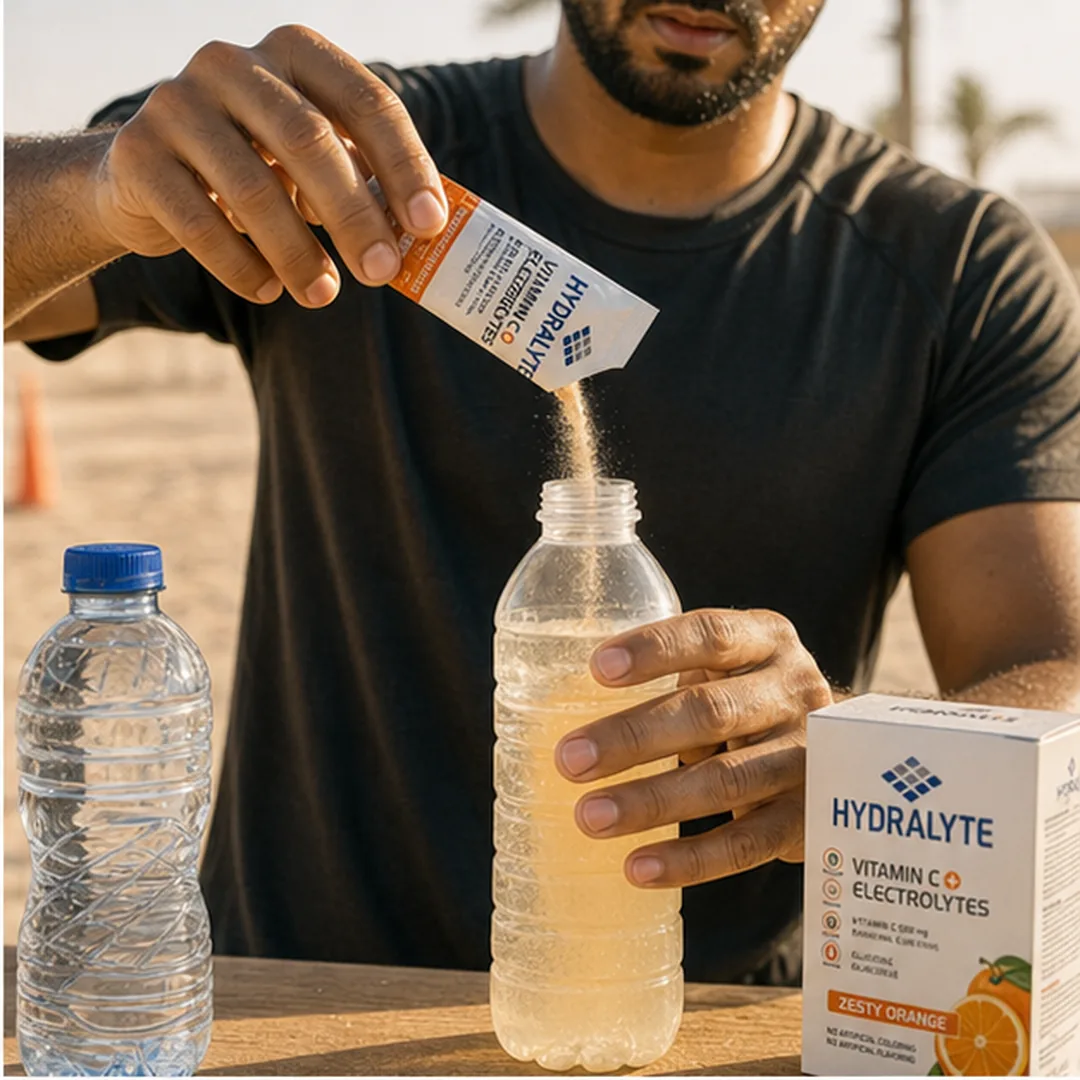
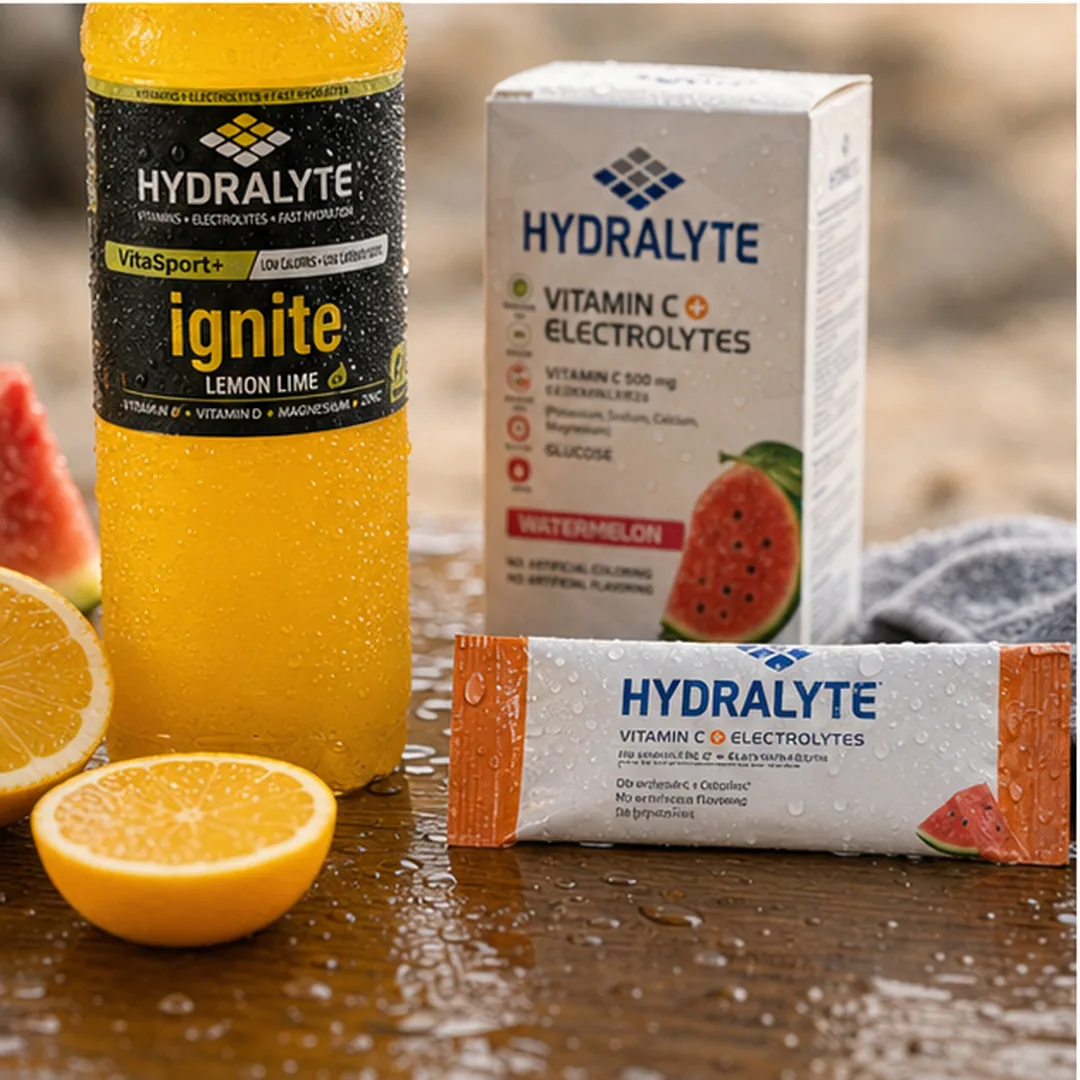
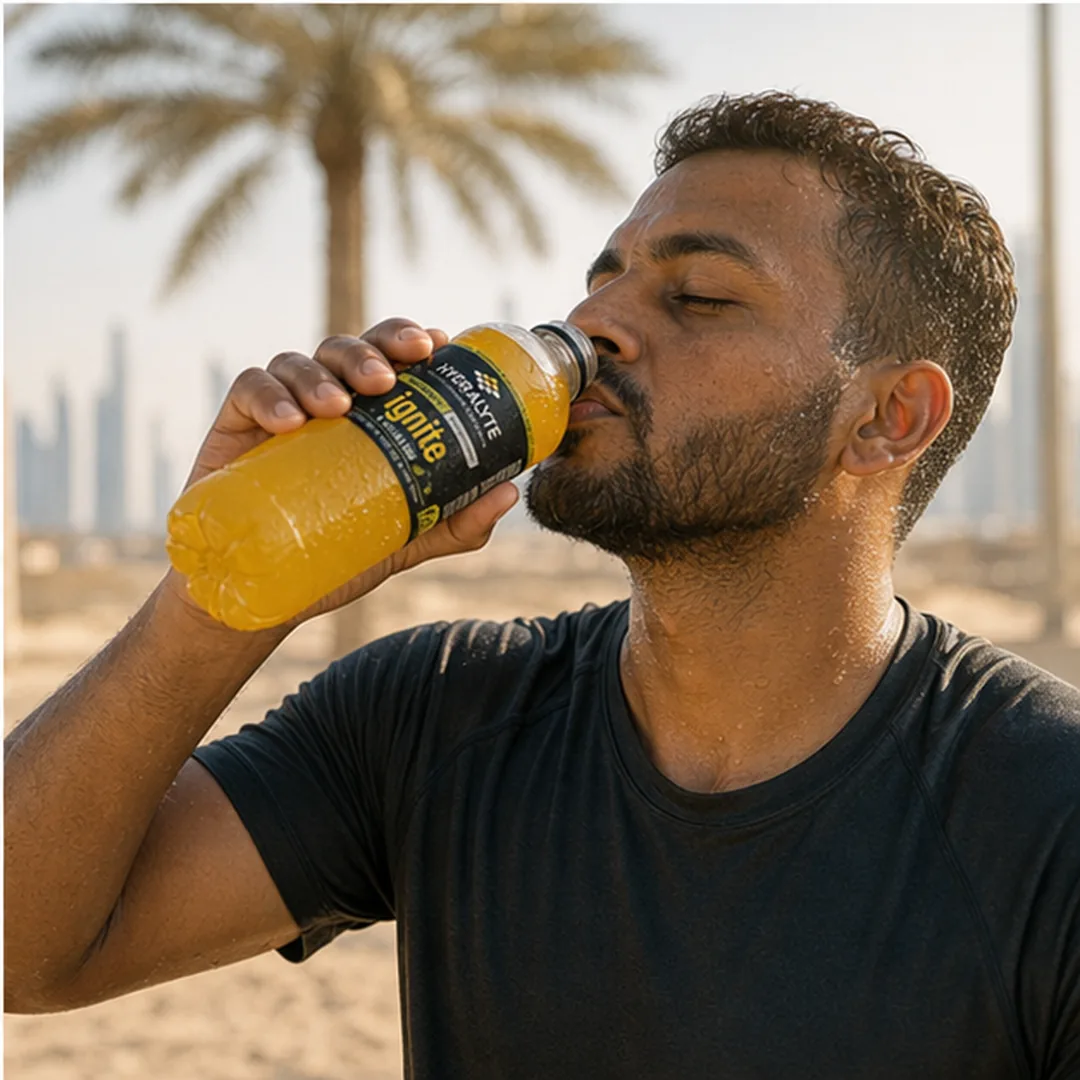
When the temperature climbs and the work is hard, the instinctive response is to drink more water. Water is essential, and staying hydrated is one of the most important things any worker can do in the UAE summer. But the debate of electrolytes vs water matters because, under extreme heat and heavy sweating, plain water on its own is not always enough to keep the body working safely. Understanding why is the difference between a worker who stays sharp through a long shift and one who fades, cramps or collapses.
The issue comes down to what the body actually loses when it sweats. Sweat is not pure water; it carries away salts and minerals that the body needs to function. Replace the water but not those minerals, and you can end up with a new set of problems, sometimes more serious than the dehydration you were trying to prevent. The science is well understood, but it rarely filters down to the people who need it most, the workers labouring outdoors in 45-plus-degree heat for hours at a stretch.
This article unpacks the real difference between water and electrolyte replacement, explains exactly when each one matters, and offers a practical framework for getting hydration right on a UAE work site. If you want to see how different options stack up for your team, it helps to %compare electrolyte options side by side% before settling on a hydration strategy, because the right choice depends on the demands of the job.
What electrolytes actually are
Electrolytes are minerals that carry an electrical charge when dissolved in the body's fluids. That charge is not a curiosity; it is the basis of how the body runs. Nerve impulses, muscle contractions, the steady beat of the heart and the careful balance of fluid inside and outside every cell all depend on electrolytes being present in the right concentrations. The main ones are sodium, potassium, chloride, magnesium and calcium, and each is lost, to varying degrees, when a person sweats.
In everyday life the body manages these levels automatically through diet and the kidneys. A normal meal restores what a sedentary day uses up. The problem in extreme heat is one of scale: when a worker sweats litres over a shift, the losses outstrip what casual eating and drinking can replace, and the careful balance the body relies on starts to slip. That is the moment when the choice between plain water and a properly balanced electrolyte drink stops being trivial and starts to matter for safety.
What the body loses through sweat
Sweating is the body's primary cooling mechanism, and in the UAE summer the volumes lost can be substantial over a working day. A worker doing heavy manual labour in direct sun can lose well over a litre of sweat an hour, and across a full shift that adds up to several litres. Crucially, that sweat contains electrolytes, chiefly sodium, along with potassium, chloride, magnesium and calcium. These minerals are carried out of the body in solution, and unlike the water, they are not so easily replaced by simply drinking from a tap.
When heavy sweating depletes these electrolytes and a worker drinks only plain water, the concentration of salts in the body falls. The water dilutes what remains, and the body's careful balance is disturbed. This is why simply drinking large quantities of water during intense, prolonged heat exposure can sometimes make a worker feel worse rather than better, a counter-intuitive truth that catches out even experienced labourers who assume that more water is always the answer.
What each electrolyte does
It helps to know that these minerals are not interchangeable; each plays a distinct role. Sodium is the most significant for workers in the heat, because it is lost in the greatest quantity through sweat and because it governs how the body holds on to water. Potassium works alongside sodium to keep fluid balanced inside and outside the body's cells and is vital for steady muscle and heart function. Magnesium and calcium are central to muscle contraction and relaxation, which is why a shortfall often shows up first as the painful cramps that many outdoor workers know all too well. When all of these are running low at once, the body simply cannot perform as it should, however much plain water is poured into it.
Why sweat losses vary so much
No two workers sweat at the same rate, and this is one reason a blanket hydration rule rarely fits everyone. Body size, fitness, the intensity of the task, the humidity and how well a person has adapted to the heat all influence how much sweat, and how much salt, is lost. Someone newly arrived in the UAE typically loses more salt in their sweat than a worker who has spent several summers acclimatising, because the body gradually learns to conserve sodium. This is why new arrivals are often among the most vulnerable, and why understanding individual variation matters. To get a sense of how these factors combine on your own site, it is worth taking time to %assess the heat stress risk on your site% before the peak of summer arrives.
Why plain water can fall short
Plain water is perfect for everyday hydration and for shorter periods of moderate activity. The limitation appears specifically under conditions of prolonged, heavy sweating, which is exactly what outdoor work in extreme heat produces. In these conditions water alone addresses only half of what the body has lost, leaving the salt deficit unaddressed and, in some cases, making it worse.
The dilution problem
As sodium levels drop and water intake stays high, the body's sodium concentration can fall too low, a condition known medically as hyponatremia. Mild versions of this leave workers feeling unexpectedly tired, headachy and unwell despite drinking plenty. In rarer, severe cases the imbalance becomes genuinely dangerous, affecting the brain and in extreme situations becoming life-threatening. The body also struggles to hold on to the water it has been given, because it is sodium that helps fluid stay where it is needed rather than being passed straight through and lost in urine.
The thirst trap
Plain water quenches thirst quickly, which sounds helpful but can actually cut hydration short. A worker may stop drinking because they no longer feel thirsty, even though their body still needs both fluid and salts. This is the thirst trap: the sensation of thirst is satisfied long before the body is genuinely replenished. A properly balanced electrolyte drink encourages more complete rehydration and helps the body retain the fluid for longer, because the sodium it contains signals the body to hold on to what it has taken in rather than flushing it away.
The absorption advantage
There is also a quieter, more technical reason electrolytes help. A correctly balanced solution, with the right ratio of sodium and a small amount of glucose, is absorbed from the gut more efficiently than plain water. This is the same principle behind oral rehydration solutions used to treat dehydration around the world. For a worker who needs to rehydrate quickly during a short break, that faster, more complete absorption can make a meaningful difference to how they feel when they return to the task.
When electrolytes genuinely matter
Electrolytes are not a marketing gimmick to be sprinkled on every glass of water; they matter most in specific, predictable situations. The clearest case is sustained physical work in high heat and humidity, where sweat losses are large and continuous. Workers who sweat heavily, who are out in the sun for hours, or who are doing demanding manual tasks benefit most from electrolyte replacement. Anyone who has experienced the relentless conditions of %the realities of construction work% will recognise just how quickly fluid and salts drain away on a summer afternoon.
Individual needs vary, which is why a one-size-fits-all rule rarely works. Body size, sweat rate, the intensity of the job and the length of the shift all change the equation. Tools that let you %calculate personal hydration needs% can help translate these factors into practical targets for how much to drink and when, rather than leaving it to guesswork.
Situations that call for electrolytes
Some scenarios reliably tip the balance towards electrolyte replacement rather than water alone:
- Continuous heavy physical work in direct sun for more than an hour or two at a stretch.
- Conditions of high humidity, where sweat evaporates poorly and the body sweats even harder to cool down.
- Long shifts where cumulative sweat losses build up across the day.
- Workers who are new to the climate and have not yet acclimatised to UAE summer conditions.
- Anyone who has already shown early signs of heat strain, such as cramping or unusual fatigue, and needs to recover before continuing.
Reading your own body
Workers can also learn to read their own signals. Persistent muscle cramps despite drinking water are a classic sign that salts, not just fluid, need replacing. Feeling drained, headachy or unusually irritable late in a long, sweaty shift, even after drinking plenty, can point to the same thing. The colour and frequency of urine offer a rough but useful guide to overall hydration: pale and regular is reassuring, dark and infrequent is a warning. None of these signs is a precise instrument, but together they help workers notice when plain water is not keeping pace with what their bodies are losing, and when electrolyte replacement would make a real difference.
The risks of getting it wrong
Understanding why hydration matters is easier when the consequences of neglecting it are clear. Dehydration in extreme heat does not announce itself dramatically at first. It begins quietly, with reduced concentration, slower reactions and a creeping fatigue that workers often push through without realising what is happening. On a busy site, that dip in alertness is itself a safety hazard, because tired, foggy workers make more mistakes around machinery, vehicles and heights.
Left unchecked, the picture worsens. Heat exhaustion brings heavy sweating, weakness, nausea, headache and dizziness, and it is a clear signal that a worker must stop, rest in the shade and rehydrate. If ignored, it can progress to heat stroke, a medical emergency in which the body's cooling system fails and the core temperature climbs dangerously high. At that point the situation is genuinely life-threatening and requires immediate medical attention. The salt-imbalance problems caused by drinking only water sit alongside these heat illnesses, sometimes overlapping and sometimes compounding them, which is why getting the balance of fluid and electrolytes right is not a minor detail but a core part of keeping workers safe.
Striking the right balance
The goal is not to replace water with electrolyte drinks entirely, but to use each appropriately. Water remains the backbone of hydration; electrolytes top up what heavy sweating strips away. A sensible approach for outdoor work in extreme heat looks something like this.
- Drink regularly throughout the shift rather than waiting for thirst, which is already a sign of mild dehydration.
- Use electrolyte replacement during and after long, sweaty work to restore lost sodium and other minerals.
- Avoid drinking very large volumes of plain water in one go during prolonged heat exposure, which can worsen dilution.
- Pay attention to how you feel, and treat persistent fatigue, cramps or headaches as a signal to rest and rehydrate properly.
For employers, building this balance into the working routine protects both health and productivity. Workers who are properly hydrated think more clearly, react faster and make fewer mistakes, which matters as much for safety as it does for output. A well-hydrated <a href="/industries">workforce</a> is, quite simply, a safer and more capable one, and the cost of providing electrolytes is trivial compared with the cost of a serious heat incident.
Timing matters as much as quantity
How hydration is spread across the day is as important as the total amount consumed. Front-loading fluid before a shift begins gives the body a buffer, while small, steady top-ups through the working hours keep levels stable rather than swinging between deficit and overload. After the shift, continued rehydration helps the body recover overnight so that the worker starts the next day in good shape rather than already behind. This twenty-four-hour view is far more effective than treating hydration as something that only happens during a mid-morning break.
Common myths about hydration in the heat
Several persistent myths get in the way of good hydration practice on UAE sites. The first is that thirst is a reliable guide; in reality, by the time a worker feels thirsty they are already mildly dehydrated, and in older workers the thirst signal is even less dependable. The second myth is that any cold drink will do, when in fact sugary soft drinks and strong coffee can work against hydration, the former by drawing water into the gut and the latter through its mild diuretic effect.
A third myth is that electrolyte drinks are only for athletes. The science that helps a marathon runner finish strong is exactly the same science that helps a scaffolder get through an August afternoon, and arguably the worker faces the harsher conditions. A final, dangerous myth is that drinking enormous amounts of water is always safe and always better. As the dilution problem shows, that is not true under prolonged heavy sweating, where balance, not sheer volume, is what protects the body.
Special considerations for vulnerable workers
While good hydration practice protects everyone, some workers face higher risk and deserve closer attention. Those newly arrived in the UAE have not yet acclimatised, and their bodies lose more salt in sweat and cool less efficiently until they adapt over a couple of weeks. Older workers may have a blunted sense of thirst, meaning they feel the urge to drink later than they should, and they can dehydrate before realising it. Anyone managing a chronic health condition, taking certain medications, or recovering from a recent illness may also be more susceptible to the effects of heat and fluid loss.
For these workers, the balance between water and electrolytes matters even more, because they have less margin for error. Steady, scheduled drinking rather than reliance on thirst is especially important, as is timely electrolyte replacement during heavy sweating. Supervisors who are aware of who in their team carries extra risk can keep a discreet eye out for early signs of strain and step in before a problem develops. None of this requires singling anyone out uncomfortably; it simply means recognising that a one-size-fits-all approach leaves the most vulnerable least protected, and adjusting accordingly.
Choosing the right approach for your workforce
Not every electrolyte product is the same, and the right choice depends on the demands of the job and the preferences of the people doing it. Factors such as sodium content, sugar levels, ease of preparation on site and acceptability to workers all play a part. Taking a little time to %find the right product for your workforce% means the hydration solution is one people will actually use, which is ultimately what makes it effective.
For employers, it is also worth thinking about how electrolyte provision fits into the working day in practice. Ready-to-use formats that workers can prepare quickly are far more likely to be used than anything fussy or time-consuming, and acceptability of taste matters more than people expect, because a product that workers dislike will simply be left unopened. Building electrolyte replacement into existing break routines, rather than treating it as an extra task, helps it become a habit. The easier and more pleasant it is, the more reliably workers will keep their salts topped up through a long, hot shift.
Making provision practical on site
The best hydration product in the world achieves nothing if it never reaches the worker's hand at the right moment. Practical provision means cool drinking water and electrolytes at the point of work, not a long walk away, along with clear guidance on when to use each. It means stocking enough that supplies never run out mid-afternoon, and assigning someone on each shift to keep an eye on both the supply and the workers using it. When provision is this seamless, hydration becomes part of the rhythm of the day rather than an afterthought, and that consistency is what keeps people safe across an entire summer.
How heat and humidity change the equation
The UAE summer is not simply hot; it is hot in a way that makes the body work especially hard to stay cool. In dry heat, sweat evaporates quickly and carries heat away efficiently. On the humid coast, however, the air is already saturated with moisture, so sweat lingers on the skin and evaporates poorly. The body responds by sweating even more in an attempt to cool down, which means greater fluid and salt losses for less cooling benefit. This is why the same task can feel far more punishing on a humid day in a coastal city than on a dry day inland, even at a similar temperature reading.
This humidity effect is one of the reasons electrolyte replacement matters so much in the region. A worker can be drenched in sweat that simply will not evaporate, losing salts steadily while gaining little relief. Add the radiant heat from concrete, metal and machinery on a typical work site, and the cooling challenge becomes severe. Understanding this helps explain why a hydration approach that might be perfectly adequate in a milder climate can fall short here, and why balancing water with electrolytes is not an optional extra but a sensible response to genuinely extreme conditions.
Acclimatisation and why it takes time
The body is remarkably adaptable, and over a couple of weeks of repeated heat exposure it becomes noticeably better at coping. It learns to start sweating sooner, to sweat more efficiently, and crucially to conserve sodium so that less salt is lost in each litre of sweat. This process, known as acclimatisation, is one of the body's most useful defences against heat. It is also why workers returning from leave in a cooler country, or newly arrived in the UAE, are temporarily more vulnerable until their bodies readjust.
During this adjustment period, careful hydration with both fluid and electrolytes is especially important, because the unacclimatised body loses more salt and is less efficient at staying cool. Employers who phase in heavy outdoor work for new arrivals, rather than throwing them straight into the most demanding tasks, give their bodies time to adapt and reduce the risk of early-season heat illness. Acclimatisation is free, but it cannot be rushed, and good hydration supports it rather than replacing it.
Hydration and worker performance
Hydration is often framed purely as a health and safety issue, but it is also a performance issue, and the two are closely linked. Even mild dehydration, well before any obvious symptoms appear, dulls concentration, slows reaction times and saps physical stamina. On a work site, those small declines add up to slower work, more errors and a higher chance of accidents. A worker who is even slightly behind on fluid and salts is simply not operating at their best, however willing they are.
Restoring proper hydration reverses these effects. Workers who are well hydrated stay sharper for longer, maintain their strength through the afternoon, and recover better between shifts. For employers, this means that good hydration is not a cost to be minimised but an investment that pays back in productivity, quality and safety. The relatively small expense of providing water and electrolytes is dwarfed by the value of a workforce that stays alert and capable through the hottest part of the year. Seen this way, the electrolytes-versus-water question is also a question about how well your operation runs.
What a balanced electrolyte drink actually contains
Not all drinks marketed for hydration are designed for the same purpose, and the differences matter when the goal is replacing what heavy sweating takes away. A purpose-built rehydration solution is formulated around a careful balance: enough sodium to replace what is lost and to help the body hold on to fluid, a small amount of glucose to aid absorption, and supporting minerals such as potassium. The sodium content is the single most important figure, because sodium is both the electrolyte lost in the greatest quantity and the one that governs fluid retention.
Many ordinary soft drinks and even some sports drinks, by contrast, are built around flavour and energy rather than rehydration. They often carry a high sugar load with comparatively little sodium, which makes them pleasant to drink but poorly matched to the needs of a sweating worker. A very sugary drink can even slow the absorption of fluid in the gut, the opposite of what someone needs during a short rehydration break. Reading what a product actually contains, rather than relying on packaging claims, is the surest way to tell whether it is genuinely fit for the conditions on a UAE work site.
Why a little sugar helps
It can seem contradictory that an effective rehydration drink contains some sugar when high-sugar drinks are discouraged. The explanation lies in how the gut absorbs fluid. A modest amount of glucose, in the right ratio with sodium, actively helps the body draw water across the gut wall and into the bloodstream, speeding rehydration. The problem with sugary soft drinks is not that they contain sugar at all, but that they contain far too much of it and too little sodium, tipping the balance the wrong way. The goal is a measured, balanced formulation, not a sugar-free one, and certainly not a sugar-heavy one.
Hydration for the whole working day
Effective hydration in extreme heat is not a single event but a continuous thread running through the entire day, and even beyond it. The most reliable approach treats hydration as something that begins before work, continues steadily through every hour of exposure, and carries on into the evening to support recovery. Workers who think of it this way rarely fall into a deep deficit, because they never let the gap between losses and replacement grow too wide.
Starting the day already well hydrated gives the body a buffer for the morning's losses. Drinking small, regular amounts through the shift, with electrolyte replacement layered in during the hardest, sweatiest stretches, keeps levels stable rather than swinging between deficit and overload. Continuing to rehydrate after the shift helps the body recover overnight, so that the next morning begins from a position of strength rather than a hangover of yesterday's losses. Across a long, hot summer, this steady, all-day rhythm is what separates workers who cope well from those who struggle, and it is far more effective than trying to fix dehydration with a single large drink at a break.
Practical mistakes to avoid
Even employers and workers who take hydration seriously can fall into avoidable traps. Recognising these common mistakes is half the battle, because most of them are easy to fix once spotted.
- Waiting for thirst before drinking, when thirst already signals mild dehydration and lags behind real need.
- Relying on a single mid-morning break to catch up on fluid, rather than drinking steadily across the day.
- Providing only plain water for roles that involve hours of heavy sweating, leaving the salt deficit unaddressed.
- Placing water and supplies too far from the work, so that the effort of fetching a drink discourages regular hydration.
- Choosing an electrolyte product that workers find unpleasant or hard to prepare, which then goes unused.
- Ignoring early warning signs such as cramps or unusual fatigue and pushing on until the situation becomes serious.
Each of these mistakes undermines an otherwise sensible approach, and each can be corrected with a little planning and attention. The goal is to remove every barrier between the worker and proper hydration, so that staying topped up on both fluid and salts becomes the path of least resistance rather than an effort of will.
Bringing it together
In the end, electrolytes vs water is not really a contest. Both have their place, and the smartest hydration strategy in extreme heat uses water as the foundation while relying on electrolytes to replace what intense sweating takes away. Water keeps the system topped up; electrolytes keep it balanced. Neither alone is sufficient for the most demanding conditions, but together they keep the body's remarkable cooling system working as it should.
For anyone working through a UAE summer, that combination is what keeps the body, and the worker, functioning safely all day long. Employers who understand the distinction, and who build it into a proper hydration routine, protect their people from preventable harm and keep their operations running smoothly through the hottest months. To explore the full set of resources that can help you put this into practice, %browse the full range of free hydration tools% and start building a hydration approach that genuinely fits your workforce.
Frequently Asked Questions
Is plain water bad for you in extreme heat?
Plain water is not bad and remains essential, but during prolonged heavy sweating it may not be sufficient on its own. Without replacing lost salts, drinking only water can dilute the body's sodium and leave a worker feeling unwell despite being well hydrated. The best approach combines water with electrolyte replacement when sweat losses are heavy and sustained. Water is the foundation; electrolytes restore the balance.
What are electrolytes and why do they matter?
Electrolytes are minerals such as sodium, potassium, magnesium and calcium that carry electrical charge in the body. They regulate fluid balance, nerve signals and muscle function, and they are lost in sweat, which is why replacing them matters during intense work in the heat. When they run low, workers can suffer cramps, fatigue and poor concentration even if they are drinking plenty of water. Restoring them keeps the body performing as it should.
Do office workers need electrolyte drinks?
For most indoor, low-exertion work, plain water is perfectly adequate. Electrolyte replacement is most valuable for those doing demanding physical work in high heat and humidity, where sweat losses are large and sustained. An office worker in an air-conditioned environment will generally meet their electrolyte needs through normal meals. The picture changes only if they are sweating heavily, such as during exercise or outdoor activity.
Can you drink too much water in the heat?
Yes. Consuming very large volumes of plain water during prolonged heat exposure without replacing sodium can lead to a dangerous dilution of the body's salts, a condition called hyponatremia. Balancing fluid intake with electrolyte replacement avoids this risk. The aim is steady, regular drinking paired with salt replacement, rather than gulping huge amounts of water at once. Balance, not sheer volume, is what protects the body.
How do I know if I need electrolytes rather than just water?
Persistent muscle cramps, unusual fatigue, headaches or irritability late in a long, sweaty shift, despite drinking plenty of water, are classic signs that salts need replacing. The duration and intensity of sweating are the key factors: short, light activity rarely needs electrolytes, while hours of heavy work in the sun usually does. Learning to read these signals helps workers respond before strain becomes serious. When in doubt during demanding outdoor work, electrolyte replacement is the safer choice.
How much sweat do workers lose in the UAE summer?
Workers doing heavy manual labour in direct sun can lose well over a litre of sweat an hour, and several litres across a full shift. The exact amount varies with body size, fitness, humidity, the intensity of the task and how acclimatised the person is. High humidity on the coast makes sweat evaporate poorly, so the body sweats even harder to stay cool. These large, sustained losses are precisely why electrolyte replacement becomes important.
Are sports drinks the same as electrolyte rehydration solutions?
Not always. Many sports drinks are formulated for sustained athletic performance and can contain a lot of sugar with relatively modest sodium. A purpose-built oral rehydration solution typically has a balance of sodium and glucose designed for efficient fluid absorption and rehydration. For workers focused on safely replacing what they lose to sweat, the sodium content and absorption profile matter more than flavour or branding. Comparing options carefully helps you pick the right tool for the job.
Do new arrivals to the UAE need to be more careful about hydration?
Yes. Workers who have not yet acclimatised to the climate tend to lose more salt in their sweat and are generally more vulnerable to heat illness. The body gradually adapts over a couple of weeks of exposure, learning to conserve sodium and cool more efficiently. During that adjustment period, extra attention to both fluid and electrolyte replacement is sensible. Employers should pay particular care to staff who are new to the region.
Can caffeine and sugary drinks help with hydration?
They are poor substitutes for water and electrolytes in the heat. Strong coffee has a mild diuretic effect, and very sugary drinks can draw water into the gut, neither of which helps when the body is already under heat stress. While moderate consumption is not harmful, these should not be relied on as a hydration strategy during demanding outdoor work. Water and balanced electrolyte replacement remain the dependable choice.
What is the simplest hydration rule for a hot work shift?
Drink regularly throughout the shift rather than waiting for thirst, and add electrolyte replacement whenever the work involves long periods of heavy sweating. Avoid gulping huge volumes of plain water at once, and treat cramps, headaches or unusual fatigue as a signal to rest and rehydrate properly. Spreading hydration across the whole day, including before and after work, is far more effective than trying to catch up at a single break. Keep it steady, keep it balanced.