Ask how much water a person needs in a day and you will usually hear the familiar advice about eight glasses. For an office worker in a climate-controlled building that figure is a reasonable starting point. For an outdoor worker labouring through a UAE summer, it is almost meaningless. The honest answer to how much water per day a person truly needs is: it depends — and in the Gulf heat, it depends a great deal.
Fluid requirements for outdoor work are driven by how much a person sweats, and sweat rates vary enormously with temperature, humidity, sun exposure, workload and individual physiology. A worker carrying out heavy physical tasks in direct sun can lose several times more fluid per hour than someone doing light work in the shade. Planning hydration around a fixed daily number, rather than these real drivers, leaves people under-hydrated on the very days they are most at risk.
This article sets out, in practical terms, what actually determines an outdoor worker's daily water needs in the UAE, why generic guidance is unreliable in extreme heat, how to estimate intake for individuals and whole crews, and how to turn all of this into a hydration plan that holds up through the worst of the summer. The aim is not a single magic number, but a way of thinking that keeps the hardest-working people properly protected.
Why generic water advice fails in the heat
The popular guidance on daily water intake was never designed for people sweating heavily for hours in extreme heat. It is built on the needs of sedentary adults in temperate climates, where fluid losses are modest and predictable. In UAE summer conditions, the body's cooling system runs at full capacity, and the fluid lost through sweat has to be replaced or core temperature begins to climb. Two workers standing side by side may need very different amounts depending on their roles, body size and how acclimatised they are to the heat.
Consider the scale of the gap. A general daily intake figure for an adult might be in the region of two to three litres from all sources, including food. An outdoor worker in peak summer can lose that much in sweat alone within a few hours of heavy labour. Applied to a hot work front, the everyday rule is not just inaccurate — it is dangerously low, because it implies a worker is well hydrated long before they actually are.
There is a deeper problem with fixed advice, too. It encourages people to stop thinking. A worker who believes they have done their duty after eight glasses has no reason to keep drinking, even on a day when their body is screaming for more. A supervisor who has handed out the standard ration has no reason to look harder at conditions. Rules that replace judgement with a number can quietly remove the very vigilance that hot-weather safety depends on, which is the opposite of what they are meant to do.
This is why hydration is best treated as an individual calculation rather than a one-size-fits-all rule. A %personal hydration calculator% can take account of body weight, activity level and conditions to give a far more realistic target than a generic glass count, helping each worker understand roughly how much they should be drinking across a shift. The point is not precision to the millilitre, but moving away from a number that bears no relationship to what the body is losing. A good estimate that you revisit beats a precise figure that is precisely wrong.
How the body loses water in extreme heat
To understand daily needs, it helps to understand the mechanism. When the body heats up — from the surrounding air, from direct sun, and from the metabolic heat generated by muscular work — it cools itself chiefly by sweating. As sweat evaporates from the skin it carries heat away. The harder the body has to work to stay cool, the more it sweats, and the more fluid it loses.
In the UAE this cooling system faces a particular challenge: humidity. On the coast, summer humidity is often very high, and humid air slows evaporation. Sweat that cannot evaporate drips off the body without doing its cooling job, so the body keeps producing more in an attempt to compensate. The result is that a worker can lose a great deal of fluid while still struggling to bring their temperature down — the worst of both worlds.
Sweat carries more than water
Sweat is not pure water. It contains dissolved salts, principally sodium, along with smaller amounts of potassium, chloride and other electrolytes. Over a long, hot shift these losses add up. Replacing only the water and not the salts can leave the body's chemistry out of balance, which is why the question of how much to drink cannot be separated from the question of what to drink. We return to this below.
Why the body falls behind
A crucial detail is that the body cannot signal its needs quickly or precisely. Thirst lags behind actual fluid loss, often by a significant margin, so a worker can be measurably dehydrated before feeling any strong urge to drink. The gut also limits how fast fluid can be absorbed, so once a worker falls behind they cannot simply drink their way out in one go. This combination — slow signalling and limited absorption — is why hydration must be managed proactively across the whole shift rather than reactively when someone finally feels thirsty.
It also explains why hot work is so unforgiving of small errors. A modest shortfall each hour compounds quietly through the morning, so by the time symptoms appear the worker may be several hours and a litre or more behind. The deficit that began as a barely noticeable lag has become a genuine risk, and recovering from it takes far longer than preventing it would have.
The main factors that drive daily water needs
Several factors combine to determine how much fluid an outdoor worker needs on any given day. Understanding them helps supervisors plan breaks and stock the right amount of water and electrolyte solution at the work front.
- Temperature and humidity: higher heat and humidity dramatically increase sweat losses and slow the body's ability to cool.
- Workload: heavy lifting, carrying and continuous movement raise the metabolic heat the body must shed.
- Sun exposure: direct sunlight adds a significant radiant heat load compared with shaded work.
- Clothing and protective equipment: coveralls, high-visibility gear and PPE trap heat and reduce evaporative cooling.
- Acclimatisation and fitness: workers new to the heat or to the task tend to be at greater risk early on.
- Body size and individual physiology: larger workers and those who sweat heavily generally need more fluid than lighter, lower-sweating colleagues.
No single factor acts alone. A moderate workload in dry shade is a very different proposition from the same workload in humid sun while wearing heavy PPE. This is why a structured assessment that weighs these factors together gives a much more honest picture than any one of them in isolation. Before setting expectations for a shift, it is worth taking a moment to %assess the heat-stress risk on a given day% so that the day's hydration plan reflects the conditions people will actually face.
It is also worth distinguishing between the factors you can control and those you cannot. Temperature, humidity and sun are fixed by the day and the location, but workload scheduling, clothing choices, the availability of shade and the timing of breaks are all within an employer's control. A sound hydration plan leans hard on the controllable factors to offset the ones it cannot change: moving the heaviest tasks to cooler hours, providing shaded rest, and ensuring water and electrolytes are within easy reach so that drinking never means a long walk in the sun.
How protective equipment changes the maths
PPE deserves particular attention because it is so easy to underestimate. Coveralls, high-visibility layers, gloves, hard hats and any chemical or dust protection all reduce the body's ability to shed heat by evaporation. A worker in heavy protective clothing effectively carries their own microclimate, often several degrees hotter than the surrounding air, and sweats accordingly. Two workers in identical conditions doing identical tasks can have markedly different fluid needs purely because one is wearing more protective equipment than the other. Any estimate that ignores PPE will understate the needs of the most heavily protected — and often the most exposed — workers on site.
Water alone is not always enough
When sweat losses are heavy, replacing fluid is only half the picture. Sweat also carries electrolytes — particularly sodium — out of the body. Drinking large volumes of plain water without replacing these salts can, in extreme cases, dilute the body's sodium levels and cause its own problems, while also leaving the worker feeling that water is "not satisfying."
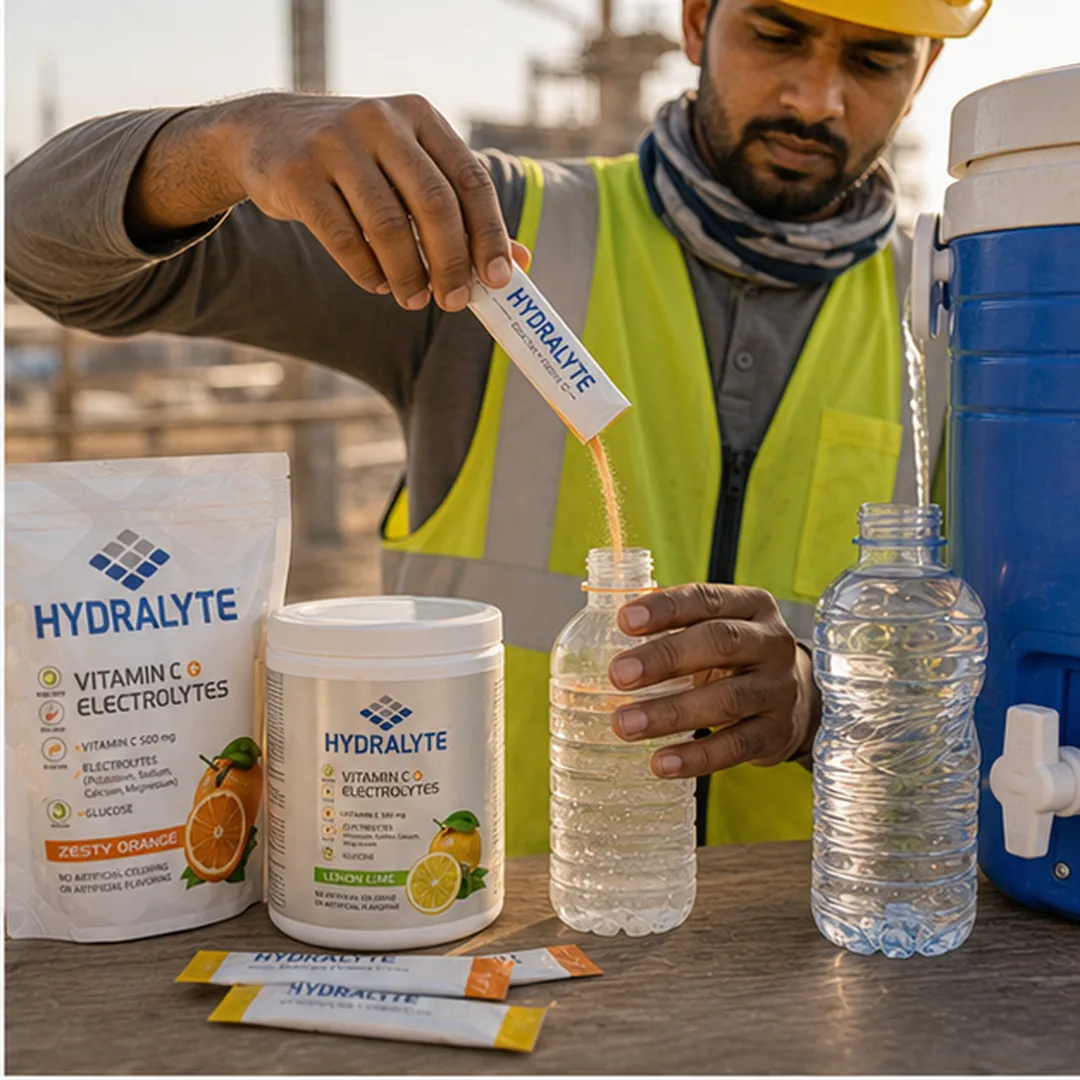
For long, hot shifts an electrolyte solution helps the body retain the fluid it takes in and replaces what sweat removes, supporting steadier energy and fewer cramps. Sodium in particular helps the gut absorb water and the body hold onto it, so a properly formulated electrolyte drink can hydrate more effectively than the same volume of plain water. The right balance between water and electrolytes shifts with the intensity and duration of the work, which is another reason a tailored approach beats a fixed daily figure.
Choosing the right electrolyte support
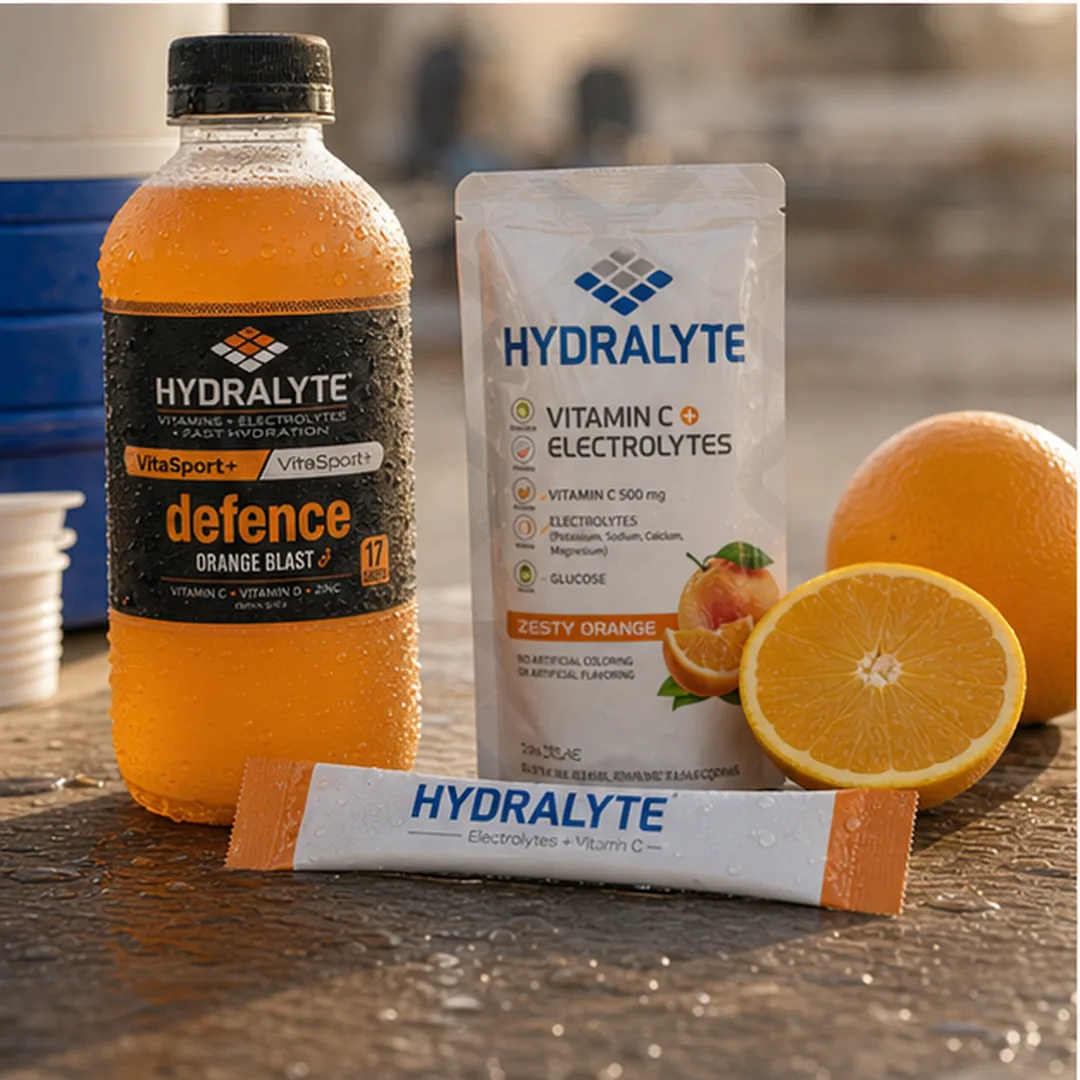
Not all electrolyte products are equal. Some are formulated chiefly for taste and sugar content rather than for replacing the salts lost in heavy sweat, and a high-sugar sports drink is not the same as a rehydration solution designed for fluid replacement. A drink loaded with sugar can actually slow fluid absorption and leave a worker with an energy spike followed by a slump, which is the last thing a crew needs in the middle of a hot shift. For employers stocking supplies at scale, it pays to %compare electrolyte products side by side% so that what reaches the work front is genuinely suited to heavy sweating in extreme heat, rather than chosen on price or familiarity alone. The goal is a product that restores both fluid and the electrolytes the body has actually lost.
When water is enough, and when it is not
It would be wrong to suggest workers should drink electrolyte solutions all day regardless of the work. For light tasks, short exposure or cooler parts of the season, plain water is perfectly adequate and remains the foundation of hydration. The case for electrolytes strengthens as the work gets heavier and longer and as sweat losses mount. A useful way to think about it is that water handles the routine while electrolytes handle the extremes: the longer and harder the shift, and the more a worker is sweating, the more important it becomes to replace salts as well as fluid. Matching the drink to the demand avoids both under-supplying heavy roles and over-complicating light ones.
Estimating needs across a whole <a href="/industries">workforce</a>
Individual targets matter, but employers also need to plan at scale: how much drinking water to deliver to a site, how many electrolyte sachets to stock, and how to schedule breaks so that crews actually drink enough. Estimating total demand from average headcount alone tends to fall short on the hottest days, precisely when running short is most dangerous.
A structured approach lets managers %plan fluid needs across a whole crew% by combining headcount, shift length, conditions and task intensity into a single, realistic provisioning estimate. This turns hydration from a guess into a planned logistic, ensuring no one runs short during the critical midday hours. It also gives procurement a defensible basis for what they order, rather than a number plucked from last year's invoice.
A worked example
Consider a 150-worker site in Abu Dhabi during August, with crews doing heavy work through the morning before the midday rest period. As a rule of thumb, planning for the heaviest-sweating roles rather than the site average avoids the trap of under-provisioning. If the most exposed crews may each need the better part of a litre per hour during active work, and there are several hours of work either side of the <a href="/industries">midday break</a>, the daily total for the site climbs quickly into the hundreds of litres for drinking alone — before accounting for the electrolyte solution heavy roles will also need. The figures here are illustrative, not a citation, but they make the point: planning from a generic per-person figure would leave such a site well short.
The same example shows why a buffer matters. Conditions vary day to day, some workers drink more than others, and a delivery delay or a hotter-than-forecast afternoon should never mean a crew runs dry. Planning with a sensible margin above the estimate — and storing water where it stays cool and accessible — turns a tight calculation into a robust one. Running out of water on a 45°C afternoon is not a minor inconvenience; it is a safety failure, and a modest buffer is cheap insurance against it.
Building drinking into the rhythm of the shift
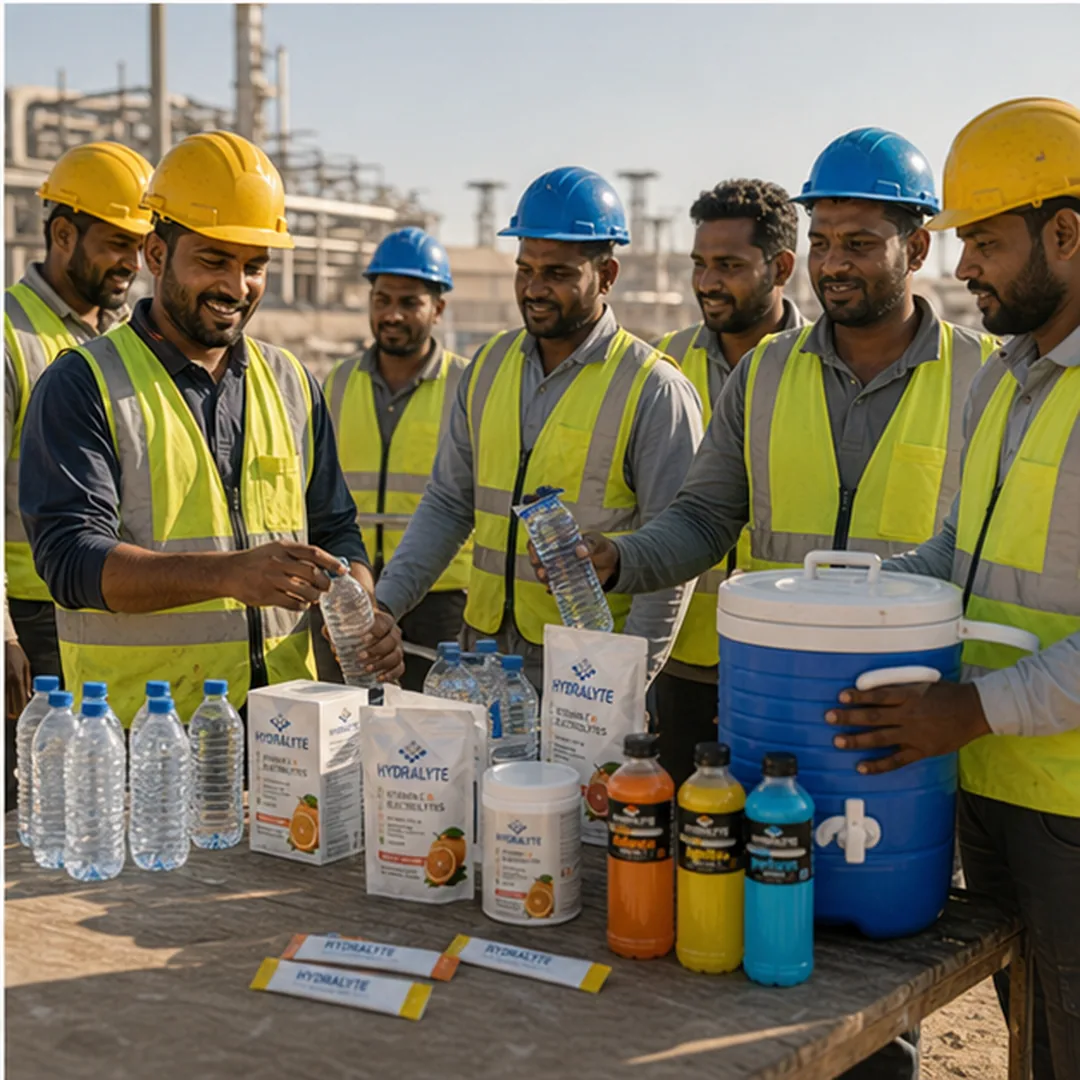
Provisioning the right volume is only useful if people actually drink it. Many crews under-consume not because water is unavailable but because stopping to drink feels like an interruption, or because the supply is inconveniently far from where they are working. The fix is largely logistical: place water and electrolytes within a few steps of the work front, build short, regular drinking pauses into the work pattern, and have supervisors prompt the habit rather than leave it to individual initiative. A culture where drinking is normal and expected does more for hydration than any single piece of equipment.
Practical guidance for the working day
Rather than trying to drink a day's worth of water in a few large sittings, workers stay better hydrated by drinking modest amounts at regular intervals throughout the shift. The body can only absorb so much fluid at once, so gulping a litre during a single break largely passes straight through, whereas steady sips are absorbed and retained far more efficiently.
Starting the day already hydrated, topping up steadily, and continuing to drink after work to recover are all part of the picture. A worker who arrives on site already short of fluid spends the morning playing catch-up and rarely closes the gap before the heat peaks. Pre-hydration the evening before and a deliberate drink before the shift begins set a much better baseline.
Reading the early warning signs
Workers and supervisors should know the early signs that fluid losses are getting ahead of intake. Thirst is a late signal, not an early one — by the time someone feels truly thirsty they are already behind. More useful indicators include headache, fatigue out of proportion to the task, dizziness, irritability, muscle cramps and a noticeable drop in concentration. Urine colour remains the simplest day-to-day check: pale straw indicates good hydration, while dark yellow is a sign to drink more. Encouraging this quick, private self-check gives every person an immediate way to monitor their own status without waiting for a supervisor.
The cost of getting it wrong
It is tempting to view hydration purely as a welfare issue, but under-hydration carries hard operational costs too. A dehydrated worker is slower, less accurate and more prone to mistakes, and the mental fog that accompanies even mild fluid loss degrades exactly the judgement that safety-critical tasks depend on. Across a crew, chronic under-hydration shows up as reduced output, more errors and more near misses long before anyone is sent to a clinic.
At the more serious end, a single case of heat illness can halt work, trigger an investigation and put a person's health at real risk. Heat exhaustion left unmanaged can progress to heat stroke, which is a medical emergency. Set against this, the cost of providing adequate water, electrolytes and scheduled breaks is trivial. Planning daily water needs properly is one of the rare safety investments that pays back in productivity as well as protection, which is why it deserves to be managed deliberately rather than left to chance.
There is a reputational and contractual dimension as well. On major projects, clients and main contractors increasingly expect demonstrable heat-management practices, and a serious incident can affect a company's standing on future work. Being able to show that hydration was planned, provisioned and monitored — rather than left to the discretion of individuals — is both a safety asset and a commercial one. The records that come from managing hydration deliberately are exactly the records that prove diligence after the fact.
Hydration and the midday break
The UAE's summer Midday Break Rule, enforced by the Ministry of Human Resources and Emiratisation, bans work in the sun and open areas during the hottest part of the day — around the early afternoon — each year from mid-June to mid-September. This rest period is a cornerstone of heat protection, but it is not, on its own, a hydration strategy. A worker who is already badly behind on fluid when the break begins will struggle to recover in a single rest period, and one who returns to work without rehydrating properly starts the afternoon at a disadvantage.
The break is best used as a deliberate rehydration window: a chance to drink steadily, take electrolytes if the morning has been heavy, cool down in the shade and check how each worker is coping before the day resumes. Planning daily water needs around the rhythm of the working day — including the break — makes the rule far more effective than treating it as a simple pause in production.
Adjusting through the season
Daily water needs are not fixed even for the same worker. They rise through the early summer as temperatures climb, shift with humidity, and change as a worker becomes acclimatised and begins to sweat more efficiently — which, counter-intuitively, can increase fluid losses. A figure that was adequate in spring can be well short by midsummer.
Revisiting hydration plans as conditions change — rather than setting them once and forgetting them — keeps provision matched to reality. Reassessing individual targets periodically, especially after acclimatisation or a change of role, ensures the numbers stay honest as the season progresses. A short weekly review of conditions, consumption and any incidents is usually enough to catch drift before it becomes a problem.
The acclimatisation paradox
One of the less intuitive points is that getting fitter for the heat does not reduce fluid needs — if anything it increases them. As a worker acclimatises over their first weeks in the heat, their body learns to sweat earlier and more freely, because sweating is the cooling mechanism. A well-adapted worker is better protected, but they are also losing more fluid per hour and therefore need to drink more, not less. Plans that quietly assume experienced workers can manage on less are getting this exactly backwards. Experience changes how comfortably a worker copes; it does not exempt them from the underlying physics of fluid loss.
Common mistakes that leave workers short
Even well-intentioned employers fall into a handful of recurring traps. Recognising them is often the quickest route to a better hydration outcome, because each one is straightforward to fix once it is seen clearly.
- Planning from the site average: averaging across roles consistently under-supplies the heaviest-sweating workers, who are also the most at risk. Provision should be driven by the toughest roles, not the typical one.
- Relying on thirst: by the time workers feel thirsty they are already behind. Scheduled drinking beats waiting for the urge.
- Treating the midday break as the whole strategy: the rest period is essential, but it does not replace steady hydration through the morning and afternoon.
- Ignoring PPE and humidity: estimates based on air temperature alone understate needs for heavily protected workers and for humid coastal days.
- Stocking high-sugar drinks instead of rehydration solutions: sweet sports drinks are not a substitute for products formulated to replace lost salts and fluid.
- Setting the plan once: needs rise as the season heats up and as workers acclimatise, so a plan made in spring will be short by midsummer.
None of these mistakes is exotic; they are the everyday shortcuts that creep in when hydration is treated as common sense rather than a managed process. The remedy is the same in each case — replace assumption with assessment, and revisit the plan as conditions change.
What workers can do for themselves
Employers carry the duty to provide and plan, but workers have a real part to play too, and a workforce that understands the basics is far easier to keep safe. The single most valuable habit is to arrive on site already hydrated. Hydration is not something that can be crammed into the working day; a worker who drinks well the evening before and again before the shift starts the day with a reserve, while one who arrives parched spends the morning behind.
Through the shift, the goal is steady, modest intake rather than occasional large drinks, paired with the simple self-checks already described — urine colour and an honest read of how one feels. After work, continued drinking helps the body recover and resets the baseline for the next day. Workers who also look out for one another, mentioning when a colleague seems to be flagging, add a layer of protection that no plan can provide on its own. Hydration is most reliable when it is a shared habit rather than a rule imposed from above.
Different roles, different needs
It is worth remembering that not all outdoor work is the same. A static security post in the shade carries different demands from continuous loading and unloading in the sun. For example, %workers in logistics and delivery roles% move between air-conditioned cabs and hot outdoor environments repeatedly through the day, creating a stop-start hydration pattern that needs its own planning. Tailoring water and electrolyte provision to each role, rather than applying a blanket number, is the most reliable way to keep every worker safe and performing well through the UAE summer.
Heavy outdoor trades sit at the other end of the spectrum. For %outdoor crews on construction projects%, the combination of sustained physical effort, direct sun and protective equipment makes for some of the highest fluid demands on any site, and these roles should drive provisioning rather than be averaged in with lighter work. The broader lesson is that the same headline figure can be dangerously wrong for one role and wasteful for another.
From a number to a plan
A blanket daily target offers a false sense of precision; it implies everyone needs the same amount when the real range is enormous. The more useful mindset is to abandon the search for a single magic number and instead match fluid provision to the conditions, the task and the individual, reassessing as any of those change.
Done well, this keeps the hardest-working people properly protected without burdening lighter roles with rules that do not fit their day, and it gives managers a defensible basis for the supplies they order and the breaks they schedule. The practical takeaways are straightforward: estimate from the heaviest-sweating roles, not the average; combine water with proper electrolytes on hard days; spread intake across the shift rather than in a few large drinks; use the midday break as a rehydration window; and review the plan as the season heats up.
It helps to think of hydration the way you would think of any other critical supply on site. No competent manager would order materials by guesswork, leave them in an inconvenient store and hope crews used them correctly; they would calculate the need, position the stock where it is wanted, and check that it is being consumed as planned. Water and electrolytes deserve the same discipline, because in a UAE summer they are every bit as essential to keeping work moving safely. The tools to do this — individual targets, workforce estimates and daily condition assessments — exist precisely so that managers do not have to rely on instinct alone.
The shift in mindset is the whole point. A fixed daily figure feels reassuringly simple, but its simplicity is exactly what makes it unreliable in extreme heat. By trading that false certainty for a flexible, conditions-led approach, employers protect their people more effectively and run their operations more smoothly through the hardest months of the year. Hydration handled this way stops being a vague welfare gesture and becomes what it should be — a planned, measurable part of keeping a workforce safe and productive through a UAE summer.
Frequently Asked Questions
How much water does an outdoor worker need per day in the UAE summer?
There is no single correct figure, because needs depend on sweat rate, workload, conditions and body size. A heavily exerting worker in direct sun can require several times more fluid than someone doing light shaded work. Using a hydration calculator to set an individual target is far more reliable than a fixed daily number. The aim is to match intake to what the body is actually losing, not to hit a generic glass count.
Is the eight-glasses-a-day rule enough for hot outdoor work?
No. That guidance was built for sedentary adults in temperate climates and was never intended for people sweating heavily for hours in extreme heat. Outdoor workers in the Gulf summer typically need considerably more, and the exact amount should be matched to their conditions and tasks. Applied to a hot work front, the everyday rule can be dangerously low.
Can someone drink too much water?
Yes, although it is uncommon. Drinking very large volumes of plain water without replacing the sodium lost in sweat can dilute the body's electrolyte levels, a condition known as hyponatraemia. For long hot shifts, balancing water with an electrolyte solution is safer than relying on water alone. This is one reason heavy-sweating roles benefit from proper rehydration products rather than just more water.
What is the easiest way to check if a worker is drinking enough?
Urine colour is the simplest everyday gauge. Pale straw-coloured urine generally indicates good hydration, while dark yellow suggests the worker needs to drink more. Encouraging this quick self-check gives every person an immediate, private way to monitor their status. Thirst, by contrast, is a late signal and should not be relied on as the only prompt to drink.
Should workers drink plain water or electrolyte solutions?
For light work or short exposure, plain water is usually fine. For long, heavy shifts in the heat, where a lot of salt is lost in sweat, an electrolyte solution is more effective because it helps the body absorb and retain fluid and replaces lost sodium. The heavier and longer the work, the stronger the case for electrolytes alongside water.
How does humidity affect how much water a worker needs?
High humidity, common on the UAE coast, slows the evaporation of sweat, so the body's cooling becomes less efficient and it sweats even more to compensate. This raises fluid losses and makes it harder to bring core temperature down. On humid days, workers can lose a great deal of fluid while still feeling hot, so hydration planning should account for humidity, not just temperature.
How should employers estimate water needs for a whole site?
Estimating from average headcount alone tends to fall short on the hottest days. A better approach combines headcount, shift length, conditions and task intensity, and plans from the heaviest-sweating roles rather than the site average. A workforce hydration planning tool can turn these inputs into a realistic provisioning estimate for both drinking water and electrolyte supplies.
Does the midday break cover a worker's hydration needs?
No. The Midday Break Rule provides essential rest during the hottest hours, but it is a rest provision, not a hydration strategy. A worker who is already badly dehydrated cannot fully recover in one break, and one who returns without rehydrating starts the afternoon at a disadvantage. The break is best used as a deliberate rehydration window within a wider plan.
Do daily water needs change as the summer goes on?
Yes. Needs rise as temperatures climb through early summer and shift with humidity. They also change as workers acclimatise: a well-adapted worker sweats more efficiently, which can actually increase fluid losses per hour. Hydration plans should be reviewed regularly through the season rather than set once and forgotten.
Why do two workers doing the same job need different amounts of water?
Body size, fitness, sweat rate, level of acclimatisation, health and even clothing all influence how much fluid a person loses. One worker may sweat far more heavily than another doing identical work, and a newcomer to the heat behaves differently from a seasoned colleague. This individual variation is exactly why a single daily figure is unreliable and why targets are better set per person.