Every summer, the UAE's Ministry of Human Resources and Emiratisation enforces measures designed to protect outdoor workers from extreme heat, and every summer some employers are caught out by gaps in their preparation. Staying on the right side of MoHRE compliance is not only a legal obligation but a clear marker of how seriously a business takes the welfare of its people. For summer 2026, getting the fundamentals in place early is the difference between a smooth season and a scramble when inspectors arrive or when a worker falls ill.
This checklist brings together the core duties most relevant to heat safety, framed in practical terms. It is not a substitute for the official regulations, which employers should always consult directly, but it is a useful working guide for safety managers and business owners who want to make sure nothing important slips through the cracks before the hottest months take hold. The aim is to move you from a vague sense that you are "probably fine" to a documented, confident position in which every obligation has an owner, a method and a record.
The UAE's climate makes this more than a paperwork exercise. Summer temperatures regularly exceed 45°C, and on the coast the combination of heat and very high humidity pushes the human body close to its limits. In those conditions, the gap between a compliant operation and a negligent one is measured in human health, not just in fines. Treat what follows as the backbone of your seasonal readiness, and revisit it each year because the regulations, your <a href="/industries">workforce</a> and your sites all change over time.
Understanding what MoHRE compliance actually covers
Before working through specific duties, it helps to frame what "compliance" means in the context of summer heat. MoHRE's framework is built around a simple principle: employers carry a duty of care towards workers exposed to dangerous environmental conditions, and that duty is sharpest during the peak heat of the year. The regulations translate this principle into concrete expectations around working hours, rest, shade, water and the handling of heat-related illness.
Crucially, the obligations apply most directly to those working outdoors or in open, unconditioned spaces, but the underlying duty of care extends further. Warehouse workers in poorly ventilated buildings, drivers in cabs without functioning air conditioning, and maintenance crews moving between cool offices and scorching rooftops can all be exposed to heat strain even when they fall outside the headline rules. A thoughtful compliance approach looks at real exposure rather than only the letter of a single regulation.
It is also worth recognising that compliance is dynamic rather than fixed. Regulations are reviewed and occasionally adjusted, the makeup of your workforce changes from year to year, and your sites and tasks evolve as projects progress. An approach that was sufficient two summers ago may have quiet gaps today. The employers who stay genuinely compliant are those who revisit their obligations annually, confirm they are still reading the current requirements, and adjust their provisions to match the work as it actually is now, rather than as it was when the policy was first written.
Who carries responsibility
Responsibility does not rest solely with the business owner named on the trade licence. In practice, it is distributed across project managers, site supervisors, HSE officers and team leaders, each of whom must understand their part. The owner sets policy and provides resources; managers translate policy into rotas and provisions; supervisors enforce the rules hour by hour on the ground. When any link in that chain is weak, compliance fails regardless of how good the paperwork looks. Assigning clear ownership for each item on this checklist is therefore the first practical step.
The midday work ban: the headline rule
The most well-known summer rule is the <a href="/industries">midday break</a>, during which work under direct sunlight and in open-air areas is prohibited across the peak afternoon hours of the hottest months. Each year this applies from the middle of June to the middle of September, covering roughly the early afternoon window when the sun is at its most punishing. This is the single most visible compliance point and the one most likely to attract attention if ignored.
Planning work around the ban
Compliance is about more than simply stopping work during the prohibited window. Employers need to reorganise shifts so that productivity is preserved, typically by shifting demanding outdoor tasks to the early morning and the later afternoon. Schedules, signage and supervisor briefings should all reflect the ban clearly, so that no team is left working outdoors when they should be resting. A fast way to confirm you have the basics covered is to %run a quick MoHRE compliance check% before the season begins.
Avoiding the common traps
The ban catches out employers in predictable ways. Some assume that a thin awning or the shadow of a building counts as being out of the sun; it does not when the task itself is in the open. Others quietly allow "just finishing up" during the prohibited hours, which is precisely the kind of informal exception that inspections target. A few forget that the ban applies to subcontractors and labour-supply workers on their site, not only to direct employees. Build the prohibited window into your scheduling software, your toolbox talks and your site rules so that stopping work becomes automatic rather than a judgement call made under deadline pressure.
Providing shade, rest and cooling
The midday ban only works if there is somewhere for workers to go. MoHRE expectations around heat safety extend to providing adequate shaded rest areas where workers can cool down during breaks and across the prohibited hours. These spaces should be genuinely sheltered, reasonably cool and large enough for the workforce using them.
Rest areas that actually function
A token patch of shade is not enough. Effective rest areas are positioned close to where people work, offer real protection from the sun, and ideally provide seating and ventilation or cooling. They should be maintained throughout the season rather than set up once and forgotten, and they work best when paired with the hydration provisions covered below. A rest area that workers have to walk ten minutes to reach in full sun will be underused, defeating its purpose.
Cooling that suits the site
The right cooling solution depends on the setting. On a large project, air-conditioned rest cabins or shaded, fan-ventilated structures make sense. On a dispersed or mobile operation, portable shade and cooling at multiple points may be more practical than a single central facility. The goal is consistent: lower the core temperature of resting workers enough that they recover before returning to work, rather than carrying accumulated heat strain from one work period into the next.
Sizing rest provision to the workforce
A frequent gap is providing rest space that looks adequate on a quiet morning but cannot absorb the whole crew when the prohibited window forces everyone to stop at once. Rest areas should be sized for peak demand, not average use, because the midday ban concentrates the entire outdoor workforce into the same cool spaces at the same time. Consider a site where two hundred workers must all rest through the early afternoon: a single cabin built for fifty simply pushes the overflow back into the sun, undoing the very protection the ban is meant to provide. Planning capacity around the busiest moment of the day, and adding shade or seating as headcount grows through a project, keeps the provision honest as conditions change.
Hydration and heat-illness preparedness
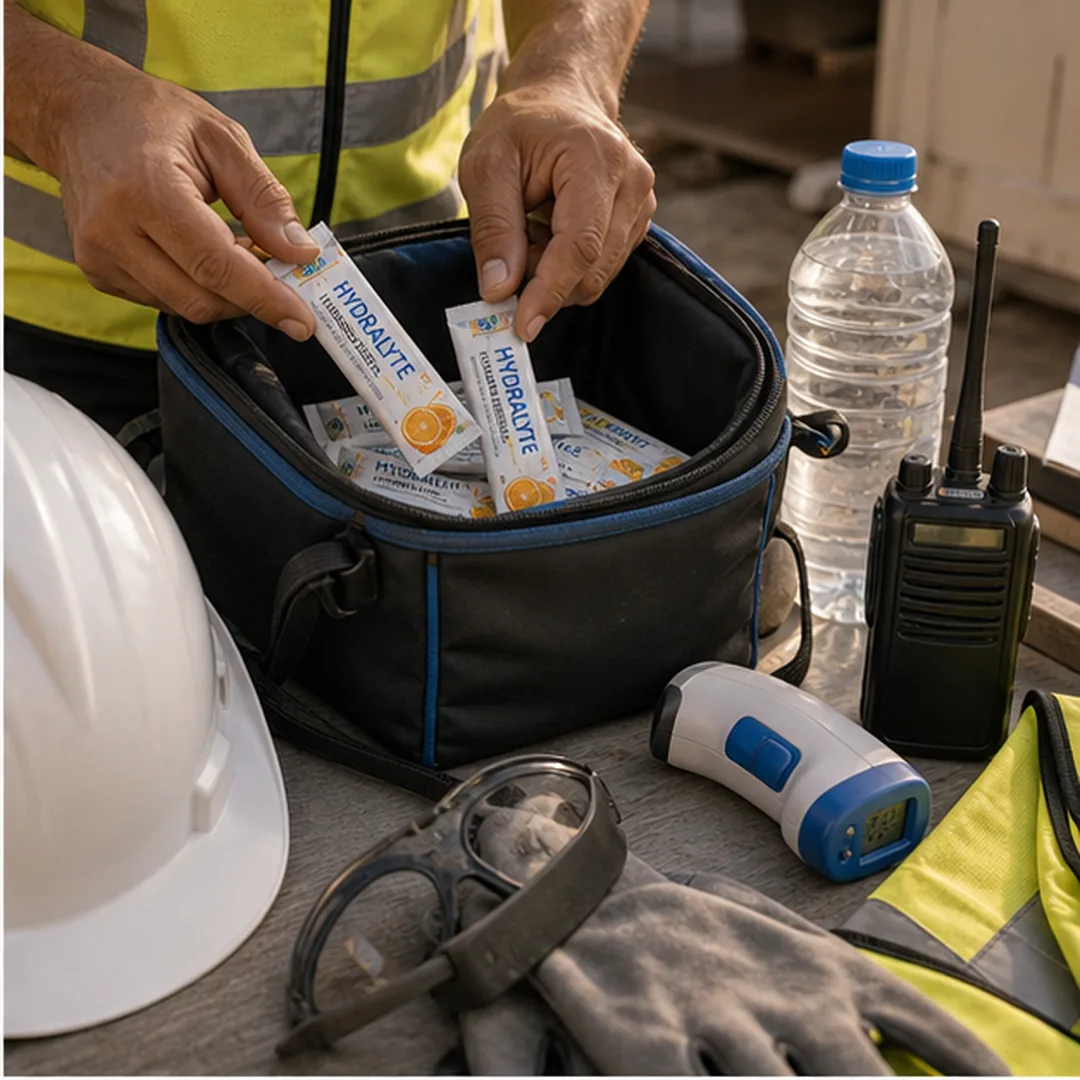
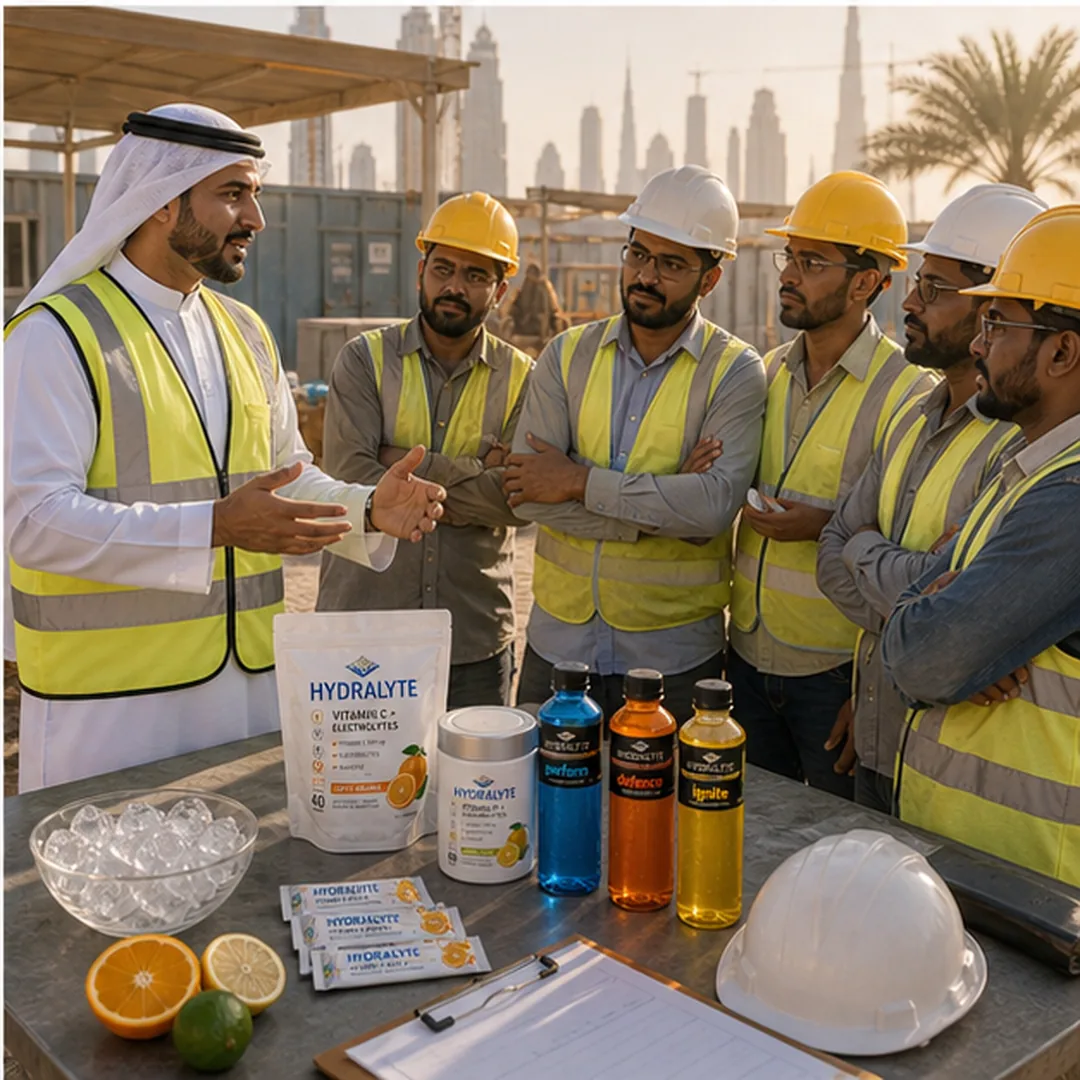
Access to drinking water and the means to stay hydrated sits at the heart of heat safety. Employers should ensure cool drinking water is readily available across the site, and for workers sweating heavily through long shifts, electrolyte solutions are an important addition that plain water alone cannot replace. In extreme heat the body loses not only fluid but sodium, potassium and other minerals through sweat, and replacing only the water can leave a worker functionally under-hydrated.
- Provide cool, clean drinking water within easy reach of all work areas
- Supply electrolyte solutions for workers facing heavy, prolonged sweating
- Set up shaded rest areas close to the work, maintained all season
- Reschedule demanding outdoor tasks around the midday ban
- Train supervisors to recognise and respond to heat illness
- Keep records of your heat-safety measures and worker briefings
Preparedness also means people. Supervisors and first-aiders should know how to spot the early signs of heat exhaustion and heat stroke and how to respond if a worker collapses. A plan that exists only on paper offers little protection; what counts is whether the people on the ground know what to do on the day it matters. Designing the day so that fluids are taken before thirst arrives is far more reliable than hoping individuals remember on their own, which is why a deliberate plan beats good intentions every time. If you want a system tailored to your shifts and sites, you can %build a structured workforce hydration plan% rather than improvising.
Why heat-illness training belongs in the checklist
Equipment and schedules address the conditions, but people address the moments when things go wrong. A workforce that can recognise the early signs of heat exhaustion and respond correctly when a colleague collapses is far better protected than one relying solely on rules and rotas. For this reason, training should sit firmly within any compliance checklist rather than being treated as an optional extra.
Supervisors in particular need to know the difference between heat exhaustion, which usually leaves a worker conscious and able to talk, and heat stroke, which brings confusion or loss of consciousness and is a medical emergency. They should know how to cool an affected worker quickly, when to call for help without delay, and why fluids must never be forced on someone who is not fully alert. Refreshing this knowledge at the start of each summer keeps it sharp, because skills that are never practised fade well before they are needed.
Making training stick
Training that consists of a single slide deck in a language half the audience does not speak is training in name only. Effective heat-illness training is short, repeated, hands-on and delivered in the languages your teams actually use. A five-minute toolbox talk on a hot morning, a quick demonstration of how to cool a casualty, and a clear reminder of who to call carry far more weight than an annual classroom session that is forgotten by lunchtime. Embedding the message into daily routines is what turns knowledge into reliable action.
It also helps to give workers, not just supervisors, a stake in spotting trouble. A colleague is often the first to notice that someone has stopped sweating, become unusually quiet or started stumbling, and a team trained to look out for one another catches problems earlier than any single supervisor can. Encouraging that culture of mutual watchfulness, where reporting that a workmate looks unwell is welcomed rather than seen as interrupting the job, is one of the most powerful and least expensive protections an employer can build.
Risk assessment and record keeping
Underpinning all of the above is a sound understanding of where the risks actually lie on your site. Conditions vary enormously between a shaded indoor task and heavy work in open sun, and a one-size-fits-all approach tends to over-protect some and under-protect others. Taking time to %assess your site's heat stress risk% lets you direct resources where they are needed most and demonstrates a considered, defensible approach if your measures are ever questioned.
Documenting the assessment itself is valuable, too, as it records the reasoning behind your decisions and shows that protections were tailored to real conditions rather than applied by rote. Record keeping rounds out compliance. Documenting your hydration provisions, rest facilities, schedule changes and training sessions creates evidence that the right steps were taken. This matters especially for sectors with dispersed or mobile teams, such as %outdoor logistics operations%, where it is harder to oversee every worker directly and where clear records show that the system, not just luck, is keeping people safe.
What good records look like
Useful records are specific and dated rather than generic. A folder containing photographs of shade structures with timestamps, attendance sheets from toolbox talks, water and electrolyte delivery logs, revised summer rotas, and a simple incident-and-near-miss log tells a far stronger story than a single policy document. Consider a 150-worker site in Abu Dhabi during August: if a worker suffers heat exhaustion and the matter is reviewed, the operation that can produce a clear paper trail of provisions and briefings is in a very different position from one that can only describe intentions. Records protect workers first and the business second, and both are worth the modest effort.
Sector-specific considerations
While the core duties apply across the board, the practical shape of compliance differs by sector. The headline rules were written with the most exposed industries in mind, and those industries face the steepest challenge in meeting them well. Understanding your sector's particular exposure helps you target effort where it counts.
For %construction sites in particular%, the combination of heavy physical labour, reflective surfaces, working at height and dense activity creates some of the most demanding heat conditions anywhere in the economy. Shade can be hard to provide near active work fronts, and the sheer number of workers makes consistent hydration a logistical task in its own right. In the oil and gas sector, remote locations and protective equipment add layers of difficulty, while in logistics and last-mile delivery the challenge is overseeing mobile workers who are rarely under direct supervision. Each setting calls for the same principles applied with sector-specific judgement.
Acclimatisation and the workers most at risk
A dimension that compliance checklists often overlook is that not every worker faces the heat with the same resilience. The body adapts to working in high temperatures over a period of days to a couple of weeks, gradually becoming more efficient at sweating and regulating its own temperature. A worker who has laboured outdoors all season is far better adapted than one who arrives fresh, and that difference has real safety consequences. New arrivals to the UAE, workers returning from extended leave in cooler climates, and anyone moving from an air-conditioned role to an outdoor one are all temporarily more vulnerable, even when they are otherwise fit and experienced.
A sensible approach builds a short ramp-up for these workers rather than placing them straight into a full day of heavy outdoor work in peak conditions. Lighter duties, longer or more frequent breaks, and closer supervision for the first week allow the body to adapt before it is fully tested. Recognising acclimatisation as a real factor, and managing it deliberately, closes a gap that catches out operations which assume every able-bodied worker is equally ready for the heat on day one.
Personal factors that raise the risk
Beyond acclimatisation, individual circumstances shift a worker's exposure to harm. Certain common medications affect how the body handles heat and fluid balance, some chronic conditions reduce tolerance, and the disruption of fasting during a summer that overlaps with religious observance can change hydration patterns through the working day. None of this requires intrusive enquiry, but it does call for a culture in which a worker can quietly raise that they are struggling, and a supervisor who responds by adjusting the work rather than pressing on. Treating heat tolerance as variable rather than uniform makes the whole system more humane and more reliable.
Building a practical compliance calendar
One of the most effective ways to keep heat-safety obligations from slipping is to convert them into a dated calendar rather than a static document. Compliance is not a single event but a sequence of actions that unfold across the year, and mapping them to specific weeks turns good intentions into scheduled work with named owners. A calendar also makes it obvious when something has been missed, because an unticked task on a fixed date is far harder to ignore than a vague aspiration.
What belongs on the calendar
A workable calendar starts well before the hottest months. In the spring, schedule the inspection and repair of shade structures, the servicing of water coolers, the ordering of electrolyte stock, and the refreshing of multilingual signage. As the prohibited window approaches, schedule supervisor briefings, the publication of revised summer rotas, and a dry run of your heat-illness response so that people have rehearsed it before they need it. During the season itself, set recurring checks on water supply, rest-area condition and worker feedback, and after the season, schedule a short review to capture what worked and what should change next year.
The discipline of dating each item is what makes the difference. An operation that decides in May exactly which week it will brief supervisors, and assigns that task to a named manager, almost never finds itself improvising in July. The calendar becomes the institutional memory that carries good practice from one summer to the next, regardless of staff turnover.
Coordinating with subcontractors and labour suppliers
On many UAE projects the workforce on any given day is a mix of direct employees, subcontractor crews and labour-supply workers. This shared environment creates a shared responsibility, and a frequent compliance failure is assuming that someone else is looking after the people you did not directly hire. In practice, the conditions on your site are your concern regardless of whose payroll a worker sits on, and inspections will not accept the division of contracts as an excuse for unequal protection.
The practical answer is to write heat-safety expectations into your site rules and your contracts with suppliers, then enforce them uniformly. Make it explicit that the midday ban, the rest provisions and the hydration standards apply to everyone present, and that supervisors of subcontractor crews are expected to brief their teams accordingly. Provide shared water and rest facilities rather than leaving each contractor to fend for itself, because fragmented provision tends to leave gaps precisely where oversight is weakest.
Verifying, not assuming
It is not enough to state the expectation; you should verify that it is being met. A simple walk of the site during the prohibited window, a check that all crews have access to cool water, and a quick conversation with a few workers about whether they understand their entitlements will reveal far more than any contract clause. Where a supplier consistently falls short, that is a procurement signal as much as a safety one, because the cost of an incident on your site is yours to bear no matter who employed the worker involved.
Handling a heat-illness incident on the day
Even a well-prepared operation can face a heat-illness incident, and how it responds in the first few minutes matters enormously. Compliance is not only about prevention; it is also about having a clear, rehearsed response that protects the worker and demonstrates that the system functioned as intended. A calm, competent response can be the difference between a worker who recovers fully and a far worse outcome.
The essentials are straightforward but must be known in advance. Move the affected worker to a cool, shaded place immediately. Loosen heavy clothing and begin active cooling with whatever is to hand, such as water, fanning or cool damp cloths. Offer fluids only if the worker is fully alert and able to drink safely. Most importantly, recognise the line between heat exhaustion and heat stroke: confusion, agitation or loss of consciousness signals an emergency that requires immediate medical help, and any delay in that situation can be life-threatening.
After the incident
Once the immediate situation is handled, the response continues. Record what happened, including the conditions, the worker's role and the actions taken, both to support any medical follow-up and to learn from the event. Review whether the incident points to a gap, such as a rest area too far from the work front or a crew that had not absorbed its briefing, and close that gap promptly. Treating each incident, and each near-miss, as information rather than merely a problem to be filed away is what steadily strengthens an operation's resilience over successive summers.
Preparing before the season, not during it
One of the most common reasons employers fall short is timing. Heat-safety measures put in place reactively, after the first severe day or the first incident, are always harder to implement well than those readied in advance. The weeks before the hottest months are the time to audit shade structures, service water coolers, stock electrolytes, refresh signage and brief supervisors, so that nothing is improvised once temperatures climb.
Early preparation also smooths the operational side. Reorganising shifts around the midday ban affects scheduling, client commitments and labour planning, and these are far easier to adjust calmly in advance than under pressure mid-season. Building the changes into the year's planning, rather than treating each summer as a surprise, turns compliance from an annual scramble into a settled routine that the whole workforce understands.
Communicating the rules to the workforce
Compliance on paper means little if workers themselves do not understand the protections they are entitled to. Briefings in the languages your teams actually speak, clear visual reminders on site, and simple explanations of why the midday break and hydration measures exist all help. When workers understand the reasoning, they are far more likely to take breaks, drink regularly and look out for one another, which strengthens both safety and the genuine spirit of the regulations.
The business case for going beyond the minimum
It is easy to frame heat-safety compliance purely as a cost and an obligation, but that framing misses half the picture. The same measures that keep an operation on the right side of the regulations also protect the productivity that the business depends on through its most challenging quarter. A workforce that is properly hydrated, adequately rested and confident that its employer is looking after it simply performs better, makes fewer mistakes and sustains its effort more reliably than one that is left to struggle through the heat.
The costs of getting it wrong, by contrast, are large and often hidden. A serious heat-illness incident brings the immediate human toll, but it also brings stop-work disruption, investigation time, potential penalties, higher insurance exposure and reputational damage that can affect future contracts. Even short of an incident, an under-protected workforce loses output steadily across the season through fatigue, errors and absence. When these costs are weighed against the relatively modest expense of water, electrolytes, shade and training, the economics point clearly toward doing more than the minimum rather than just enough to avoid trouble.
Reputation and recruitment
There is a longer-term dimension, too. In a competitive labour market for skilled and reliable workers, an employer's reputation for how it treats people in the heat travels quickly. Operations known for genuinely looking after their teams find it easier to attract and retain the experienced workers who are most valuable and most costly to replace. Treating heat safety as a visible commitment rather than a grudging compliance task therefore pays back not only in immediate productivity but in the steady advantage of a workforce that wants to stay.
Common compliance mistakes to avoid
Across many operations the same avoidable mistakes recur each summer, and knowing them in advance is half the battle. The most frequent is leaving preparation too late, so that provisions are scrambled together reactively once the heat has already arrived and the easy, calm decisions of the spring have become hard, pressured ones in mid-season. Closely related is treating the policy document as the goal in itself, mistaking a well-written plan on a shelf for protections that actually function on the ground.
Other common failures include providing only plain water to heavily sweating workers and assuming it is sufficient, setting up a single distant rest area that workers cannot realistically reach during short breaks, and applying the rules unevenly so that subcontractors or pressured crews quietly keep working through the prohibited hours. Many operations also neglect record keeping until an incident forces the question, by which point the evidence of good practice that would have helped them simply does not exist. Each of these mistakes is straightforward to avoid once it is named, which is why a clear checklist, used honestly, is such a valuable tool.
Treating compliance as a baseline, not a ceiling
It is worth remembering that MoHRE rules set a minimum standard. The best employers treat them as a floor to build on rather than a target to just reach. Going beyond the basics, with abundant cool water and electrolytes, generous shade, regular breaks and a genuinely informed workforce, not only keeps people safer but also sustains productivity through a season that would otherwise grind operations down. There is a strong business case alongside the moral one, because heat illness causes lost time, disrupted schedules and reputational harm that far outweigh the modest cost of doing things properly.
The organisations that come through summer best are those that have stopped thinking of heat safety as a compliance burden and started treating it as part of how good work gets done in a hot climate. They invest a little ahead of time, document what they do, train their people, and then operate with confidence through the hardest months. The shift in mindset is subtle but powerful: instead of asking "what is the least we must do to avoid trouble," they ask "what does it take to keep our people healthy and productive through a punishing season," and the answer to the second question reliably satisfies the first as a by-product.
That mindset also tends to make compliance easier rather than harder over time. An operation that has internalised heat safety builds it into procurement, scheduling and supervision without needing a special effort each year, so the annual cycle becomes a matter of confirming and refreshing rather than rebuilding from scratch. The checklist then serves its proper purpose: not as a hoop to jump through, but as a dependable way to verify that a settled, well-run system is still doing its job. Use this checklist to confirm the essentials are in place, then aim higher. If you would like help building or reviewing your seasonal heat-safety approach, %speak to our team% and summer 2026 will be both compliant and far more comfortable for everyone on site.
Frequently Asked Questions
What is the MoHRE midday work ban?
It is a summer rule that prohibits work under direct sunlight and in open-air areas during the peak afternoon hours of the hottest months. It applies each year from mid-June to mid-September, covering roughly the early afternoon window. Employers must reorganise schedules so demanding outdoor work happens in the cooler parts of the day, and ensure no team, including subcontractors, is left working outdoors during the prohibited window.
Does MoHRE compliance require more than just providing water?
Yes. While cool drinking water is essential, full heat-safety compliance also involves shaded rest areas, rescheduling work around the midday ban, training supervisors to handle heat illness and keeping records of these measures. For heavy sweating, electrolyte solutions are an important addition to plain water, because sweat removes minerals as well as fluid. Compliance is best understood as a complete programme rather than a single provision.
How can I quickly check whether my site is compliant?
The fastest starting point is a structured compliance check that walks through the key duties, from the midday ban to hydration and rest provisions. It will not replace reading the official regulations, but it helps you spot obvious gaps early, well before the hottest months and any inspections. Pairing it with a site risk assessment gives you a clear, defensible picture of where you stand.
Is meeting the MoHRE rules enough to keep workers safe?
The rules set a minimum standard rather than a complete safety programme. The most responsible employers treat them as a baseline and go further, providing abundant cool water and electrolytes, generous shade, regular breaks and a well-trained workforce. This protects people more effectively and helps maintain productivity through the summer, which carries a clear business benefit alongside the moral one.
Who is responsible for heat-safety compliance within a company?
Responsibility is shared across the organisation rather than resting on one person. The business owner sets policy and provides resources, managers turn that policy into rotas and provisions, and supervisors enforce the rules hour by hour on site. Assigning a clear owner to each compliance task is one of the most effective ways to ensure nothing is missed when the pressure of the season builds.
Do the rules apply to indoor and warehouse workers?
The headline midday ban targets outdoor and open-air work, but the underlying duty of care extends to anyone exposed to dangerous heat. Workers in poorly ventilated warehouses, drivers in cabs without working air conditioning, and crews moving between cool and scorching environments can all suffer heat strain. A sound approach assesses real exposure rather than relying only on the letter of a single rule.
What records should I keep to demonstrate compliance?
Keep specific, dated evidence rather than a single policy document. Useful records include timestamped photographs of shade structures, attendance sheets from toolbox talks, water and electrolyte delivery logs, revised summer rotas, and a simple incident-and-near-miss log. If your measures are ever questioned, this paper trail shows that protections were planned and delivered, not improvised.
When should I start preparing for the summer rules?
Start in the weeks before the hottest months rather than waiting for the first severe day. Use that window to audit shade, service water coolers, stock electrolytes, refresh signage, revise rotas and brief supervisors. Early preparation makes the operational changes far easier to absorb and means your protections are in place before workers ever need them.
How is electrolyte hydration different from drinking water?
In extreme heat, sweat carries away sodium, potassium and other minerals as well as water. Drinking only plain water can dilute the body's remaining electrolytes and leave a heavily sweating worker functionally under-hydrated despite feeling they have drunk enough. Electrolyte solutions replace both fluid and the lost minerals, which helps sustain alertness, physical capacity and safety through long, hot shifts.
Does the midday ban apply to subcontractors on my site?
Yes. The protection follows the work and the conditions, not the employment contract, so subcontractors and labour-supply workers on your site are covered by the same prohibited hours. A common and avoidable failure is allowing one group to keep working while direct employees rest. Build the ban into your site rules so it applies uniformly to everyone present.