Few working environments combine as many heat-safety challenges as a remote oil and gas site in the UAE interior. The desert pushes daytime temperatures to extremes, the work is physically demanding and often carried out in heavy protective equipment, and — critically — the nearest hospital may be a long drive or a helicopter flight away. In this setting, oil and gas hydration is not a comfort issue; it is a core part of keeping people alive and operations running safely.
What makes field operations distinct is the compounding of risk. On an urban site, a worker who begins to overheat can be moved to air conditioning and, if necessary, reach medical care quickly. On a remote desert site, the same worker faces fiercer heat, fewer cool refuges and a far longer wait for help. That distance turns prevention from good practice into an absolute priority: the goal must be to stop heat illness before it starts, because the safety net is so much further away.
This is the reality across much of the UAE's upstream sector, where exploration and production reach deep into the desert and offshore. Crews may work rotational shifts far from population centres, in conditions that regularly exceed 45°C with intense radiant heat from sand and steel. Building hydration into the fabric of field planning — rather than bolting it on as a seasonal reminder — is one of the most effective protections an operator can put in place. This guide sets out how to do exactly that, from understanding the environment through to embedding hydration in everyday standard operating procedure.
The unique heat challenge of remote sites
Desert field conditions stack several hazards on top of one another. Ambient temperatures are punishing, radiant heat from sand and equipment adds to the load, and there is often little natural shade across an exposed site. Tasks frequently involve heavy manual effort, and the flame-resistant coveralls, gloves and other protective gear essential to the industry trap heat and limit the body's ability to cool through evaporation.
The isolation factor changes the whole risk calculation. With emergency response measured in tens of minutes or more, even a relatively rapid deterioration can outpace help. Before deploying crews, operators should %oil and gas field operations% to understand exactly how severe conditions are on a given day, so that work scheduling, rest provision and hydration planning can be matched to the real environment rather than to assumptions.
Consider a drilling crew working a remote concession in the western desert of Abu Dhabi during August. The site might sit two hours by road from the nearest town with a hospital, with the final stretch on graded desert track. Daytime temperatures push past 48°C, the steel and sand radiate heat back at the workers, and the crew is in flame-resistant coveralls throughout. If a worker on this site develops heat stroke, the clock that matters is not how fast an ambulance can reach a city street but how long it takes to stabilise and evacuate someone across that distance. That single scenario explains why field hydration planning has to be measured against a far less forgiving standard than urban work.
Why the desert is harsher than the city
It is tempting to treat all UAE heat as broadly equivalent, but the desert interior is a more hostile environment than the coastal cities in several ways. Daytime highs run hotter away from the moderating influence of the sea, the temperature swing between day and night is wider, and the open terrain offers almost no shade or shelter. Dust and glare add to the strain on workers, and the sheer distance from infrastructure means that everything from cold water to medical help has to be deliberately provided rather than assumed to be nearby.
The work itself also tends to be heavier and longer than typical urban tasks. Field operations frequently run on extended shifts and rotational rosters, with crews living on or near site for days at a time. That means the body is exposed to heat stress not just for a few hours but across long working days, with limited opportunity to fully recover between them. Cumulative dehydration over a rotation is a real and underappreciated hazard: a worker who ends each day slightly behind on fluids can drift into chronic depletion by mid-rotation, with fatigue and reduced heat tolerance that raise the risk of a serious incident. Planning has to account for the whole rotation, not just the single shift.
Offshore and coastal field work has its own profile
Not all field operations sit in the deep desert. Offshore platforms and coastal facilities trade the dry, radiant heat of the interior for relentless humidity, and that changes the hazard rather than reducing it. On a humid offshore installation, sweat evaporates poorly, so the body's primary cooling mechanism is blunted exactly when it is needed most. A worker on a platform in the Gulf can be drenched in sweat that provides little cooling benefit, losing fluid and salt heavily while gaining almost nothing in return. The apparent temperature — how hot it actually feels and how hard the body has to work to cope — can be more punishing than a higher dry-bulb reading in the interior. Offshore crews face the same isolation problem as desert ones, with evacuation dependent on boats or helicopters and weather windows, so the case for proactive, electrolyte-led hydration is, if anything, even stronger over water.
Why hydration planning must be proactive
On a remote site, reactive hydration — waiting until someone feels unwell — is far too risky. By the time a worker recognises serious heat strain, they may already be beyond the point where simple measures suffice, and skilled help is not close at hand. Proactive planning means assuming heavy fluid losses are inevitable and building the response in advance, before a single worker steps onto the site.
This is a mindset shift as much as a procedural one. Rather than asking "what do we do if someone overheats?", proactive planning asks "how do we make sure no one reaches that point?" That question drives decisions about supply volumes, break frequency, shaded rest provision, task scheduling and training — all settled in advance so that on the day, hydration is automatic rather than something anyone has to remember under pressure.
Proactive planning also means designing for the worst plausible day rather than the average one. The peak of a heatwave, a delayed resupply, an unexpectedly extended shift to complete a critical operation — these are the moments when a thin margin becomes a crisis. An operation that provisions, schedules and trains for the toughest realistic conditions will cope easily on an ordinary day, whereas one built around averages will be caught out exactly when the stakes are highest. In remote field work, where there is no quick fix available, building in that headroom is not over-caution; it is basic prudence.
Core elements of proactive field hydration
- Reliable delivery and cold storage of ample drinking water and electrolyte solutions at the work front
- Scheduled, enforced hydration breaks rather than drinking left to individual discretion
- Shaded or cooled rest areas positioned close to where work is carried out
- The hardest tasks planned for the cooler parts of the day
- Clear procedures and trained personnel for recognising and managing heat illness on site
Recognising heat illness in the field
Everyone on a remote site should be able to recognise heat illness as it develops, because early intervention is what keeps a minor problem from becoming a crisis far from help. The progression typically runs from heat cramps and heat exhaustion towards heat stroke, each stage more dangerous than the last. Heat cramps show as painful muscle spasms, often in the legs or abdomen, and are an early warning that fluid and salt balance is slipping.
Heat exhaustion brings heavy sweating, weakness, dizziness, nausea, headache and clammy skin — a clear signal to stop, cool down and rehydrate immediately. Heat stroke is a medical emergency: the body's cooling system fails, the worker may become confused or lose consciousness, and the skin may turn hot. On a remote site, recognising the earlier stages and acting at once is vital, because the long evacuation time means there is little margin to spare once heat stroke sets in. Training every crew member to spot these signs in themselves and in their colleagues is a non-negotiable part of field safety.
A particular danger in the field is that the symptoms of heat illness overlap with ordinary tiredness, so workers may dismiss early warnings as just the effect of a long shift. A worker who feels weak, headachy and a little nauseated may push on, assuming they simply need to finish the task — precisely the wrong response in extreme heat far from help. Embedding a culture where these symptoms trigger an immediate stop, not a quiet endurance, is one of the most valuable things training can achieve. It is far better to lose twenty minutes to a precautionary rest and rehydration than to lose hours and risk a life to an avoidable heat-stroke evacuation.
The role of simple self-checks
Between formal symptom recognition and doing nothing lies a useful middle ground: simple self-checks that workers can perform without equipment. The colour of urine is one of the most practical day-to-day indicators of hydration status — pale straw suggests adequate fluid, while dark, scant urine is a warning that intake has fallen behind losses. Encouraging crews to notice this at each rest break, without any sense of embarrassment, gives every worker a private gauge that costs nothing and needs no instrument. Bodyweight is another: a worker who weighs in at the start of a rotation and notices a steady drop across the days, beyond what diet alone would explain, is very likely accumulating a fluid deficit. None of these checks replaces proper symptom training, but together they help workers catch a developing problem in its earliest, most reversible stage, long before cramps or dizziness force the issue.
Electrolytes matter more in the field
The long shifts, heavy exertion and continuous heavy sweating typical of field work mean that workers can lose large quantities of electrolytes, not just water. Relying on plain water alone over a long desert shift can leave the body short of the sodium it needs to retain fluid, contributing to cramps, fatigue and, in serious cases, dangerous electrolyte imbalance — a real concern when medical help is hours away.
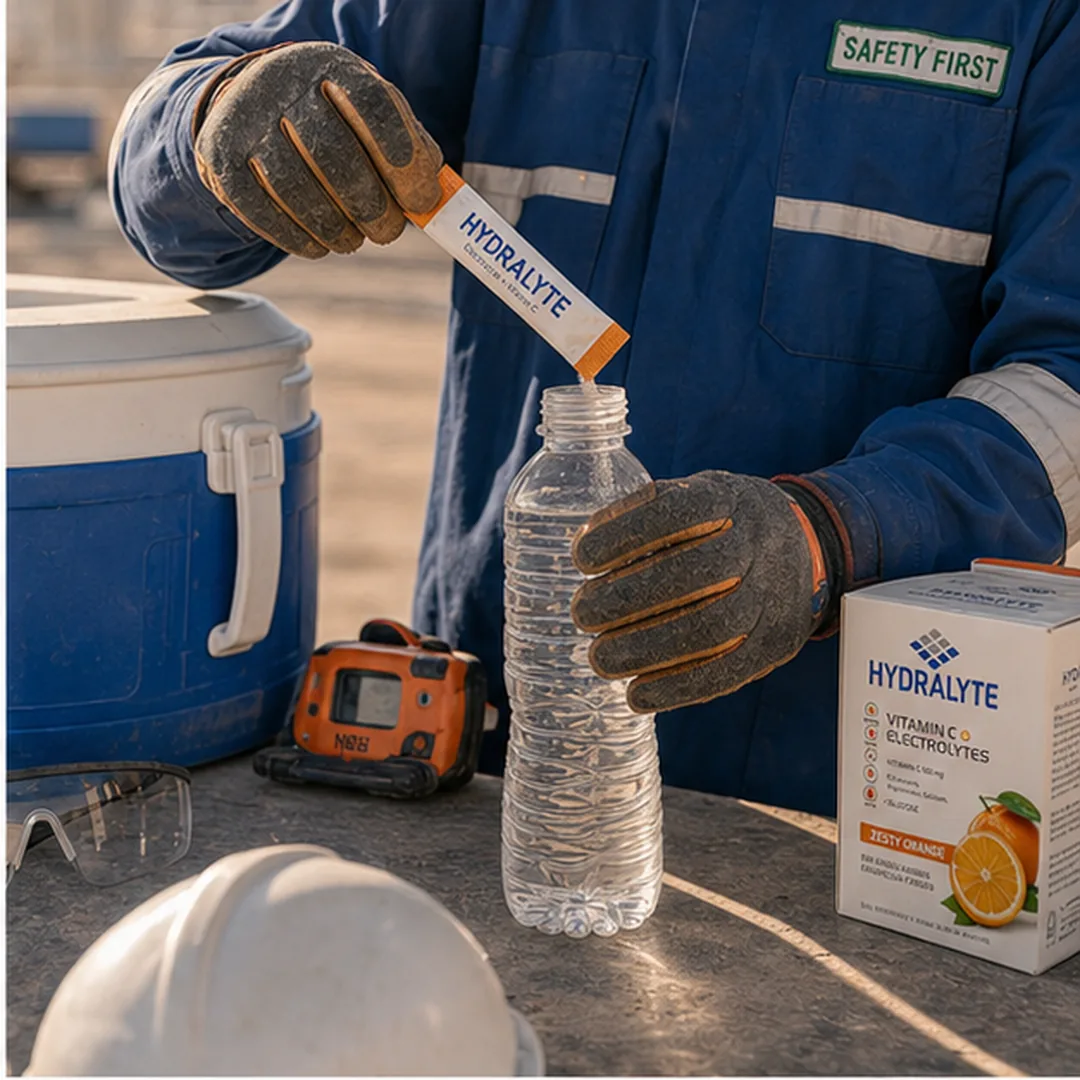
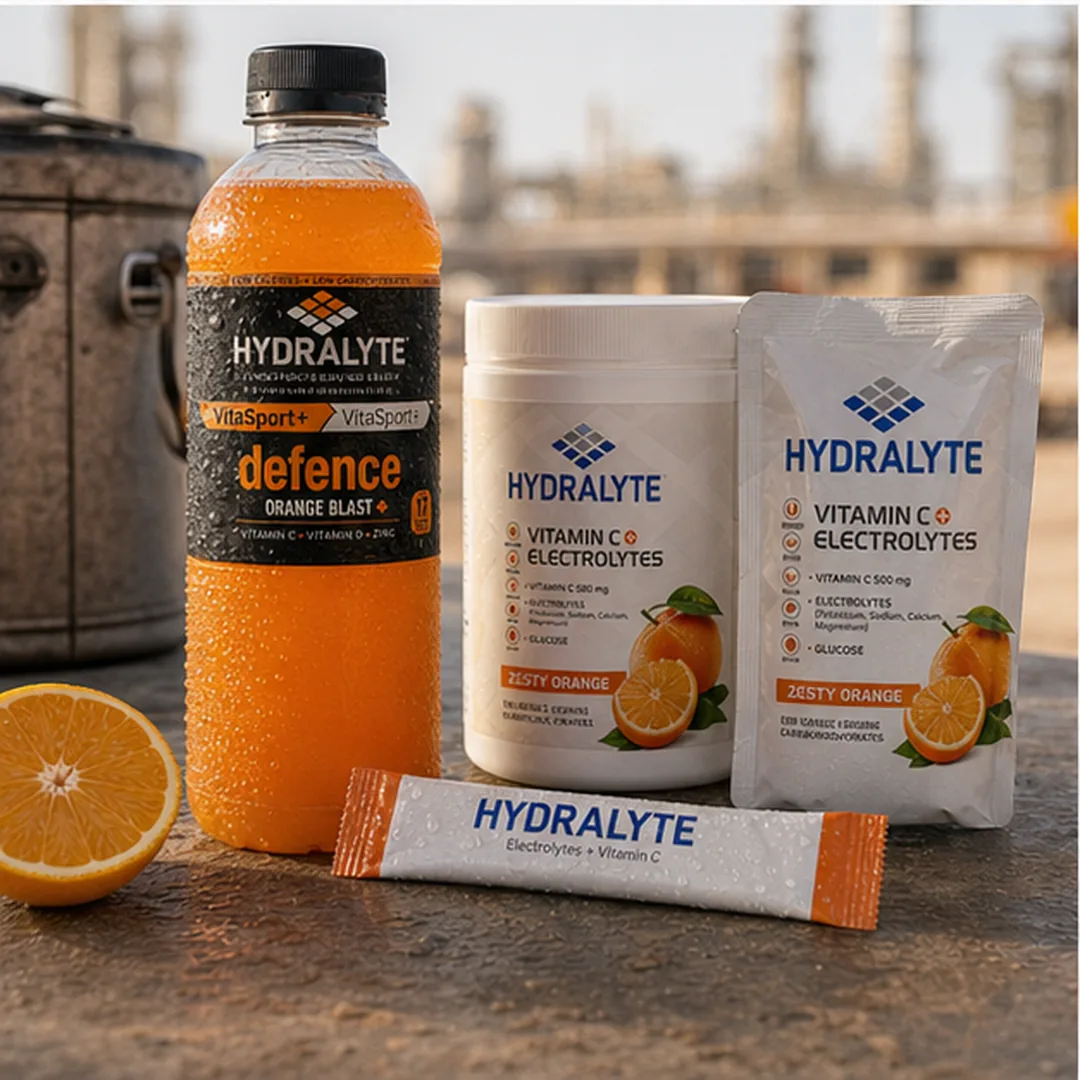
Electrolyte solutions are therefore central to field hydration rather than optional. Providing them as a standard part of every shift, and training workers to use them through the day rather than only when they feel unwell, helps maintain fluid balance across the brutal hours and supports both safety and sustained performance. Operators choosing what to stock can %compare electrolyte solutions for field use% to find formats and formulations that suit field conditions, where palatability, ease of preparation and effective sodium content all matter.
There is a balance to strike. Drinking very large volumes of plain water without replacing salt can, in extreme cases, dilute the body's sodium to dangerous levels — a condition sometimes seen in endurance settings and a genuine risk for someone sweating heavily for hours and drinking only water. Electrolyte solutions help avoid both ends of the problem: they encourage workers to drink enough by being more palatable than warm plain water, and they replace the salts that heavy sweating strips away. For field crews, the practical message is to drink consistently throughout the shift and to make electrolytes a routine part of that intake rather than an emergency measure reached for only once cramps or dizziness appear.
Choosing formats that survive field conditions
What works in an office or a city site does not always survive a desert rotation. Field conditions favour formats that are robust, easy to store and simple to prepare with the water available on site. Pre-measured sachets or tablets that dissolve in a standard water bottle remove the guesswork of mixing and travel well in heat and dust, whereas anything that needs refrigeration before use or careful measuring tends to be skipped when crews are tired. Palatability is not a luxury here either: a solution that workers find pleasant enough to drink in volume will keep them hydrated far better than a technically superior one they avoid. Shelf life matters too, because supplies may sit in a store for weeks before a rotation begins. Weighing these practical factors — preparation, taste, packaging and storage life — alongside the formulation itself is what turns a good product on paper into one that actually protects a crew in the field.
Planning hydration logistics for a whole crew
Remote operations cannot simply restock from a nearby shop. Everything a crew needs has to be planned, transported and stored, which makes accurate provisioning essential. Underestimating demand on a peak-heat day, far from resupply, is a serious failure. Operators benefit from a structured way to %gauge heat risk at remote sites% that factors in crew size, shift length, task intensity and conditions, so the right volume of water and electrolytes is on site before it is needed.
Cold storage deserves particular attention. In desert heat, water left unprotected quickly becomes unpleasantly warm, and workers drink less of it. Insulated containers, shaded storage and a reliable cooling chain all help keep fluids palatable enough that people actually consume the amounts they need. A provisioning plan should also carry a deliberate margin for the hottest days and for delays in resupply, since running short in the field is not a recoverable mistake.
Practical provisioning considerations
- Estimate per-worker daily fluid needs for the worst expected conditions, not the average day
- Build in a safety margin for resupply delays and unplanned extended shifts
- Maintain a cooling chain so water and electrolytes stay cold and appealing
- Position supplies at the work front, not only at a distant central store
- Track consumption so future provisioning is based on real field data
The hidden problem of access at the work front
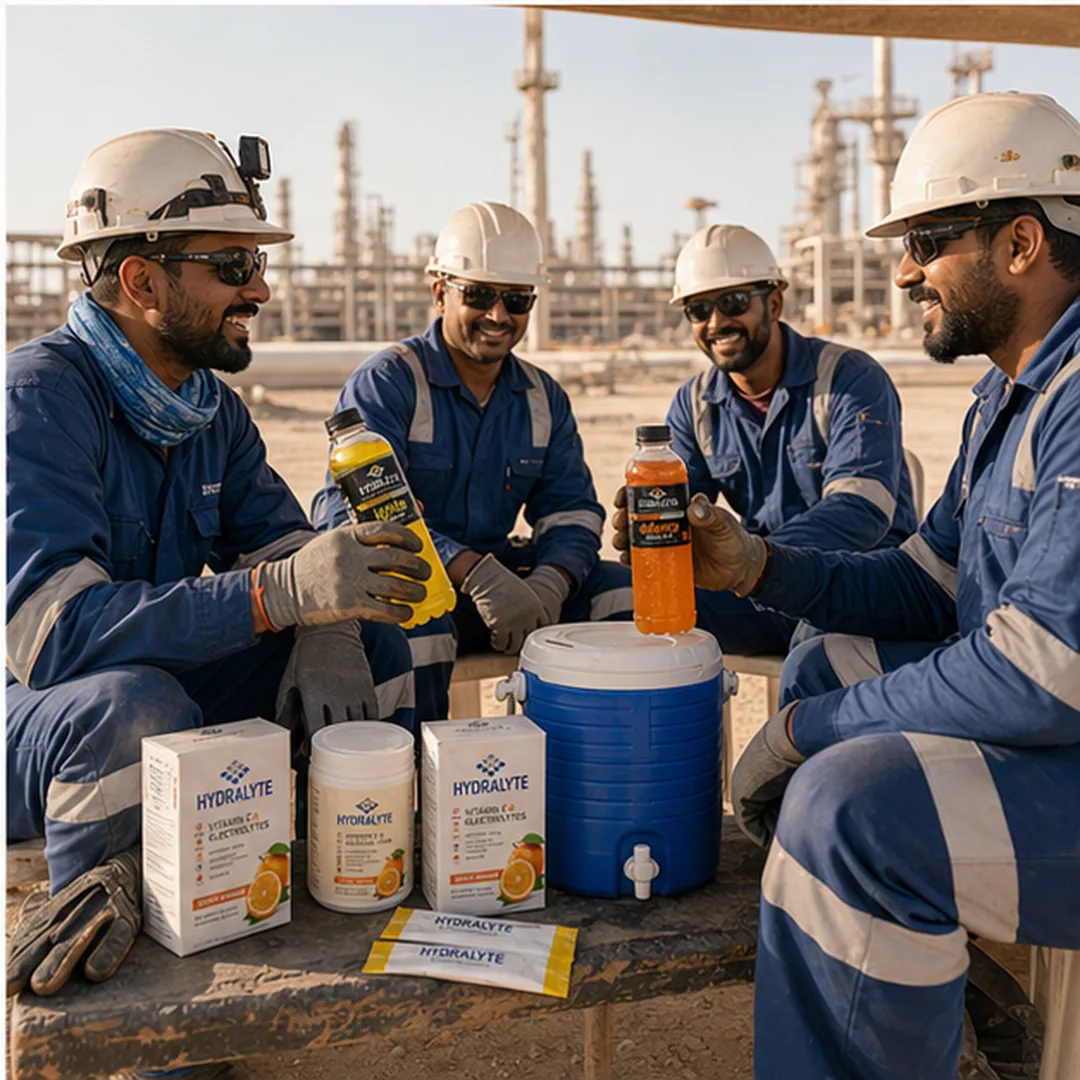
A subtle but common failure is provisioning the right total volume yet placing it where workers cannot easily reach it. If the only cold water sits in a cabin several minutes' walk from where a crew is working, the practical effect is that people drink less, because stepping away repeatedly feels like an interruption to the task. The solution is to push supplies right out to the work front — insulated dispensers, cooler boxes restocked through the day, or a designated runner whose job is to keep fluids flowing to where the crew actually is. The principle is simple: every barrier between a worker and a cold drink, however small, reduces intake, and on a remote site the cumulative effect of those small barriers across a long shift can be the difference between a hydrated crew and a depleted one. Provisioning is not finished when the right quantity arrives on site; it is finished when every worker can drink without leaving their work.
The challenge of protective equipment
Much field work cannot be done without flame-resistant coveralls, gloves, helmets and other essential protective gear. This equipment is non-negotiable for the hazards it guards against, but it comes at a thermal cost: it traps body heat and blocks the evaporation of sweat that the body relies on to cool itself. A worker in full kit effectively carries their own microclimate, and in desert heat that microclimate can become dangerously hot.
Because the gear cannot simply be removed, hydration and work scheduling have to compensate. That means even more frequent breaks, more attention to fluid and electrolyte intake, and a realistic acceptance that tasks take longer and are more taxing in heavy PPE than the same work would be in lighter clothing. Planning the day around this reality — rather than expecting field workers to match the pace of cooler, lighter conditions — is part of managing oilfield heat stress responsibly. Where possible, cooling vests, well-ventilated rest areas and rotation of workers in and out of the hottest tasks can ease the burden the equipment imposes.
Supervisors should also be alert to the fact that PPE hides the visual cues of heat strain. The flushed face and visible heavy sweating that might prompt a colleague to intervene are concealed beneath coveralls, helmet and visor, so a worker can be in serious difficulty before anyone notices from the outside. This makes scheduled check-ins, the buddy system and self-reporting even more important in heavily kitted crews than in lighter work, because the team cannot rely on simply seeing trouble develop. The equipment that protects against fire and chemical hazards quietly removes one of the natural warning systems for heat — a trade-off that has to be consciously managed.
Scheduling work around the heat and the law
How work is scheduled across the day is one of the most powerful levers an operator has. The hottest hours of the afternoon are the most dangerous, and the UAE's <a href="/industries">Midday Break</a> Rule reflects this by prohibiting work in the sun and open areas during the peak afternoon period through the height of summer, with enforcement by the Ministry of Human Resources and Emiratisation. For field operations, aligning the working day with these requirements is both a legal obligation and a sound safety strategy.
In practice this means front-loading the heaviest, most exposed tasks into the cooler morning hours, using the prohibited midday window for rest in shaded or cooled areas, and resuming work as conditions ease. Operators can %check your operation against MoHRE requirements% to confirm their summer arrangements meet the rules, but the underlying principle goes beyond compliance: working with the rhythm of the desert day, rather than against it, keeps crews safer and more productive across the season.
For continuous operations that cannot simply pause, scheduling becomes a more sophisticated exercise. Work-rest cycles can be tightened as the heat climbs, with shorter spells of work followed by longer cooled rest as conditions worsen through the day. Critical tasks that genuinely must run through the hottest hours should be staffed with fresh, well-rested workers, supported by extra cooling and hydration, and kept as brief as the operation allows. The principle throughout is to reduce the time any individual spends working hard in peak heat, spreading the exposure thinly and recovering it deliberately rather than letting any one worker absorb a dangerous, unbroken dose.
Night shifts are not a complete escape
Shifting heavy work to the night is a sensible tactic in extreme summer, and it removes the direct radiant load of the sun, but it is not a free pass. Desert nights cool more than humid coastal ones, yet temperatures can remain high well into the small hours, and the body's hydration needs do not switch off in the dark. Night-shift crews still sweat under PPE, still face long shifts, and have the added challenge of disrupted sleep, which itself reduces heat tolerance and judgement. A worker who has slept poorly through a hot day before a night shift starts that shift already at a disadvantage. The same hydration discipline — scheduled breaks, electrolytes, cold water at the work front, buddy checks — applies fully at night, and the assumption that darkness solves the heat problem is a quiet source of risk that supervisors should guard against.
Communication and emergency readiness
Remote sites must assume that something will eventually go wrong and plan for it in advance. Reliable communication, clearly understood escalation procedures and a known evacuation plan are as much a part of hydration safety as the water itself, because they determine what happens if prevention falls short. Every worker should know how to raise the alarm, where the nearest cooled refuge is, and what the first response to a suspected heat casualty looks like.
First-aid capability on site is especially valuable where help is distant. Having personnel trained to recognise and begin managing heat illness, along with the means to cool a casualty actively while evacuation is arranged, can make the difference during the long wait for professional care. These measures do not replace prevention, but they form the essential backstop for the rare occasions when it is needed. Regular drills keep the plan from becoming a document that no one remembers under real pressure.
Active cooling deserves special mention because it is what bridges the gap until evacuation. For a serious heat casualty, getting the body temperature down quickly matters enormously, and simple means kept ready on site — shaded space, cold water, ice packs or cooling sheets, fans or any source of airflow — can be used to cool a casualty while help is on the way. Crews should know in advance where this equipment is and how to use it, because improvising during an emergency wastes the very minutes that count most. On a remote site, the difference between a good and a poor outcome often lies in what the crew does in the first crucial minutes, long before any external responder arrives.
A culture of looking out for each other
Engineering and logistics get a crew most of the way, but the final layer is human. In an environment where help is distant, workers watching one another for the early signs of heat strain becomes a genuine safeguard. A buddy system, combined with training so that everyone can recognise dehydration and heat illness and knows the correct response, means problems are caught early — when a rest, shade and rehydration can still resolve them.
The buddy system works best when it is specific rather than vague. Each worker should know exactly who they are paired with, and the pairing should be close enough that they actually see one another during the shift. Brief, regular check-ins — a quick word at each rest break about how the other is coping — normalise the conversation so that admitting to feeling unwell is routine rather than a sign of weakness. In a strong field-safety culture, raising a concern about a colleague is treated as exactly the right thing to do, never as interference, because everyone understands that in this environment a missed early sign can have grave consequences.
Leadership sets the tone
No safety culture survives a supervisor who quietly rewards pushing through. If crews see that the people who skip breaks and work through the heat are praised for getting the job done, the written policy becomes a dead letter, however well drafted. Conversely, when a supervisor visibly takes their own hydration breaks, asks crew members how they are coping, and treats a precautionary stop as good judgement rather than weakness, the message lands far more powerfully than any briefing. Field leaders carry particular weight because the crew watches what they do, not what the manual says. Building hydration into the things supervisors are recognised and held accountable for — alongside production and schedule — is one of the surest ways to make the practice genuinely stick across a season and across changes of personnel.
The role of acclimatisation in field crews
Acclimatisation is as important in the oilfield as anywhere, and arguably more so given the intensity of the work. The body needs a period of days to a couple of weeks of graded exposure to adapt to working in extreme heat, becoming more efficient at cooling itself and at conserving salt. A worker newly arrived on a rotation, returning from leave in a cooler climate, or transferred from a less demanding role is not yet adapted and faces a markedly higher risk during their first exposures to full desert conditions.
This has direct planning implications. New and returning crew members should be eased into the heaviest tasks rather than thrown straight onto a full peak-season workload, with closer monitoring during their first days on site. Given the internationally mobile <a href="/industries">workforce</a> common to the UAE's energy sector, where personnel may arrive from many different climates, treating acclimatisation as a deliberate, managed process rather than something that simply happens is an important safeguard. Hydration support matters most precisely during this adjustment window, when the body's defences against heat are not yet fully developed.
It is also worth remembering that acclimatisation is partly perishable. A worker who spends two or three weeks of leave in a temperate climate loses some of the adaptation built up over the previous rotation and needs to rebuild it on return, not start where they left off. The same applies after any extended break from heat exposure. Treating every return from leave as a fresh, if shorter, acclimatisation period — easing the worker back into full load rather than assuming they are still fully adapted — closes a gap that catches out experienced crews who feel, mistakenly, that the desert holds no surprises for them. For %plan hydration for the whole crew%, this layered approach — assessing conditions, planning hydration proactively, prioritising electrolytes, provisioning carefully, scheduling around the heat and fostering mutual vigilance — is what allows demanding work to continue safely through the UAE summer. Where the margin for error is narrowest, disciplined hydration is one of the most powerful protections an operator can put in place.
Embedding hydration into standard operating procedure
The difference between operations that manage heat well and those that do not often comes down to whether hydration is treated as a system or as a slogan. When hydration is written into standard operating procedures — with named responsibilities for provisioning, defined break schedules, documented training and clear emergency steps — it survives changes of crew, supervisor and season. When it lives only in posters and good intentions, it tends to fade as soon as attention shifts elsewhere.
Operators who want to build or review such a system can %speak to our team about a field hydration programme%, turning a set of good practices into a repeatable programme tailored to their specific sites and crews. The aim is for hydration to become as routine as a permit-to-work or a toolbox talk: simply part of how the operation runs, every day, without anyone having to be reminded.
Ultimately, hydration on a remote field site is a shared responsibility that runs from the planners who provision the supplies to the workers who watch one another at the work front. None of the individual measures is complicated; the discipline lies in doing all of them, consistently, every day of the season. Operators who embed hydration into their standard procedures — rather than treating it as a seasonal reminder — find that it becomes second nature to their crews. In an environment as unforgiving as the UAE desert in summer, that quiet, everyday rigour is precisely what keeps demanding work both productive and safe.
Frequently Asked Questions
Why is hydration more critical at remote oil and gas sites?
Remote desert sites combine extreme heat, heavy work in protective equipment and a long distance from medical help. Because emergency care may be far away, preventing heat illness before it starts is essential rather than relying on a quick response afterwards. This makes proactive hydration planning a core safety priority rather than a matter of comfort. The whole approach has to be built around the assumption that help is not close at hand.
Are electrolytes more important for field workers than water alone?
For long, hot shifts with heavy sweating, yes. Plain water cannot replace the sodium and other electrolytes lost in sweat, and a shortfall can contribute to cramps, fatigue and dangerous imbalances. Providing electrolyte solutions as standard and using them through the shift helps maintain fluid balance and sustains performance over a long desert day. Treating them as routine rather than as an emergency measure is the safer default.
How should operators plan hydration supplies for remote crews?
Because resupply is difficult, operators should estimate demand in advance using crew size, shift length, task intensity and conditions, then transport and store enough water and electrolytes before they are needed. Reliable cold storage is essential, since warm water in the desert heat discourages workers from drinking enough. Provisioning should carry a margin for the hottest days and for resupply delays. Supplies also need to reach the work front, not just a distant store.
What role does a buddy system play in field heat safety?
In isolated environments where help is distant, workers watching one another for early signs of heat strain provides a vital safeguard. A buddy system, paired with training so everyone can recognise dehydration and heat illness, helps catch problems while rest, shade and rehydration can still resolve them. It adds a human layer of protection on top of engineering and logistics measures. It works best when pairings are specific and the partners actually see one another during the shift.
How does protective equipment affect heat risk in the field?
Flame-resistant coveralls, gloves and helmets are essential for the hazards they guard against, but they trap body heat and block the evaporation of sweat the body uses to cool itself. A worker in full PPE effectively carries a hot microclimate. Since the gear cannot be removed, operators must compensate with more frequent breaks, greater attention to fluid and electrolyte intake, and slower expected work rates. PPE also hides the visible signs of heat strain, so check-ins matter more.
What are the early warning signs of heat illness on a remote site?
Early signs include painful muscle cramps and the symptoms of heat exhaustion: heavy sweating, weakness, dizziness, nausea, headache and clammy skin. These are signals to stop, cool down and rehydrate at once. Confusion, loss of consciousness or hot skin point to heat stroke, a medical emergency that demands immediate cooling and evacuation given the distance from hospital care. Simple self-checks such as urine colour can flag a problem even earlier.
How does the UAE Midday Break Rule apply to oil and gas field work?
The Midday Break Rule prohibits work in the sun and open areas during the peak afternoon hours through the height of summer, enforced by MoHRE. For field operations this means scheduling the heaviest outdoor tasks into the cooler morning, using the midday window for rest in shaded or cooled areas, and resuming as conditions ease. Aligning the working day with the rule is both a legal duty and sound safety practice. Continuous operations should tighten work-rest cycles as the heat climbs.
What should happen if a worker shows signs of heat stroke far from help?
Heat stroke is a medical emergency. The crew should move the worker to the coolest available place, begin active cooling immediately, raise the alarm and start the evacuation plan without delay. Trained first-aiders and the means to cool a casualty actively are especially important on remote sites, because professional care may be hours away. Rapid early action during the wait can be life-saving, so crews should know in advance where cooling equipment is kept.
Does night-shift work remove the heat-stress problem?
It reduces the direct radiant load of the sun but does not remove the hazard. Desert and especially coastal nights can stay hot well into the small hours, crews still sweat under PPE, and disrupted daytime sleep lowers heat tolerance and judgement. The full hydration discipline — scheduled breaks, electrolytes, cold water at the work front and buddy checks — applies just as much at night. Assuming darkness solves the problem is a quiet source of risk.
How can operators make field hydration consistent across crews and seasons?
Embedding hydration into standard operating procedures is key: named responsibilities for provisioning, defined break schedules, documented training and clear emergency steps that survive changes of crew and supervisor. When hydration is treated as a system rather than a seasonal poster campaign, it becomes as routine as a permit-to-work. Leadership that visibly models good hydration behaviour reinforces it, and reviewing each season's experience helps refine the programme over time.