Establishing a Professional Construction Site Hydration Guide UAE for Maximum Safety and Compliance
In the challenging climate of the Middle East, a robust hydration strategy is more than a welfare benefit; it is a critical safety requirement for operational continuity. Implementing a comprehensive construction site hydration guide UAE employers can rely on ensures that site managers and HSE officers mitigate the risks of heat-exhaustion while maintaining strict adherence to local labor regulations. By moving beyond simple water provision and adopting a scientific approach to electrolyte replacement, firms can significantly reduce heat-related incidents and improve overall worker productivity during peak temperature months.
The Three Pillars of an Effective Construction Site Hydration Program
A successful program rests on the quality of the product, the efficiency of distribution, and the accuracy of documentation. First, the selection of a standard ORS-standard electrolyte product like Hydralyte is essential, as standard sports drinks often contain excessive sugar and insufficient sodium for industrial-grade labor. Second, distribution must be systematic rather than reactive. This involves a dual approach of scheduled welfare station servings and personal issue for those in isolated zones. Finally, documentation is the cornerstone of regulatory safety. Maintaining daily distribution logs ensures a clear evidence trail for MOHRE compliance, proving that the employer has fulfilled their legal duty of care through proactive intervention.
Optimizing Welfare Station Infrastructure for Modern UAE Job Sites
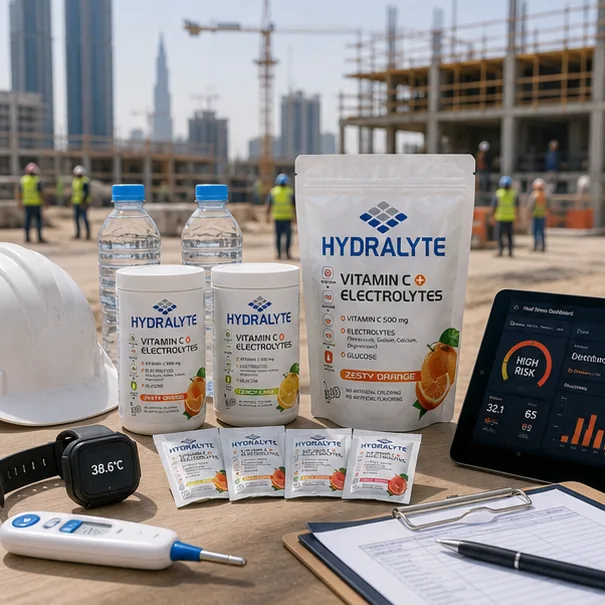
Infrastructure density is key to ensuring that every worker has immediate access to hydration without significant downtime. For large-scale projects, the use of 800g pouches at fixed welfare stations provides the primary bulk format for high-volume consumption. These stations should be positioned so that no worker is more than a short walk from a replenishment point. On vertical sites, verticality poses a unique challenge; stations must be placed on multiple floors accessible by the main hoist. For workers in areas where fixed stations are impractical, such as those on high-reach scaffolding or remote site boundaries, the distribution of individual sachets ensures that hydration remains accessible regardless of the physical constraints of the site.
Enforcing a Rigid Consumption Schedule through Active Supervision
Passive availability is often the primary reason for program failure. Simply providing the product is insufficient if workers do not pause to consume it at regular intervals. Effective construction site hydration guide UAE protocols require active supervisor enforcement. Supervisors must be trained to prompt consumption at every scheduled break and verify that each worker has finished their serving before returning to their task. Measuring compliance through periodic spot checks and reviewing welfare logs allows HSE managers to identify gaps in the program. This top-down enforcement culture transforms hydration from an optional activity into a mandatory safety protocol, mirroring the use of personal protective equipment.
Calculating Quantities and Strategizing Seasonal Logistics
Accurate procurement prevents both waste and dangerous shortages. Managers should calculate requirements based on a per-worker, per-day serving model, typically factoring in at least two servings during standard shifts and three during peak summer. Utilizing the 800g pouches as the base for welfare stations provides the most cost-effective bulk solution, while maintaining a secondary stock of sachets for upper-floor teams and emergency kits. Ordering should follow a seasonal strategy, with stock levels peaking ahead of the high-humidity months to account for increased consumption rates. By planning logistics in advance, site managers ensure that the site never faces a hydration deficit during the most critical periods of the year. To begin designing your site-specific protocol, contact our specialist team at contact our team.
Frequently Asked Questions
What are the three non-negotiable elements of an effective UAE construction site hydration program?
(1) A standard ORS-standard electrolyte product — not sports drinks or plain water alone. (2) Systematic scheduled distribution — proactive serving at fixed intervals, not reactive when workers feel thirsty. (3) Daily documentation — distribution logs that create the MOHRE compliance evidence trail. All three elements must be present for the program to be both effective and legally compliant.
How many Hydralyte welfare stations does a 300-worker UAE construction site need?
At minimum, one station per 50-100 workers — so 3-6 stations for 300 workers. Position stations so no worker travels more than 75 meters. On multi-story structures, place stations at each floor accessible by the main hoist. Additionally, issue personal sachets to workers on upper floors and in areas more than 150 meters from any fixed station.
How does active supervisor enforcement improve construction hydration compliance?
Sites that rely on passive availability (Hydralyte is present but workers choose when to drink) see significantly lower compliance rates than sites where supervisors actively prompt and confirm consumption at each scheduled interval. Brief supervisors explicitly: at each interval call, confirm with each worker that they have consumed their full serving before the interval ends.
Implementing a Construction Site Hydration Protocol
A structured hydration protocol is the most effective way to reduce heat-related incidents on UAE construction sites. This requires more than simply placing water coolers — it demands a systematic approach to electrolyte provision timed around work-rest cycles.
Start by mapping your site's thermal exposure zones. Areas with direct solar radiation, reflective surfaces (steel decking, concrete pours), and enclosed spaces all create different dehydration risk profiles. Workers in these high-risk zones should receive Hydralyte at each mandatory rest break, not just water.
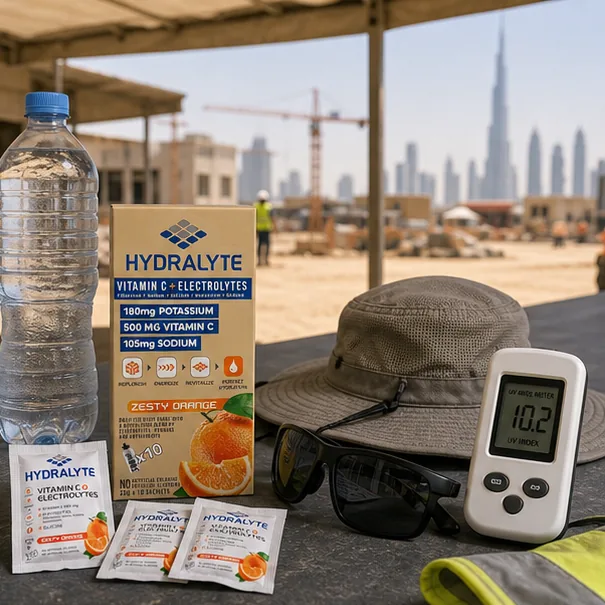
Hydration stations should be placed within 50 metres of every active work zone, stocked with Hydralyte 800g pouches for mixing at volume. For workers in mobile roles (crane operators, surveyors, scaffolders), provide individual 20g sachets that can be carried in PPE pockets and mixed with any available water source.
Document every aspect of your hydration program — from procurement receipts to distribution logs. This documentation becomes critical evidence during MoHRE inspections and any heat illness incident investigations. A well-documented program demonstrates duty of care and can significantly reduce employer liability.
Heat Acclimatisation and Hydration for New Workers
New workers arriving on UAE construction sites face the highest dehydration risk. Research shows that heat acclimatisation takes 7–14 days of gradual exposure. During this period, new workers lose significantly more electrolytes through sweat as their bodies haven't yet adapted to the thermal environment.
Implement a graduated work schedule: 50% workload in week one, 75% in week two, with increased electrolyte provision during the entire acclimatisation period. Providing Hydralyte during induction sends a clear signal that your site takes heat safety seriously — and reduces the risk of losing new workers to heat-related illness in their first fortnight.
🏗 Protecting Outdoor Workers? Hydralyte supplies bulk electrolyte programs for construction, oil & gas, logistics, and manufacturing companies across the GCC — with full MoHRE compliance documentation. See Industry Hydration Programs →
🛒 Ready to try Hydralyte? Available in three refreshing flavours across multiple pack sizes — from individual sachets to 800g bulk pouches. Shop Hydralyte Online → or request a corporate quote.