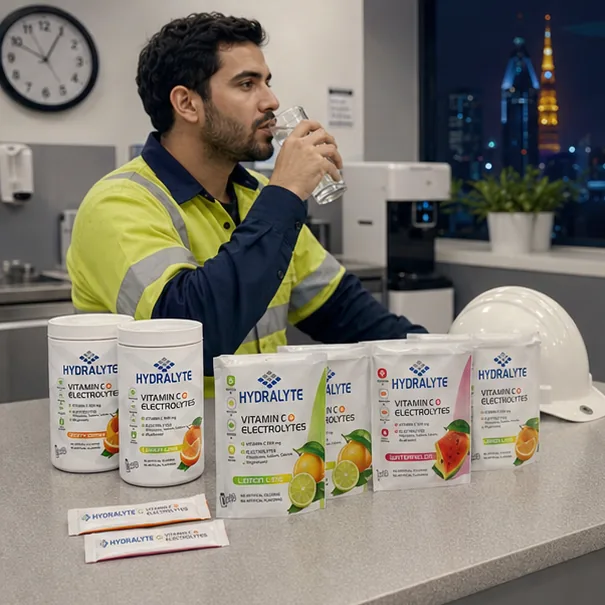
Optimizing Night Shift Worker Hydration UAE for Construction and Industrial Safety
Maintaining effective night shift worker hydration UAE is a critical safety requirement that is often overlooked due to the absence of direct sunlight. While the mandatory <a href="/industries">midday break</a> protects daytime crews from peak solar radiation, industrial and construction teams operating overnight face a persistent and significant dehydration risk. Managing <a href="/tools/heat-stress-assessment">heat stress</a> for night crews requires a rigorous approach to electrolyte provision that accounts for high ambient temperatures and the physiological challenges unique to nocturnal labor. By implementing a professional hydration protocol, site managers can ensure operational safety and regulatory compliance throughout the most demanding months of the summer season.
The Reality of Nighttime Heat Stress in UAE Summer Conditions
A common misconception among site managers is that the setting sun eliminates the risk of heat-related illness. However, meteorological data from across the Emirates confirms that nighttime conditions remain dangerously warm. In July, the ambient temperature at 11pm in Dubai is typically between 35-38°C. Even at midnight, temperatures frequently range from 32-36°C, which is well above the threshold where physical exertion triggers heavy sweat loss and electrolyte depletion. Furthermore, workers finishing their shifts at 6am are immediately met with rising morning temperatures that have already climbed past 30°C. Residual ground heat from solar-heated concrete and steel surfaces further compounds the thermal load on the body. The premise that night shifts are heat-free is scientifically incorrect for UAE conditions between June and September.
Addressing Behavioral Changes and Organizational Complacency
Night shift worker hydration UAE requires more active supervision because thirst cues are often less pronounced in the absence of the sun. Research indicates that workers voluntarily drink less fluid at night, despite losing similar amounts of water and salts through perspiration as their daytime counterparts. This behavioral shift is often matched by organizational complacency; supervisors may be less vigilant about heat safety protocols when the sun is not visible. To combat this, safety officers must treat the night environment with the same level of caution as the day shift. Relying on worker intuition for hydration is insufficient; a structured delivery of electrolytes is necessary to prevent cumulative dehydration that can lead to reduced cognitive function and increased site accidents.
Implementing a Structured Night Shift Worker Hydration UAE Schedule
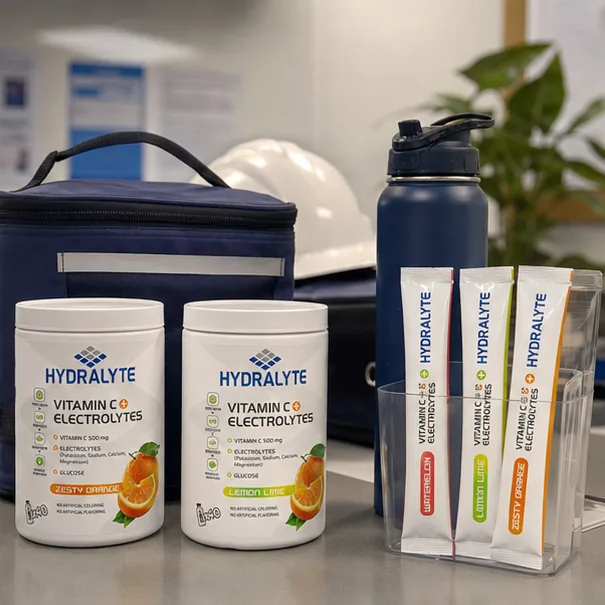
To maintain peak physiological performance, night shift hydration schedules during the summer must mirror day shift protocols. For typical night temperatures exceeding 30°C, employers should provide a professional electrolyte solution, such as Hydralyte, at a consistent 60-90 minute interval. This frequency ensures that lost sodium, potassium, and magnesium are replaced before the onset of fatigue. This rigorous schedule should only be extended to every 90-120 minutes during the cooler months of October through March when evening temperatures genuinely fall below 25°C. Utilizing 800g pouches for night shift <a href="/industries">welfare station</a>s allows for high-volume, cost-effective distribution, ensuring that every crew member has access to the exact concentration of minerals required for rapid rehydration.
The Importance of Shift Change Handover Hydration
The transition between crews represents the most vulnerable moment for <a href="/industries">workforce</a> health. The afternoon shift often finishes their duties having endured peak thermal conditions, while the incoming night shift begins their work in the residual heat of the early evening. Both groups require an immediate electrolyte provision at the handover point to stabilize their hydration levels. Providing individual sachets for personal carry during the night shift allows workers to maintain their electrolyte balance even when moving between different areas of a large site. This seamless integration of hydration products into the workflow minimizes downtime and ensures that the night crew remains as protected as the day crew. For a comprehensive consultation on setting up a compliant program for your facility, contact our B2B team at contact our team.
Frequently Asked Questions
What temperature should UAE employers expect on construction sites at 11pm in July?
UAE construction sites at 11pm in July typically measure 35-38°C ambient temperature, with residual ground heat from solar-heated surfaces adding radiant heat in the immediate working area. These temperatures are well above the 30°C threshold where dehydration risk becomes significant for physically working adults. Night shift is not a heat-free environment in UAE summer.
Should night shift hydration schedules differ from day shift schedules?
For June-September UAE conditions, no. Night shift workers performing typical construction exertion in 33-38°C evening and early morning temperatures should maintain the same 60-90 minute Hydralyte provision interval as day shift workers. The adjustment can be made in October when temperatures genuinely fall — not in summer when the night conditions remain warm enough to create meaningful dehydration.
Who should be responsible for night shift electrolyte provision when the site HSE manager works days?
Each night shift must have a designated welfare monitor — typically a night shift supervisor or team leader — who is specifically accountable for distributing Hydralyte at each scheduled interval and completing the nightly distribution log. This responsibility must be explicitly assigned and trained before the summer season, not assumed to happen informally.
🛒 Ready to try Hydralyte? Available in three refreshing flavours across multiple pack sizes — from individual sachets to 800g bulk pouches. Shop Hydralyte Online → or request a corporate quote.
The Hydralyte Advantage for UAE and GCC Conditions
Hydralyte is a potassium-rich, low-sodium isotonic electrolyte formula designed specifically for proactive daily hydration — not just reactive emergency recovery. With 500mg Vitamin C per serve and a low-sugar formula, it provides comprehensive hydration support for anyone living, working, or exercising in the extreme heat of the UAE and GCC.
Unlike traditional ORS sachets designed for acute illness, or high-sugar sports drinks designed for athletic performance, Hydralyte is formulated for safe, repeated daily consumption across the entire summer season. This makes it the preferred choice for workplace hydration programs, family use, and fitness enthusiasts across the region.
Available in three flavours (Orange Blast, Lemon Lime, Pineapple) and four pack sizes, Hydralyte is stocked online and across GCC retail, with bulk corporate supply available for businesses with 50+ workers.